
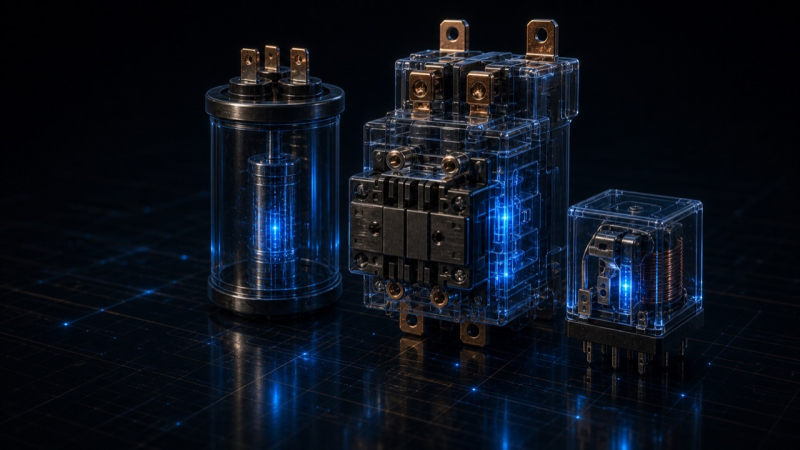
The scene: It is 4:40 PM in July. The customer says the outdoor unit "hums for a second, then nothing." You walk up to the condenser and hear a click, a low hum, and then silence. The fan blade is not spinning. You press a screwdriver handle against the fan grille and give the blade a nudge through the grille opening with the power off, then restore power. The fan takes off and runs. What just happened? By the end of this module you will know exactly what happened, which part to test, how to prove it with a meter, and why "swap the part and drive away" is only half the job.
In F7 you learned what voltage, resistance, and current are and how to measure them safely. This module introduces the cast of characters those measurements flow through: transformers, relays, contactors, capacitors, motors, sequencers, and the safety switches wired between them. F9 will teach you to read the map that connects them all. Learn these parts cold, because one of them, the capacitor, is the single most common reason an air conditioner stops working.
Short Version
Every comfort system is a chain of electrical components doing one of three jobs: changing voltage (transformers), switching power (relays, contactors, sequencers, safety switches), or converting electricity into motion (motors, with capacitors helping them start and run). The thermostat is just a panel of switches that sends 24 volts to coils. Those coils pull contacts closed, and the contacts let line voltage reach the motors. One instructor logged 242 real AC service calls and found bad run capacitors caused 52 of them, about 21 percent, more than any other single failure. So you will test capacitors almost every day of your career, and you will learn here how to do it right: measure the microfarads, compare against the rating, replace anything more than 6 percent below rating, and always ask why it failed.
Key Values
| Item | Value | Notes |
|---|---|---|
| Capacitor tolerance | Plus or minus 6 percent of rated microfarads (some makers allow plus 10, minus 6) | IB teaching rule: replace any capacitor reading more than 6 percent BELOW its rating |
| Capacitor failure share | About 21 percent of AC service calls (52 of 242 logged calls) | The number one single failure on residential cooling calls |
| Control transformer output | Nominal 24V, real-world 24 to 29.5V | Do not condemn a transformer for reading 27V |
| Typical residential transformer rating | 40VA (volt-amperes) | 40VA at 24V supplies about 1.6 amps total for everything on the control circuit |
| Contactor coil voltage | 24V on residential equipment (120V and 240V coils exist on other equipment) | Always read the coil label before testing |
| Contactor voltage drop under load | About 2V across closed contacts is acceptable; more than 5V means replace | Measured with the unit running |
| Contactor contact resistance (static) | Less than 1 ohm acceptable; more than 1 ohm replace | Power off, wires disconnected |
| Relay coil resistance | Roughly 12 to 20 ohms on common general purpose relays | An open coil reads OL |
| Run capacitor sizes | Compressors commonly 35 to 50 MFD; condenser fan motors 3 to 10 MFD; blower motors 5 to 10 MFD | MFD means microfarads |
| Start capacitor sizes | Commonly 88 to 330 MFD, switched out after start | Always has a bleed resistor and is only in the circuit for a moment |
| Dual run capacitor terminals | C (common), HERM (hermetic compressor), FAN (condenser fan) | C feeds both sections; HERM to compressor start winding; FAN to fan motor |
| Motor start methods | Shaded pole: none. PSC: run capacitor, always in circuit. CSR: start capacitor plus potential relay. ECM: electronic, no capacitor on the motor module | If a motor has a capacitor and no switch, it is a run capacitor |
Field Checklist
Bench-test sequence for each component. Power off and verified dead with your meter before touching anything, per F1 and F7. Lockout/tagout where the disconnect allows it.
Transformer
- Identify primary (line side, thicker context: 120V or 240V taps) and secondary (24V side).
- Power off. Ohm the primary winding: a few ohms to a few dozen ohms is normal, OL means open winding.
- Ohm the secondary: very low resistance, often under 1 ohm. OL means open.
- Power on. Confirm correct line voltage at the primary tap in use.
- Read secondary voltage: 24 to 29.5V is healthy. Line voltage present at primary with 0V at secondary means a failed transformer.
- Check for a blown control fuse (often 3A or 5A) before condemning anything. A blown fuse means find the short first.
Relay
- Read the coil label: coil voltage and terminal numbers.
- Power off. Ohm the coil: expect roughly 12 to 20 ohms on a common general purpose relay. OL means open coil, replace.
- Identify NO (normally open) and NC (normally closed) contact sets from the diagram printed on the relay.
- Continuity test at rest: NC pairs show continuity, NO pairs show OL.
- Energize the coil with the proper voltage: NO pairs now show continuity, NC pairs open. You should hear the click.
- Any contact set that does not change state when the coil energizes means the relay has failed.
Contactor
- Power off, verified dead. Identify coil terminals (small spade terminals on the side) and the line (L1, L2) and load (T1, T2) lugs.
- Ohm the coil: a low resistance reading proves the coil is intact. OL means open coil.
- Inspect contacts: pitting, melting, or insect debris under the contact bar. Never file contacts. The silver coating is the contact; filing destroys it.
- Static contact test: with wires disconnected, press the contact bar down by hand (or energize the coil) and ohm L1 to T1 and L2 to T2. Under 1 ohm passes, over 1 ohm fails.
- Under load (running system): measure voltage drop across each closed contact, L1 to T1 and L2 to T2. Around 2V or less passes. More than 5V means burned contacts, replace.
Capacitor (single or dual run)
- Power off, verified dead.
- Discharge the capacitor before touching the terminals: use a 20,000 ohm 2 watt bleed resistor across the terminals (or an insulated-handle tool designed for it), never your fingers, never a bare screwdriver across the terminals as a habit.
- Photograph the wiring before removing any wire. Note which colors land on C, HERM, and FAN.
- Remove the wires. The capacitor must be out of the circuit for a capacitance reading; testing in circuit gives false numbers because the motor windings are in parallel with the meter.
- Meter on capacitance mode: read C to HERM and compare to the HERM rating, read C to FAN and compare to the FAN rating.
- Apply the rule: more than 6 percent below rating fails. A 45/5 MFD capacitor fails if the HERM side reads below 42.3 MFD or the FAN side reads below 4.7 MFD.
- Visual check: a bulged or domed top, oil leakage, or rust at the base means replace it regardless of what the meter says, but remember the reverse is not true. A perfect-looking capacitor can be stone dead. The meter decides.
- Ask why it failed before you close the panel. Dirty condenser coil? Failing fan motor drawing high amps? High heat exposure? You will go deep on this in D23. For now, build the habit of asking.
Motor (PSC quick check)
- Power off. Spin the blade or wheel by hand: it should spin freely. Grinding or a locked shaft means a mechanical failure, no electrical test needed.
- Ohm the windings using the motor diagram: common to start reads higher than common to run; start to run reads the sum of both. OL on any pair means an open winding.
- Check windings to the motor case (ground): any continuity to case means a grounded motor, replace.
- A motor that hums but starts when you spin it almost always has a dead capacitor. Test the capacitor before condemning the motor.
Sequencer
- Identify the 24V heater terminals and the M (main) and A (auxiliary) contact pairs.
- Power off. Ohm the heater element: a real resistance reading (not OL) means intact.
- Continuity across M contacts at rest: OL (they are normally open).
- Apply 24V to the heater terminals and wait. Within roughly 1 to 110 seconds the M contacts should close (continuity). Remove the 24V and the contacts should reopen after a delay as the disc cools.
- No closure after a full minute with 24V applied and an intact heater means the sequencer has failed.
Full Breakdown
The big picture: one chain, three kinds of parts
Strip away the sheet metal and every residential system is the same electrical story. Line voltage (the 240V or 120V from the breaker panel) is powerful enough to run motors but too dangerous and too clumsy to run through a thermostat on the wall. So the industry splits the system into two circuits:
- Line voltage circuit: the muscle. Compressor, fan motors, electric heat elements.
- Control circuit: the brain. 24 volts, safe enough to run through thin thermostat wire, controlling everything by energizing small electromagnets.
Three families of components make this work:
- Voltage changers: transformers create the 24V control circuit from line voltage.
- Switches: the thermostat, relays, contactors, sequencers, and safety switches connect and disconnect circuits. Some are operated by your finger, most are operated by electromagnets or temperature.
- Loads: components that convert electricity into work. Motors are the big ones, and capacitors are their helpers.
A quick vocabulary rule that will serve you on every diagnostic call: a load OPERATES on a voltage and does work (motor, coil, heat strip). A switch CARRIES a voltage and only makes or breaks the path. When you say "the contactor coil operates on 24V and its contacts carry 240V," you have described the whole device in one sentence.
Transformers: how 240 becomes 24
A transformer is two coils of wire wound around a shared iron core, with no electrical connection between them. The primary winding connects to line voltage. Alternating current in the primary creates a magnetic field that grows and collapses 60 times per second, and that moving field induces (creates by magnetism) a voltage in the secondary winding. The voltage ratio follows the turns ratio: a primary with ten times the turns of the secondary steps 240V down to 24V.
Because there is no wire connecting primary to secondary, a transformer also isolates the control circuit from line voltage. That isolation is why you can wire a thermostat with bare hands on a live 24V circuit and survive, though IB practice is still power off whenever practical.
Real-world numbers: a "24 volt" transformer secondary actually reads 24 to 29.5V depending on incoming line voltage and load. A reading of 27V is healthy. Do not condemn a transformer for being above 24.
Many residential transformers are multi-tap: the primary has several wires (commonly 208V and 240V taps) so one transformer fits different supply voltages. Wiring the 208V tap to a 240V supply pushes the secondary high; wiring the 240V tap to a 208V supply pulls it low. Always land the tap that matches the measured supply.
The VA budget. Transformers are rated in VA (volt-amperes), which is volts multiplied by amps, the transformer's total capacity to deliver power. The residential standard is 40VA. At 24V, a 40VA transformer can supply about 1.6 amps total. Every coil on the control circuit draws from that budget:
- Contactor coil: roughly 8 to 12VA
- Gas valve: roughly 10VA
- Smart thermostat: 1 to 3VA continuous
- Each zone damper motor: 5 to 10VA
- IAQ accessories (UV lamps with 24V controls, media filter indicators): varies
A bare system uses maybe half the budget. Now add a smart thermostat, two zone dampers, and a condensate safety relay, and the transformer is at or over its limit. An overloaded transformer runs hot, its output voltage sags (and a contactor coil fed 18V chatters instead of pulling in cleanly), and eventually the winding opens or the 3A control fuse blows. When an accessory-loaded system has mystery 24V problems, add up the VA before you replace parts. The fix may be a 50VA or 75VA transformer or a second dedicated transformer, sized by someone who did the math.
Testing: the classic isolation test from F7 applies. Correct line voltage at the primary plus 0V at the secondary equals a failed transformer. But first check the control fuse, and if the fuse is blown, find the short that blew it. A transformer that died from a shorted thermostat wire will kill its replacement in seconds.
Relays and contactors: electromagnets that flip switches
A relay is a switch flipped by an electromagnet instead of a finger. Inside are two independent halves:
- The coil: a winding of fine wire around an iron core. Feed it the rated voltage (24V, 120V, or 240V depending on the relay) and it becomes a magnet.
- The contacts: spring-loaded metal points that the magnet pulls from one position to the other.
The two halves never touch electrically. The coil might run on 24V while the contacts carry 240V to a blower motor. That separation is the entire trick of HVAC controls: small safe voltage commanding big dangerous voltage.
NO and NC. Contacts are labeled by their at-rest position, meaning coil de-energized:
- NO (normally open): open at rest, closed when the coil energizes. Used to turn things on.
- NC (normally closed): closed at rest, open when the coil energizes. Used to turn things off when something else turns on. Classic example: a crankcase heater wired through NC contacts heats the compressor during the off cycle and shuts off when the compressor starts.
A common general purpose relay (the 90-340 style you will carry on the truck) has both NO and NC sets, and the contact sets are independent of each other, so one relay can switch multiple loads.
Testing each side separately is the discipline:
- Coil side: power off, ohm the coil. Roughly 12 to 20 ohms is typical on general purpose relays. OL means open coil, replace. With power on, rated voltage AT the coil but contacts not switching means the relay failed. Zero voltage at the coil means the relay is innocent, look upstream at whatever is supposed to feed it.
- Contact side: continuity at rest (NC closed, NO open), then energize the coil and verify every set flips. You should hear the click, but the meter is the proof, because contacts can click and still not conduct.
One field boundary worth tattooing on your brain: a general purpose relay from the truck can rebuild a failed fan circuit in an air handler in a pinch. Never substitute relays for a gas furnace control board. The board contains safety timing and flame-proving logic that a relay cannot replicate, and bypassing it can put unburned gas in a house.
A contactor is a heavy-duty relay built for the current a compressor draws. Same anatomy, bigger everything:
- Coil: on residential condensers, almost always 24V, fed by the thermostat's Y call. Read the label; 120V and 240V coils exist.
- Contacts: thick silver-alloy points on a spring-loaded bar, always normally open on a standard contactor. A single pole contactor breaks one leg of the 240V supply (the other leg stays hot at the load even when off, which matters for your safety checks). A double pole breaks both legs.
- Lugs: L1 and L2 take line voltage in; T1 and T2 feed the loads. The compressor and condenser fan motor both hang off the load side in parallel, each receiving full voltage at the same time.
Contactor failure modes you will actually see: pitted and burned contacts from years of arcing (every open and close under load draws a small arc), welded contacts that stick closed so the unit will not shut off, a failed coil, and the Phoenix special, insects. Ants and earwigs crawl between the contact faces, get crushed, and insulate the points so the unit hums but nothing runs.
Two field rules: never file contacts (the silver coating IS the contact surface; filing it off turns a marginal contactor into scrap that fails in a week), and pitted means replace, not clean.
Testing a contactor: ohm the coil for continuity, do the static under 1 ohm contact test, and on a running system do the voltage drop test across each closed pole. About 2V dropped across burned contacts is the limit of acceptable; over 5V means the contacts have become a resistor, they are making heat instead of passing power, and the contactor is done.
Capacitors: the number one service call
Here is the statistic that defines your early career: an instructor who logged 242 of his own air conditioning service calls found that bad run capacitors caused 52 of them, about 21 percent. Number two on his list was not even close. One part, one in five calls. Master this section and you have mastered the most common repair in residential HVAC.
What a capacitor is. Two long strips of metal foil separated by an insulator, rolled into a cylinder, in a can. It stores electrical charge and releases it. Its capacity to store charge is measured in microfarads, written MFD or uF.
What capacitance does for a PSC motor. A single phase motor has a chicken-and-egg problem: a magnetic field that just pulses in place cannot tell the rotor which direction to spin. The motor needs a second magnetic field that is out of step with the first to create rotation. The capacitor creates that offset. Wired in series with the motor's start winding (yes, in series with the start winding, the classic exam question), the capacitor shifts the timing, the phase, of the current in that winding so its magnetic field peaks at a different moment than the run winding's field. The rotor gets pushed around the circle instead of vibrating in place. In a PSC (permanent split capacitor) motor, that capacitor stays in the circuit the whole time the motor runs, smoothing torque and keeping amp draw in spec. A weak capacitor means a weak second field: hard starting, high amps, hot motor.
Start vs run vs dual run:
- Run capacitor: small value (3 to 50 MFD), oil filled, rated for continuous duty. In the circuit 100 percent of the time on a PSC motor. On a schematic, a capacitor with NO switch in series must be a run capacitor.
- Start capacitor: big value (88 to 330 MFD), electrolytic, black plastic case, built for seconds of duty only. It gives a violent extra phase shift for starting torque under load, then a switch (potential relay or centrifugal switch) removes it from the circuit. Left in the circuit, it overheats and ruptures, which is why it has a bleed resistor across its terminals (drains the stored charge between starts) and a pop-out vent (relieves pressure before the case bursts).
- Dual run capacitor: two run capacitors sharing one can and one common terminal, the standard part on residential condensers. Rated like "45/5 MFD 440V": 45 MFD for the compressor, 5 MFD for the fan.
Dual run terminal identification. Three terminal groups on top, and the markings matter:
- C (common): feeds both internal sections. Receives power from the load side of the contactor (typically a wire from T1).
- HERM (hermetic): the compressor section. Connects to the compressor's start winding terminal (the S terminal). HERM is the large MFD number.
- FAN: the fan section. Connects to the condenser fan motor's capacitor wire, traditionally brown. FAN is the small MFD number.
Miswire HERM and FAN and you have put 5 MFD on a compressor that needs 45. The compressor will struggle, draw locked rotor amps, and trip its internal overload. Photograph before you pull wires. Every time. See visual F8-1 for the full map.
Testing, and why under load beats the bench. Two legitimate methods:
- Bench test (capacitance mode): power off, capacitor discharged through a bleed resistor, wires removed. Meter on capacitance mode, read each section against its rating. This is the standard test and the one in the Field Checklist. Its weakness: it tests the capacitor at meter voltage, a tiny test signal, not at the 300-plus volts it sees in service. A marginal capacitor can pass a bench test and still sag under real load.
- Under load test: with the system running, measure the amps on the wire through the capacitor's start-winding circuit and the voltage across the capacitor, then calculate: MFD = (amps x 2652) / volts (the 2652 constant is for 60 Hz power). This tests the capacitor at full operating voltage doing its real job, which makes it the more accurate verdict on a marginal part. You will use it routinely in maintenance work because it requires no shutdown and no wire pulling.
The tolerance rule. Run capacitors are typically rated at plus or minus 6 percent, and some manufacturers spec plus 10, minus 6. The rule we teach and enforce: replace any capacitor reading more than 6 percent below its rating. A 45 MFD section fails below 42.3. A 5 MFD section fails below 4.7. Capacitors only lose capacitance as they age, so a part at minus 5 percent today is a callback waiting for August. Replace on the rule, not on optimism.
The visual check. A healthy capacitor has a flat top. A bulged or domed top means internal pressure from a failing part: replace it, no meter needed. Same for oil leaking from the seams or heavy rust at the base. But burn this in: a capacitor can look perfect and be completely dead. The bulge proves failure; the absence of a bulge proves nothing. The meter is the test.
The root cause mindset (a seed for D23). A capacitor is rarely the whole story. Capacitors are killed by heat, by voltage spikes, and by the motors they serve. A dirty condenser coil raises head pressure and cabinet temperature, cooking the capacitor. A fan motor with dying bearings draws high amps and stresses its capacitor; replace only the capacitor and the motor finishes the job in a month, on your callback. Storm-season voltage spikes take out capacitors in clusters. So when you find a bad capacitor, the diagnosis is not finished, it has just started: check the coil condition, measure the motor amps after the swap, look at the install date and the part's temperature rating. Module D23 will give you the full root cause discipline. For now, never let "bad cap" be the last line of your story, make it the first.
Motors: PSC, shaded pole, and ECM
A motor converts electrical current into rotation using magnetism: the stator (stationary windings) creates a moving magnetic field, and the rotor (the spinning part) chases it. The motor types differ in how they create that moving field and how they start.
Shaded pole motors are the simplest and weakest. A copper band (the "shading ring") around part of each pole delays the field there, creating just enough rotation to spin a light load. No capacitor, no start gear, cheap, and inefficient. You will find them on small condensate pumps, older draft inducers, and little exhaust fans. They are throwaway parts: test by spin and by winding continuity, then replace.
PSC (permanent split capacitor) motors are the workhorse of legacy residential equipment: condenser fans, blowers, compressors. Two windings (run and start, sharing a common terminal), with a run capacitor permanently in series with the start winding, as covered above. Identification by ohms from F7 knowledge: common to run is the lowest resistance, common to start is higher, run to start is the sum of both. The classic PSC failure signature: the motor hums but will not start, and if you spin it by hand it takes off and runs. That is a dead capacitor nine times out of ten, and the tenth time it is a motor with worn bearings that is about to kill another capacitor.
Start-assist components. Compressors starting against pressure sometimes need more torque than a run capacitor provides:
- A start capacitor adds a large second capacitance during the start moment only.
- A potential relay is the switch that removes it. Its coil reads the voltage generated across the start winding, which rises as the motor accelerates (this self-generated voltage is called back EMF, electromotive force). At roughly three quarters of full speed the voltage is high enough to pull the relay's normally closed contacts open, cutting the start capacitor out.
- A hard start kit packages a start capacitor and potential relay (or a solid state equivalent) into one add-on. It roughly halves inrush current duration and can rescue a compressor that struggles to start. It is a legitimate tool and also a band-aid that can mask a failing compressor or a system problem, so at IB a hard start kit is installed for a documented reason, not as a reflex.
- Open-frame motors (some blowers, belt drive motors) may use a centrifugal switch instead: a mechanical switch on the shaft that flies open at about 75 percent of running speed to drop the start winding circuit.
ECM motors (electronically commutated motors) are the modern standard. An ECM is a DC motor with a built-in electronic module that converts incoming AC, then fires the windings in sequence under microprocessor control. No run capacitor at all, dramatically better efficiency, and speed control that PSC motors cannot match. Two families you must keep straight:
- Constant torque ECM (often called X13 after a common model): replaces a PSC blower in a near drop-in way. It receives line voltage continuously plus 24V signal taps, and each energized tap commands a programmed torque level. It pushes harder as filters load up, to a point, but it does not measure airflow.
- Constant airflow ECM (the true variable speed motor): commanded by serial data from the system board, it actively calculates and holds a target CFM (cubic feet per minute of airflow) by adjusting speed and torque continuously. Dirty filter, closed registers, undersized duct: it ramps up to hold airflow, drawing more watts, until it hits its limit.
The diagnostic trap with ECMs, planted here for D23 and A33: the motor module is the expensive part, and techs condemn it constantly when the real problem is an input. An ECM that does not run might be missing line voltage, missing the 24V or data command, or mechanically locked. Verify line power at the motor, verify the command signal is arriving, and spin the wheel by hand with power off, before you ever blame the module. Many "bad ECM" callbacks are a bad board, a broken data wire, or a seized bearing.
Sequencers: staging electric heat without a bang
Electric furnaces and heat pump air handlers carry strip heaters that can draw 20-plus amps per element. Energizing three elements at once would slam the electrical service hard enough to dim the house lights and stress the breaker. The sequencer solves this with deliberately slow switching.
A sequencer is not an electromagnetic relay. Inside is a small resistive heater fed by the 24V control circuit, warming a bimetal disc (two metals bonded together that bend as they heat, because they expand at different rates). As the disc warms over tens of seconds, it snaps the M (main) contacts closed, powering a heat element. Many sequencers carry A (auxiliary) contacts that close next and feed the 24V signal onward to the next sequencer in the chain, so elements stage on one after another: SEQ1, then SEQ2, then SEQ3, each tens of seconds apart.
The same slowness works in reverse and it is a feature: when the call for heat ends, the disc takes time to cool, so the elements drop out in stages, and the blower (often wired through a sequencer contact too) keeps running until the elements have cooled. That delayed-off is what prevents a glowing heat element from sitting in dead air.
A diagnostic gem you will reuse in F9: reading 240V ACROSS a sequencer's open M contacts proves three things at once: the contacts are open, the heat element is intact, and every safety device downstream is closed, because the only way potential appears across the open switch is if the rest of the path is complete. Voltage across an open switch is the F7 principle doing real diagnostic work.
Pressure switches and safeties: switches with opinions
Several components in the control chain are just switches operated by physical conditions instead of coils. They are wired in series with the loads or coils they protect, so any one of them opening breaks the chain:
- High pressure switch: normally closed, opens when refrigerant head pressure exceeds its setpoint (a blocked condenser, a failed fan). Usually manual reset or auto reset depending on design.
- Low pressure switch: normally closed, opens on loss of charge so the compressor does not run itself to death pumping nothing.
- Limit switch: a temperature-operated switch over a heat exchanger or heat elements, opens on overtemperature. Automatic reset bimetal in most cases.
- Fusible link: a one-time thermal fuse in series with electric heat elements. Opens once on overcurrent or overtemperature and never resets. Replace it AND find what tripped it.
- Float switch (condensate overflow switch): opens the Y circuit when the drain pan fills, shutting cooling down before the ceiling gets wet.
- Door interlock: kills the blower circuit when the panel door is off.
The diagnostic habit that ties them together: safeties do not fail you, they inform you. A tripped high pressure switch is a messenger reporting a condenser problem. Bypassing a safety to "get it running" silences the messenger and leaves the problem, and on gas equipment it can be lethal. You will jump safeties briefly as a TEST, with the meter as witness, never as a repair.
The thermostat: a switchboard, not a brain
Strip away the touchscreen and a thermostat is a panel of switches connecting the R terminal (24V hot from the transformer) to circuits:
- R to G: runs the indoor fan (energizes the fan relay).
- R to Y: calls cooling (energizes the contactor coil at the condenser).
- R to W: calls heat (gas valve circuit or sequencer chain).
- C (common): the return path back to the transformer, which also powers the thermostat's own electronics on modern stats.
On a cooling call, R closes to Y and G together: contactor pulls in outside, fan relay pulls in inside. That is the whole control story of an AC call. It also gives you the most useful quick test in residential service: pull the thermostat off the wall and jumper R to Y. If the condenser starts, everything from the wall to the compressor is fine and the problem is the thermostat. If nothing happens, the problem is downstream and the thermostat is innocent. The 24V control chain in visual F8-3 walks the full path.
Common Mistakes
- Swapping the capacitor without checking the motor. The capacitor died for a reason. Measure the motor's amp draw against nameplate after the swap. A motor pulling high amps killed the old capacitor and will kill the new one, and the callback lands on you. (Full root cause method comes in D23; the amp check starts today.)
- Miswiring HERM and FAN. Putting the fan section on the compressor terminal feeds the compressor a fraction of the capacitance it needs: hard start, overload trips, and a possible dead compressor. Photograph the wiring before pulling any wire, and verify against the terminal markings, not the wire colors, because previous techs improvise colors.
- Testing capacitance in circuit. With wires connected, the motor windings sit in parallel with your meter and the reading is fiction. Discharge, disconnect, then test.
- Ignoring the VA budget. Stacking a smart thermostat, zone dampers, and accessories on a 40VA transformer causes sagging control voltage, chattering contactors, blown 3A fuses, and eventually a dead transformer. Add up the VA before adding the gadget.
- Condemning ECM modules without checking inputs. Verify line voltage at the motor, verify the 24V or data command is present, and spin the wheel by hand before blaming the module. The module is the expensive part and most "bad module" calls are bad inputs.
- Filing contactor contacts. The silver coating is the contact. Filing it buys a week and sells your reputation. Pitted contacts mean a new contactor.
- Condemning a transformer that reads 27V, or one that died of a short. 24 to 29.5V is normal. And if the transformer or its fuse failed, find the short before installing the replacement, or you will watch the new one die.
Next module: F9, Reading Wiring Diagrams From Scratch, where every component in this module becomes a symbol on a ladder diagram and you learn to trace the whole chain on paper before you ever open a panel.