
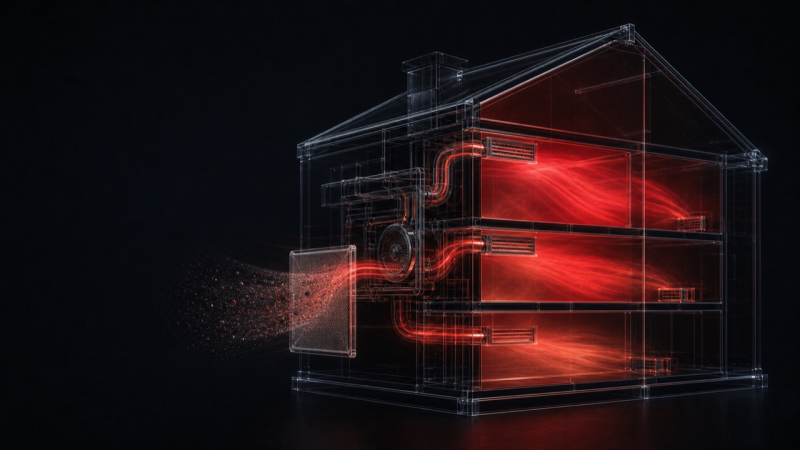
In C12 you learned that the blower has a fixed pressure budget, about 0.5 in WC on most residential equipment, and that everything in the air path spends a piece of it. This module is about the things people bolt INTO that air path on purpose: filters, air cleaners, UV lights, ventilators, humid-climate gear, zone dampers. Every one of them changes the air the household breathes, and every one of them sends a bill to the blower. The industry sells this category hard, and a lot of what gets sold is somewhere between oversold and useless. Your job is different. You are the measurement person. For every IAQ technology you will learn three things: what it actually does, how strong the evidence is that it does it, and what it costs in static pressure. For zoning, you will learn how dampers carve one duct system into pieces, why the old bypass-damper trick creates the exact coil-freeze problem C12 warned you about, and how modern modulating equipment solved it properly. The thread holding the whole module together is the one you already own: static pressure, measured before and after, every time.
Short Version
Indoor air quality work is applied static pressure management with health claims attached, so treat it as a measurement discipline. Filtration: MERV rates capture, not pressure drop, and surface area is how you buy capture without strangling the blower, which is why a 4 to 5 inch media cabinet at MERV 13 (about 0.10 to 0.20 in WC clean) beats a 1 inch MERV 13 pleat (0.25 to 0.35 clean) every single time. True HEPA (99.97 percent at 0.3 microns) carries about 1 in WC of pressure drop, so residential HEPA lives in bypass units that clean a side-stream, never in the main airstream. Electronic air cleaners capture well in the lab at near-zero pressure drop, but their collector cells need washing every 1 to 3 months and almost nobody does it, so field performance collapses. UV lights split cleanly: a coil-mounted UV lamp shining on the wet, stationary coil has decent evidence for keeping biofilm off the fins, while air-stream UV in a residential duct fights a dwell-time problem (air crosses the bulb in a fraction of a second) and a single bulb does very little to moving air. Bulbs lose germicidal output long before they stop glowing, replace yearly, and UVC burns eyes and skin, so power off before panels open. Tight homes need designed ventilation: exhaust-only is cheap and uncontrolled, supply-only pressurizes and filters, balanced ERV/HRV trades heat (and with an ERV, moisture) between airstreams, and in a Phoenix summer an ERV pre-cools 110 F incoming air against the outgoing 75 F exhaust. ASHRAE 62.2 sets the target rate: 0.03 CFM per square foot plus 7.5 CFM per bedroom plus one. Phoenix homes rarely need dehumidifiers, except evaporative cooler hybrids, which pump moisture in. Ducts here leak 20 to 30 percent of conditioned air into 140 to 160 F attics; seal with mastic or UL 181 foil tape or aerosol injection, never cloth duct tape, and re-measure static after sealing because tightening a leaky system changes the map. Zoning closes dampers to condition only calling zones, which shrinks the duct system and spikes static; the legacy fix, a bypass damper dumping supply air into the return, drives the coil cold in cooling and trips limits in heating; the modern fix is modulating equipment that ramps airflow down instead of dumping it. Record static before and after every filtration change. That is the law of this module.
Key Values
| Value | Number | What it means |
|---|---|---|
| Design TESP recall (C12) | 0.5 in WC | The blower's budget. Every IAQ device in the air path spends part of it. |
| Field trouble threshold (C12) | Above about 0.8 in WC | Strangled. IAQ add-ons installed without measuring are a common cause. |
| MERV ladder, clean drops (C12) | Fiberglass 0.05 to 0.08, MERV 8 pleat 0.15 to 0.20, MERV 11 pleat 0.20 to 0.28, MERV 13 pleat 0.25 to 0.35 (all 1 inch) | Capture rises with MERV, and so does the bill, in a 1 inch rack. |
| 4 to 5 inch media cabinet | About 0.10 to 0.20 in WC clean at MERV 11 to 13 | Surface area buys high capture at low drop. Thickness beats rating. |
| True HEPA | 99.97 percent at 0.3 microns, roughly 1 in WC drop | Cannot live in a residential main airstream. Bypass units only. |
| Electronic air cleaner cell washing | Every 1 to 3 months | Skip it and capture efficiency collapses within weeks. |
| UV bulb replacement | About every 12 months (roughly 9,000 run hours) | Germicidal output decays long before the blue glow quits. |
| Coil UV vs air-stream UV | Coil: continuous exposure, decent evidence. Air-stream: fraction-of-a-second dwell, weak in residential | The stationary target is the one UV can actually treat. |
| ASHRAE 62.2 ventilation target | CFM = 0.03 x floor area + 7.5 x (bedrooms + 1) | Awareness level: a 2,000 sq ft 3-bedroom home wants about 90 CFM continuous. |
| Typical duct leakage | 20 to 30 percent of conditioned air | The single biggest delivered-capacity thief in this market's attics. |
| Bypass damper efficiency cost | Roughly 20 to 30 percent measured in field tests with bypass open | Recirculated supply air does no work and degrades coil conditions. |
| Smallest zone rule of thumb | Smallest zone sized to carry roughly 25 to 30 percent of system airflow on single-stage equipment | Below that, closing zones spikes static and short cycles the equipment. |
| Healthy indoor RH band | About 30 to 60 percent | Phoenix homes usually sit at the bottom of it without help. |
| Wet coil and split recall (C12) | Coil wet for cooling static; healthy split 18 to 22 F | Same measurement discipline applies before and after IAQ changes. |
Field Checklist
IAQ and zoning survey on any equipped system:
- Take the C12 baseline first: TESP with the coil wet, fan table CFM, per-ton verdict. No IAQ judgment without it.
- Identify the filtration: location(s), size, depth, MERV, condition, fit, bypass gaps around the frame. Note the clean rating versus what the rack can actually afford.
- Filter change or upgrade: record static BEFORE the swap, swap, record static AFTER, both numbers on the work order.
- Electronic air cleaner present: pull the cells, inspect plate loading, check for arcing or snapping sounds, confirm the homeowner knows the washing schedule. If the cells are caked, it has not been an air cleaner for months.
- UV lamp present: power OFF before the panel opens, never look at a lit bulb. Check bulb date, glass clarity, and lamp position relative to the coil face. No date label means assume expired.
- Ventilation: find out what the home has (exhaust-only, supply-only, ERV/HRV, nothing). Confirm controls work, filters and cores are clean, and intakes are clear and away from exhaust terminations.
- Evaporative cooler hybrid: check the changeover dampers seal tight in AC mode, look for duct moisture damage, and ask which system ran last.
- Walk the attic duct: disconnected runs, crushed flex, failed cloth tape at collars, mastic condition, leakage signatures (dust streaks at joints, blown insulation patterns).
- Zone system: exercise every damper from the panel, watch the manometer while each zone opens and closes, record static in each zone state.
- Bypass damper present: note type (barometric or motorized), verify it actually modulates, and read the return air temperature with one zone closed in cooling.
- Verify zone sensor and thermostat placement: interior wall, away from supplies, sun, and heat sources.
- Photograph everything changed, and log before and after readings in the job record.
Full Breakdown
IAQ is a measurement discipline, not a product category
Walk into any supply house and you will see a wall of IAQ products, every box promising healthier air. Some of them deliver. Some deliver only under conditions residential systems never meet. The way through is the same discipline D-track taught you for diagnosis: evidence and numbers, not claims.
Three questions sort every IAQ technology, and this module asks them of each one:
- What does it actually do, physically? Capture particles, kill organisms, exchange air, move moisture. Name the mechanism.
- What is the evidence level? Strong lab results at realistic residential conditions, strong lab results at conditions a house never sees, or marketing. The honest answer is different for nearly every product on the wall.
- What does it cost in static? Everything in the air path spends blower budget. A device that cleans air while strangling airflow trades one problem for a worse one, because low airflow freezes coils and floods compressors, and you have already seen that chain.
One more framing before the technologies. The contaminants you care about come in sizes, measured in microns (a micron is one millionth of a meter; a human hair is about 70 of them). Dust and pollen run roughly 2 to 100 microns. Mold spores and pet dander run about 1 to 10. Smoke, exhaust fines, and the particles that get deepest into lungs run below 1 micron, the hardest stuff to catch. Gases and odors are not particles at all, and no filter on the MERV scale touches them. When a product claims to handle "everything," you now know enough to ask which sizes and by what mechanism.
Filtration: the ladder revisited, and why thickness beats rating
Recall the C12 ladder, because it is the spine of all residential filtration: MERV (Minimum Efficiency Reporting Value, 1 to 16 residential) rates particle capture, says nothing directly about pressure drop, and in a 1 inch rack the clean drops run roughly 0.05 to 0.08 for fiberglass, 0.15 to 0.20 for a MERV 8 pleat, 0.20 to 0.28 for MERV 11, and 0.25 to 0.35 for MERV 13. That last number is most of a 0.5 in WC budget, spent on day one, clean.
Here is the physics that makes the rest of the filtration story simple. Pressure drop through a filter rises with face velocity, the speed of air through the media. Spread the same airflow across more media surface and the velocity through any square inch falls, which drops the pressure AND improves capture, because slower air gives particles more chance to be caught. Surface area is the currency. MERV is just the weave.
A 4 to 5 inch media filter buys surface area two ways: a deeper frame, and far deeper pleats packed into it. Unfold the pleats of a 4 inch media filter and you have many times the media area of a 1 inch pleat in the same rack opening. The result on the gauge: MERV 11 to 13 capture at roughly 0.10 to 0.20 in WC clean, half or less of the 1 inch MERV 13 penalty, plus months more dust-holding capacity before the drop climbs. That is the whole argument, and it is measurable on any system in ten minutes: thickness beats rating. A homeowner who wants better filtration gets a deeper filter, not a tighter 1 inch one.
The upgrade path is a media cabinet: a purpose-built housing installed in the return, replacing the 1 inch rack or filter grille as the system's filtration point. Fitting one is real sheet metal work at the return drop, and the payoff is permanent: high capture the blower can actually afford. After any such change, the verdict comes from the manometer, not the brochure. Before static, after static, fan table, CFM per ton. If a filtration upgrade pushed the system out of the 350 to 450 window, it was not an upgrade.
HEPA reality in residential
HEPA (High Efficiency Particulate Air) is a defined standard: 99.97 percent capture of 0.3 micron particles, the hardest size to catch. It is the real thing, the filtration used in cleanrooms and surgical suites, and homeowners ask for it by name.
Here is the reality: media that dense carries a pressure drop in the neighborhood of 1 in WC, twice the ENTIRE static budget of a residential blower. Put a true HEPA filter in the main airstream of a typical house and you do not get hospital air, you get a frozen coil and a dead compressor. Residential blowers were never built for it, and no fan table extends to where that filter would put the operating point.
So residential HEPA is done as a bypass unit: a separate cabinet with its own small fan, teed into the duct system (commonly return to return, or return to supply), pulling a few hundred CFM through the HEPA media and returning it. The main blower never feels the HEPA drop. The honest math: a bypass unit cleans only the fraction it processes per pass, so it polishes the air over hours of runtime rather than scrubbing every cubic foot every pass. That is genuinely useful for the sub-micron fraction the main filter misses, and it is the only legitimate way the word HEPA belongs in a ducted residential system. A 1 inch rack filter labeled "HEPA-like," "HEPA-type," or "99 percent" is not HEPA; the standard is specific, and the marketing knows most buyers will not check.
Electronic air cleaners: the maintenance reality
An electronic air cleaner (the classic type is an electrostatic precipitator) replaces media with voltage. Ionizing wires charge incoming particles, and charged collector plates downstream attract and hold them. On paper it is elegant: high capture across a wide particle range, at near-zero pressure drop because air passes between open plates instead of through media. The lab numbers, on clean cells, are genuinely good.
The field reality is a maintenance story. The plates collect what they catch, and as they load, the electric field weakens and capture efficiency collapses, within weeks in dirty environments. The cells need pulling and washing every 1 to 3 months, forever. Almost nobody does it. The typical unit you will meet has cells caked solid, has been catching close to nothing for years, and the homeowner believes the air is being cleaned because the cabinet hums. Two more field signatures: a snapping or arcing sound means dirt is shorting the plates, and some older units generate trace ozone (a lung irritant) as a byproduct, which is its own reason some households should pass on the technology.
The honest evidence level: works as rated only when maintained on a schedule most households will not keep. When you find one, your job is the inspection and the straight conversation: show the homeowner the cells, explain the washing schedule, and let them decide whether they will actually do it. A washed-monthly electronic cleaner is a fine device. An unwashed one is a humming box, and a deep media filter that gets changed once or twice a year usually serves the same household better.
UV lights: two very different jobs wearing one name
Germicidal UV lamps emit short-wave ultraviolet light (UVC, around 254 nanometers) that damages the DNA of mold, bacteria, and viruses. Whether that matters in a duct system depends entirely on what the light is pointed at, and this is where the evidence splits cleanly in two.
Coil UV: the stationary target. A lamp mounted to shine continuously on the evaporator coil face and drain pan. The coil is wet, dark, and warm half the year, the perfect biofilm farm, and the C12 wet-coil story told you what a fouled coil costs in static and capacity. Because the coil does not move, exposure time is continuous: hours, days, weeks of dose on the same surfaces, which is why even modest lamp intensity keeps the irradiated faces clean. This is the UV application with decent evidence behind it, including documented coil cleanliness and pressure drop benefits in equipment that runs wet constantly. Its honest limits: it treats the surfaces in line of sight, the shadowed side of the coil gets little, and it is keeping a clean coil clean, not deep-cleaning a matted one. Airflow cost: effectively zero. A lamp in the plenum is not a restriction.
Air-stream UV: the dwell time problem. The same lamp sold as an air purifier, mounted in the duct to kill organisms passing by. Now do the math you can already do: duct air moves at hundreds of feet per minute, so a particle crosses a bulb's effective zone in a fraction of a second. Killing organisms in flight at that speed takes intensity and lamp length far beyond what a single residential bulb provides. Commercial systems that genuinely disinfect moving air use banks of high-output lamps sized to the duct and velocity, engineered for a calculated dose. One bulb in a residential supply plenum is not that, and the honest evidence level for single-bulb residential air-stream UV is weak. It is not snake oil at the physics level, the mechanism is real, but the dose is not there.
Bulbs and safety, both non-negotiable. UV bulb output decays with run hours: a bulb still glowing a healthy blue can be down to a fraction of its germicidal output. The blue glow proves the bulb lights, not that it works. Replacement interval is about every 12 months of continuous operation (roughly 9,000 hours), and the install date goes on a label on the cabinet. And UVC injures people fast: direct exposure burns the cornea (the eye damage shows up hours later and feels like sand under the eyelids) and burns skin like concentrated sunburn. Power the lamp off before any panel opens, never look at a lit bulb even briefly, and check that door interlocks, where fitted, actually kill the lamp. UVC also degrades plastics over time, so on inspection look at what the lamp shines on: drain pans, flex liner, and wire insulation in the beam path get brittle and chalky after years of exposure, and that is worth photographing and flagging.
Ventilation: tight homes need designed air
Older houses ventilated by accident: leaky envelopes traded air with outdoors constantly, which wasted energy but diluted indoor pollutants for free. Modern construction is tight on purpose, and a tight envelope traps everything generated indoors: cooking byproducts, CO2, moisture, off-gassing from materials, everything the occupants exhale and spray and burn. Past a certain tightness, a home needs ventilation by design, not by leakage. That is mechanical ventilation, and there are three architectures:
Exhaust-only. Fans throw indoor air out (a continuously running bath fan is the classic version), and makeup air seeps in through whatever cracks remain. Cheapest, simplest, and least controlled: the house runs at slight negative pressure, and the incoming air arrives unfiltered through walls, attics, and garages, picking up whatever lives in those paths. Negative pressure is also exactly what you do not want in a home with combustion appliances that can backdraft.
Supply-only. A fan, often a damper and small duct feeding outdoor air into the return, pushes filtered outdoor air in, and the house runs at slight positive pressure, pushing indoor air out through the cracks. You control where the air comes from and it passes through the system filter on the way in. The cost: in extreme climates you are importing unconditioned outdoor air for the equipment to handle, which in a Phoenix July means a 110 F intake stream.
Balanced, with recovery: ERV and HRV. A balanced ventilator runs two fans, exhausting stale air and supplying fresh air at matched rates, with the two airstreams crossing through a heat exchanger core so the outgoing air pre-conditions the incoming. An HRV (Heat Recovery Ventilator) exchanges heat only. An ERV (Energy Recovery Ventilator) exchanges heat AND some moisture across the core. Neither mixes the airstreams; they trade energy through the core walls.
What does an ERV do in a Phoenix summer? Picture the core with 110 F outdoor air entering one side and 75 F indoor air leaving through the other. The incoming stream gives up a large share of that 35 degree difference to the outgoing stream, so the fresh air arrives at the equipment already knocked down well toward indoor temperature, and the cooling system pays for a fraction of the ventilation load instead of all of it. During monsoon, when outdoor dew points jump, the ERV's moisture transfer also moves some of the incoming humidity into the dry outgoing stream. In a climate this hot, recovery is what makes continuous ventilation affordable, and the ERV's moisture exchange is a modest bonus most of the year and a real one in August.
How much ventilation: ASHRAE 62.2, awareness level. ASHRAE Standard 62.2 is the residential ventilation standard, and its base whole-house rate is a formula worth recognizing on sight: required CFM = 0.03 x floor area in square feet + 7.5 x (number of bedrooms + 1). A 2,000 square foot, 3 bedroom home: 60 + 30 = 90 CFM, continuous. You are not expected to design ventilation systems in this module; you are expected to recognize the standard, run the quick math, and know whether the box on the wall is even in the right league. Designed ventilation for a specific home is design work, the same way Manual D duct design is, and it gets scoped as such.
Field checks on any ventilator: the core and its filters load with dust like any other media (in this market, faster), the outdoor intake must be clear and located away from exhaust terminations, dryer vents, and flue gases, and the controls have to actually run it. A surprising number of installed ERVs are switched off because nobody explained the noise or the purpose to the homeowner.
Humidity in a dry climate, and the evaporative cooler complication
Comfort and building science both like indoor relative humidity between roughly 30 and 60 percent. Most US IAQ humidity work is dehumidification, fighting moisture. Phoenix is the opposite problem: for most of the year the desert air is so dry that homes sit at the bottom of the band or below it without any equipment at all, and the refrigerated cooling system removes what little moisture shows up as a side effect. The practical consequence: whole-home dehumidifiers are rarely justified here, and a tech who recommends one is usually solving a problem the house does not have. The exceptions are real but narrow: monsoon weeks with badly oversized equipment that short cycles before it dehumidifies, and unusual indoor moisture sources.
The genuine Phoenix humidity complication is the evaporative cooler hybrid home. An evaporative (swamp) cooler cools by soaking pads with water and blowing outdoor air through them: cheap cooling in dry air, and it works by ADDING moisture to the airstream and pressurizing the house with outdoor air. Plenty of older Phoenix homes run both: evap in the dry shoulder seasons, refrigerated AC in the humid peak. That hybrid creates the situations a measurement-minded tech has to untangle. The two systems want opposite envelopes: evap needs open windows or relief dampers to push air through the house, AC needs everything closed. The changeover dampers between the two duct paths leak, and a leaky changeover in AC mode means hot, humid outdoor air pouring into the return through the idle evap side. Wet pads and standing water feed algae and mineral scale, and a coil downstream of an evap-moistened airstream sees latent load Phoenix equipment was not configured for, which shows up in your readings as a temperature split and coil behavior that does not match the dry-climate assumptions.
Duct sealing: the leak tax and how to stop paying it
Typical duct systems leak 20 to 30 percent of the air that the homeowner paid to condition, through joints, collars, takeoffs, and seams. Now put that leakage where Phoenix ducts actually live: a 140 to 160 F attic. Supply leaks dump conditioned air into the oven. Return leaks are worse: they suck 150 F attic air, plus attic dust and insulation fibers, straight into the airstream ahead of the coil, which is simultaneously a capacity theft, a coil-loading dust feed, and an IAQ problem bigger than most of the products in this module solve. Duct sealing is the rare job in this category with strong evidence, large measurable effect, and no downside, which is why it belongs in every IAQ conversation a tech has.
The methods, with their honest standings:
Mastic. A thick, paintable sealant brushed over joints and seams, often with fiberglass mesh tape embedded across gaps. The field standard. It is messy, it is permanent, it tolerates attic heat for decades, and it is what every reputable sealing spec calls for. Use it everywhere accessible.
Foil tape, UL 181 listed. Real foil tape carrying the UL 181 listing (printed on the tape itself) is legitimate for seams and collars, especially where mastic is impractical. The thing it must never be confused with is cloth duct tape, which despite the name is banned from ducts in any competent spec: its adhesive cooks, dries, and lets go in attic heat, and in this market specifically, "sealed with duct tape" means "will be leaking again by August." If the tape does not say UL 181, it does not touch a duct.
Aerosol sealing. A machine-applied method: registers get blocked, a fog of sticky polymer particles is injected into the pressurized duct system from inside, and the particles deposit at leak edges, bridging gaps up to about 5/8 inch until the leaks seal themselves shut. Its strengths are exactly where hand-sealing fails: the joints buried under insulation, behind framing, and beyond reach, and the process measures leakage continuously, so it hands you a before and after leakage number as part of the job. It does not fix disconnected runs, crushed flex, or big mechanical damage; those get repaired by hand first.
And then re-measure static, the D25 recall. Remember the disconnected-run lesson: a leak is a pressure relief. Air escaping through holes is air not pushing against the duct system downstream, so a leaky supply can read deceptively low static. Seal the system tight and the blower finally feels the whole duct system: measured static frequently RISES after a good sealing job, while delivered airflow at the registers improves. A tech who does not understand that will read the higher number as a problem they caused. A tech who does will take the before reading, seal, take the after reading, run the fan table, and report all of it: leakage down, static up modestly, delivered air up, system map updated. Sealing changes the map, so you redraw the map. If post-sealing static lands in trouble territory, the sealing did not break the system, it revealed a duct system that was undersized all along and breathing through its wounds, and that conversation is a design conversation.
The boundary line, same as D25 drew it: finding, sealing, and repairing the duct system as built is your work. Deciding what the duct system should have been, friction rates, trunk sizing, Manual D, is M38 territory, and your before and after numbers are the evidence that starts that module's conversation.
Zoning: one system, several thermostats
A zoned system divides one piece of equipment among two or more areas with independent temperature control. The architecture has four parts:
- Zone dampers: motorized dampers in the ducts serving each zone, round in branch runs or rectangular in trunks, driven open and closed by small actuators. Common designs are power-open/power-close, and spring-return types that fail to a known position when power drops (which position matters, and the installer chose it).
- Zone thermostats or sensors: one per zone, reporting that zone's call.
- The zone panel: the control board that takes the zone calls, decides what the equipment should do, and drives the dampers. Two-zone panels are the residential workhorse; larger panels run three, four, and more zones. The panel arbitrates conflicts (one zone calling cool while another calls heat) with changeover logic and priority rules, and it protects the equipment with time delays.
- The equipment itself, which sees the panel as its thermostat.
Why zone at all: real houses do not load evenly. A two-story home stratifies, a west wing bakes every Phoenix afternoon while the east side coasts, a bonus room over the garage lives its own thermal life. One thermostat in a hallway averages all of that badly. Zoning conditions the areas that are calling and leaves the rest alone, which is honest load-matching when it is engineered properly.
And here is the cost, in the language this module runs on: closing dampers shrinks the duct system. The blower was selected to push its airflow through ALL the ducts. Close half of them and the same blower is shoving against half the duct area: static spikes, velocity and noise in the open zone jump, and on a PSC blower airflow droops exactly as C12 taught. Push it far enough in cooling and you are staring at the familiar chain: starved coil, falling suction, ice. In heating, the same restriction drives temperature rise out of range and trips high limits. Every zoning design question is at bottom a static pressure question, which is why this topic lives in this module.
Bypass dampers, and why dumping air into the return is a problem
The legacy answer to the zoned-static problem is the bypass damper: a duct connecting the supply plenum back to the return, with a damper (barometric, a weighted arm that swings open at a set pressure, or motorized, driven by a static sensor) that opens when zones close. Excess supply air, instead of piling pressure into the closed-off ducts, takes the relief path back to the return. Static controlled, problem solved.
Except look at what that air does. In cooling, the bypassed air is 55 F supply air dumped straight into the return, where it mixes down the return temperature, which makes the coil run colder, which drops suction, which pushes the coil toward freezing, and every pass around the loop makes the entering air colder still. In heating, the same loop recirculates hot supply air into the return until temperature rise climbs and the high limit trips. Either way, the bypassed air does zero work in the house while the equipment pays full price to condition it over and over: field testing of zoned systems has measured efficiency losses in the rough range of 20 to 30 percent with a bypass open versus closed. A bypass damper does not solve the zoning static problem. It relocates it to the coil and the heat exchanger and sends the bill to the utility meter.
A half-step better is the dump zone: route the excess into a low-priority area (a hallway, a room that tolerates over-conditioning) instead of the return. The air at least does something, and the coil is protected. But the honest modern answer abolishes the excess instead of relocating it:
Modulating equipment with communicating zone controls. A variable-speed blower paired with multi-stage or inverter-driven compression can simply make LESS air and less capacity when fewer zones call. One zone calling: the panel tells the equipment, the blower ramps to that zone's airflow, the compressor stages or modulates down to match, static stays civilized, nothing gets dumped, nothing recirculates. This is what zoning was waiting for, and it is why zoning on modern variable-capacity equipment works the way the brochures always claimed. Design discipline still applies: the smallest zone on single-stage equipment should be able to swallow roughly 25 to 30 percent of system airflow on its own, ducts serving zones get sized expecting solo operation, and a system that cannot turn down far enough for its smallest zone will short cycle no matter how smart the panel is.
Zone sensors, and the faults you will actually find
Sensor and thermostat placement makes or breaks a zone's behavior, because the panel only knows what the sensor tells it. The rules are the same ones thermostats have always had, applied per zone: interior wall, about 5 feet up, in the space the zone actually represents, away from supply register blast, direct sun through windows, lamps, TVs, and kitchen heat. The classic zoned-home failure is a sensor in a stairwell or a sun-washed wall voting for the whole upstairs.
The fault list, in the order you will meet it:
- Stuck dampers. A seized actuator, a stripped gear, a blade jammed by a screw or debris. Stuck CLOSED: the zone is starved no matter what its thermostat begs for, and the complaint is one chronically hot or cold area. Stuck OPEN: the zone gets conditioned on every other zone's call, and the complaint is one area always overshooting. The test is direct: command each damper from the panel and verify movement, by sight where accessible, and by the manometer where not, because a damper that actually closes changes the static signature and one that only hums does not.
- Mis-wired panels. Zone 1 thermostat driving zone 2's damper, swapped at the panel or at the actuator. Symptom: calls in one room condition a different room, which homeowners describe in ways that sound like ghosts until you map it. Five minutes of commanding zones one at a time while a hand checks register flow sorts it out.
- One-zone short cycling. Single-stage equipment serving a small zone alone: the zone satisfies in minutes, the equipment slams off, the zone drifts, it slams on. Short cycling is the wear pattern that kills capacitors and compressors, and the cure is staging, modulation, smarter zone grouping, or honest resizing, not a bigger bypass.
- Bypass faults. A barometric bypass with the weight set wrong (always open: permanent recirculation and capacity loss even with all zones open; never opens: no relief at all), or a motorized bypass with a failed static sensor. With one zone closed in cooling, read return air temperature: a return running well below the house's actual return temperature is a bypass confessing.
- Transformer overload. Panels, multiple damper actuators, and accessories stacked onto one undersized transformer brown out intermittently, and intermittent low-voltage gremlins in a zoned system trace to VA math more often than to any exotic cause.
The diagnostic that ties it together is the one this course has been building since C12: static per zone state. Manometer in, all zones open, record. Close zone by zone from the panel, record each state. A healthy modulating system holds civilized static in every state because airflow follows the open zones. A single-speed system with a working bypass shows controlled rise. Stuck dampers, dead bypasses, and undersized zone ducts each leave a recognizable fingerprint in that little table, and the table goes in the job record where it becomes the next tech's baseline.
The static thread, start to finish
Step back and look at what this module actually was: C12 gave you the budget, D25 gave you the map, and A36 walked the catalog of everything the trade installs into that budget. The filter ladder is a static decision. The media cabinet is a static solution. HEPA exiled to bypass cabinets is a static verdict. The electronic cleaner's one real advantage is a static advantage. Coil UV earns its place partly by protecting the coil's pressure drop. Duct sealing redraws the static map and gets re-measured. Zoning is static management with thermostats attached, and the death of the bypass damper is the story of equipment finally learning to modulate instead of strangle. A tech who carries a manometer and the before-and-after habit into every IAQ and zoning conversation cannot be sold a humming box, and neither can their customers. Measure, change one thing, measure again, write both numbers down. That is the whole discipline.
Common Mistakes
- Upgrading filtration by MERV instead of by surface area. A 1 inch MERV 13 pleat in a builder rack spends most of the static budget on day one. The cost: a "healthier air" visit that delivers a starved coil by August. Capture upgrades ride on depth and area, and the manometer checks the work.
- Skipping the before reading on a filter change. Without the before number, the after number proves nothing and the equipment's static history grows a hole. Two readings, every filtration change, no exceptions.
- Trusting a glowing UV bulb. Germicidal output decays long before the glow does. A three-year-old bulb is blue decoration. Date the bulb, replace yearly, and never service one hot: UVC burns corneas in seconds and the pain arrives hours later.
- Calling an unmaintained electronic air cleaner "filtration." Caked cells catch nothing, and the system behind one is effectively running unfiltered. Pull the cells and look before crediting the device with anything.
- Treating a bypass damper as a solution instead of a symptom. Bypassed supply air recirculates, chills the return in cooling, freezes coils, and wastes 20 to 30 percent of the work. Protect the coil today, and point the system toward modulation or proper zone duct sizing tomorrow.
- Sealing ducts and walking away from the higher static reading. A tightened system feels its real duct sizing for the first time. The after measurement is part of the sealing job, and a post-sealing trouble number is a design finding, not a sealing failure.
- Ignoring the evap cooler side of a hybrid home. A leaking changeover damper makes every AC-side reading a lie and feeds humid outdoor air into a system tuned for desert air. Check the changeover before trusting anything downstream.
- Exercising zero dampers on a zoned-system visit. Stuck and mis-wired dampers are the two most common zoning faults, and both are found in five minutes at the panel. A zoned system whose dampers were never commanded was inspected, not diagnosed.
What Is Next
M38 takes the duct system from diagnosis to design: Manual D, friction rates, sizing the trunks and returns that this module kept flagging as too small. Every static map, leakage number, and zone-state table you record in the field is raw material for that work. And the discipline stays the same all the way up the ladder: measure first, change one thing, measure again, and let the numbers do the recommending.