
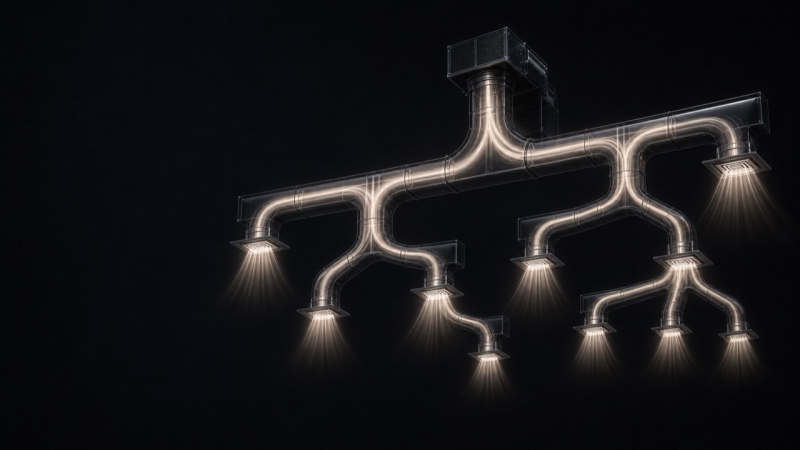
In M37 you ran Manual J at the Phoenix 112 F design condition and used Manual S to select equipment whose real expanded-data capacity matched the load. That gives you the right machine making the right amount of cooling. This module covers the third link in the ACCA chain, Manual D, the duct design standard, because here is the brutal truth the whole industry keeps relearning: ducts are where good equipment goes to die. A perfectly sized, perfectly charged, variable speed system bolted to a strangled, leaky, badly-fitted duct system delivers a fraction of its rating, and the homeowner experiences none of what the spec sheet promised. You already know how to measure a sick duct system from C12 and D25. This module teaches you how a healthy one is designed, so you can size new ducts correctly, judge existing ducts against the math instead of against a hunch, and build a retrofit plan that fixes the worst problems first.
Short Version
Manual J gave you room-by-room loads; each room's airflow target is its share of the sensible load times the system CFM, so a room carrying 15 percent of the sensible load gets 15 percent of the air. Manual D starts from the blower's rated pressure, the same 0.5 in WC design TESP from C12, and subtracts everything that is not duct: wet coil, filter, registers, grilles, dampers. What survives is the available static pressure (ASP), the budget the duct friction is allowed to spend, and it is usually shockingly small, often 0.10 to 0.18 in WC. Divide ASP by the total effective length (TEL) of the longest run, straight feet plus the equivalent length of every fitting, and multiply by 100: that is the friction rate, the number you set on a friction chart or ductulator to size every duct in the system. Fittings dominate TEL: a radius elbow costs about 5 feet, a square-throat elbow about 35, and a panned return path can cost over 100, so one bad fitting can erase 30 feet of budget on its own. Flex duct only matches the chart when it is pulled tight; compressed flex can carry several times the friction of the same duct stretched, up to roughly ten times when badly accordioned. Velocity limits cap the sizing from the other side: keep supply trunks at or under about 900 FPM, branches near 600, returns at 600 or less, and filter grille faces near 300, or the system makes noise and pressure instead of comfort. Returns are the most commonly undersized element in residential work, and every closed bedroom door needs a return path: a dedicated return, a jumper duct, or a transfer grille, sized to hold door-closed room pressure near 3 Pa (about 0.012 in WC). On an existing system, never redesign from guesswork: measure the static profile first (C12 TESP, D25 four-port map), then climb the retrofit priority ladder in order: returns first, worst fittings next, sealing third (A36 methods), full resizing last. Recommend duct renovation over equipment-only replacement when the measured static proves the ducts cannot deliver design airflow, because new equipment inherits old ducts and pays their debts.
Key Values
| Value | Number | What it means |
|---|---|---|
| Design TESP recall (C12) | 0.5 in WC | The pressure most residential blowers are rated to deliver design CFM against. Manual D's starting budget. |
| Available static pressure (ASP) | Rated TESP minus all non-duct drops | What is left for duct friction after coil, filter, registers, grilles, and dampers take their cut. |
| Typical ASP outcome | About 0.10 to 0.18 in WC | On a 0.5 system with honest accessories. A 1 inch high-MERV pleat can drive it negative. |
| Friction rate formula | FR = ASP x 100 / TEL | In WC per 100 feet of effective length. The single number that sizes every duct in the system. |
| Workable friction rate window | Roughly 0.06 to 0.18 | Below 0.06 the ducts get huge and expensive to build; above 0.18 the system is loud and the blower strains. |
| Radius elbow equivalent length | About 5 ft | A gentle fitting, the cheap kind. |
| Square-throat elbow equivalent length | About 35 ft | One bad fitting choice costs about 30 feet of budget versus the radius version. |
| Panned return path | Often 100 ft equivalent or more | Joist cavities pressed into duct service, with leaks included free. |
| Flex compression penalty | Several times chart friction, up to roughly 10x | Flex only matches the friction chart pulled tight. Accordioned flex is a different, much worse duct. |
| Supply trunk velocity limit | About 900 FPM max, 700 comfortable | Above this, noise and pressure climb fast. |
| Supply branch velocity limit | About 600 FPM | Branches feed rooms; quiet matters most here. |
| Return velocity limit | About 600 FPM ducts, 300 FPM filter grille face | Returns must be slow. The C12 filter face target lives here. |
| Door-closed pressure limit | About 3 Pa (0.012 in WC) | Above this a closed bedroom is pressurized and starves the return. Size jumpers and transfer grilles to stay under it. |
| Transfer grille rule of thumb | About 1 square inch free area per CFM | Quick field sizing to keep door-closed pressure low. |
| Room CFM share | Room sensible load / total sensible load x system CFM | Manual J to Manual D in one line. |
| Duct leakage recall (A36) | 20 to 30 percent typical | What unsealed residential systems lose, before any sizing math applies. |
Field Checklist
Duct survey and design review on an existing system:
- Pull the equipment data: rated CFM and rated TESP from the nameplate or installer manual, tonnage, blower type (PSC, constant torque, constant airflow ECM from C12).
- Measure the static profile as found: C12 two-port TESP minimum, D25 four-port map when the number is sick. Wet coil, full cooling speed.
- Walk every accessible duct run with a flashlight. Photograph: crushed or kinked flex, sagging runs, sharp fittings, panned or cavity returns, disconnected or taped-only joints, missing insulation.
- Sketch the system: trunk sizes, branch sizes and lengths, fitting types, register and grille sizes and locations. A phone sketch beats a memory.
- Count the returns. Note every bedroom with a door and no return path, and check door undercuts.
- Measure grille and register face velocities where noise or starvation is suspected; compare to the velocity limits.
- Estimate the worst run's TEL: straight feet plus fitting equivalent lengths. Compare against the ASP that survives the installed accessories.
- Rank the three worst restrictions by measured evidence, not by appearance.
- Build the retrofit plan in ladder order: returns, worst fittings, sealing, resizing. Each step gets a predicted static improvement.
- Re-measure after every change. The after-reading is part of the job.
Full Breakdown
From load to air: what Manual J hands to Manual D
One sentence of M37: Manual J calculated the heating and cooling load of every room at design conditions, and Manual S picked equipment whose expanded-data capacity matches the whole-house load. Manual D's job is delivery. The equipment makes the cooling; the ducts decide which rooms actually receive it.
The handoff is a simple proportion. The system's total airflow comes from the equipment selection, anchored on the C12 rule of 400 CFM per ton nominal. Each room's airflow target is its share of the sensible load:
Room CFM = (room sensible load / total sensible load) x system CFM
Worked example you will see through this whole module: a 3 ton system moving 1,200 CFM, total sensible load 30,000 BTU/h. The master bedroom carries 4,500 BTU/h sensible, which is 15 percent of the total, so it gets 15 percent of the air: 180 CFM. A small office at 1,500 BTU/h gets 5 percent: 60 CFM. Do that for every room and you have the airflow map the duct system must deliver.
Why does this matter so much? Because without it, duct design is vibes. The installer who runs a 6 inch flex to every room because that is what is on the truck has decided that every room has the same load, which is never true. The west-facing master with two windows needs triple the air of the north-facing office, and if it does not get it, no thermostat setting fixes the 4 pm complaint. Room-by-room CFM targets are the contract between the load calculation and the sheet metal.
And here is the stake this module plays for: the industry consistently finds that poor airflow is the most common deficiency in installed systems, more common than charge problems. You can run a flawless Manual J, select the perfect machine through Manual S, and lose everything in the last fifty feet of duct. Ducts are where good equipment goes to die. Manual D is how you stop the dying.
The available static pressure budget
Recall the C12 anchor: most residential equipment is rated to deliver its design airflow at 0.5 in WC total external static pressure. Manual D treats that number as a bank account, and the first move of the design is to watch everything that is not duct make withdrawals.
The blower must push air through every component in the air path. The wet evaporator coil takes a cut. The filter takes a cut. The supply registers, the return grilles, and any balancing dampers each take a cut. None of those are duct, and none of them respond to duct sizing, so Manual D subtracts them off the top. What survives is the available static pressure, ASP: the only pressure the duct friction is allowed to consume.
Run the worked example with honest numbers, the same component values you learned to measure in D25:
| Item | Pressure drop (in WC) |
|---|---|
| Blower rating at 1,200 CFM | 0.50 |
| Wet coil (published data) | 0.21 |
| 4 inch media filter, clean | 0.10 |
| Supply registers | 0.03 |
| Return grille | 0.03 |
| Balancing damper | 0.03 |
| ASP left for duct friction | 0.10 |
Read that table twice, because it carries the central shock of Manual D: a blower rated at half an inch has one tenth of an inch left for the entire duct system, supply and return combined, after ordinary accessories eat their share. The ducts that look like the whole system get the smallest slice of the budget.
Now run the same table with one substitution: a 1 inch MERV 13 pleated filter at 0.30 in WC clean, the restriction trap from C12. The ASP becomes 0.50 minus 0.21 minus 0.30 minus 0.09, which is negative 0.10. There is no duct system that can be designed for that house. Not a bad one, none. The filter choice alone determined whether the design was possible before a single duct was drawn. That is why Manual D forces you to pick every accessory first and look up its real published pressure drop, never a guess: the accessories are not details, they are the budget.
Two design responses when ASP comes out too small: choose lower-drop accessories (a deeper filter, a larger return grille, registers selected for low drop), or select equipment with a higher rated static. What you do not get to do is pretend, because the blower will not pretend with you.
Total effective length: fittings are the real distance
Air does not care how many feet of duct it travels. It cares how much friction it fights, and fittings generate friction wildly out of proportion to their physical size. Manual D handles this with equivalent length: every fitting is assigned the number of feet of straight duct that would produce the same pressure loss. Total effective length, TEL, is the straight feet of the longest supply run plus the longest return run, plus the equivalent length of every fitting along that path.
The equivalent length values are the part to internalize, because they group into three cost tiers:
Cheap fittings, about 5 to 15 feet each. Radius elbows (a gentle curved turn), gradual wyes (a Y-shaped branch split), straight takeoffs from low-velocity trunks. Air follows curves happily.
Moderate fittings, about 20 to 40 feet each. Square-throat elbows (a hard 90 degree corner), typical register boots, standard tee takeoffs. Air slams into flat walls and tumbles, and turbulence is friction.
Expensive fittings, 60 to over 100 feet each. Bullhead tees (air forced to split against a flat face), close-coupled fittings fighting each other, and the champion: panned return paths, where sheet metal is nailed across floor joists to press the building cavity into duct service, with multiple hard turns and leakage included free.
The comparison that should live in your head: a radius elbow costs about 5 equivalent feet, a square-throat elbow about 35. Same turn, same spot in the attic, 30 feet of difference. A run with three lazy fitting choices can carry an extra 90 feet of effective length that no tape measure will ever show, and the room at the end of that run will be the warm one.
This is also why TEL, not square footage, predicts which house has duct trouble. A compact house with brutal fittings can have a longer effective length than a sprawling house with gentle ones. When you walk a duct system, you are not counting feet, you are pricing fittings.
The friction rate worksheet
Now the two numbers meet. The friction rate is the pressure the design allows the air to lose per 100 feet of effective length:
Friction rate (FR) = ASP x 100 / TEL
Finish the worked example. The longest supply run: 60 straight feet plus a square-throat elbow at 35, a takeoff at 35, and a register boot at 35, totaling 165 effective feet. The return path: 25 straight feet plus a return grille drop fitting at 60, totaling 85. TEL = 165 + 85 = 250 effective feet.
FR = 0.10 x 100 / 250 = 0.04 in WC per 100 feet.
Judge that against the workable window of roughly 0.06 to 0.18. Below 0.06, the math is telling you the ducts must be enormous to move air this gently, which is expensive and often physically impossible in the available space. Above 0.18, the design is spending pressure recklessly and the system will be loud. Our 0.04 is below the floor, and that is the worksheet doing its job: it failed the design on paper, before anyone hung a duct.
How do you rescue it? The formula shows you the two levers. Raise ASP: the accessory table is already lean, so little room there. Or cut TEL: replace the square-throat elbow with a radius elbow (35 becomes 5) and upgrade the takeoff (35 becomes 10). TEL drops to 195, and FR = 0.10 x 100 / 195 = 0.05. Better. Swap the register boot for a low-loss boot and the design crosses into the workable window. Fittings were the problem, fittings were the fix, and the worksheet found it for the price of arithmetic.
That is the entire logic of Manual D in one paragraph: budget what the blower has, subtract what the accessories take, spread what is left across the effective length, and size every duct so it spends pressure no faster than that rate.
Sizing ducts: the friction chart and the ductulator
With the friction rate set, sizing becomes a lookup. A friction chart is a graph relating CFM, duct diameter, friction rate, and velocity; a ductulator is the same data on a sliding wheel calculator, and most techs now use the app version. Set the friction rate, find the CFM, read the diameter and check the velocity.
From the worked example at FR 0.05, reading a standard round-metal-duct chart: the 1,200 CFM trunk wants about an 18 inch round duct, which moves air at roughly 680 FPM, comfortably under trunk limits. The 180 CFM master bedroom branch wants about 9 inch round; the 60 CFM office takes a 6 inch. Every duct in the system gets sized at the same friction rate, which is what makes the airflow land where the design intended.
Three material realities adjust the lookup:
Round metal is the reference. Smooth, rigid, lowest friction per inch of diameter. The chart is built for it.
Rectangular duct pays an aspect-ratio tax. A rectangular duct has more wall surface touching the air than a round duct of equal area, so it needs more cross-section for the same flow. Charts handle this through equivalent diameter tables: an 18 inch round is roughly equivalent to a 20 by 14 rectangular, not 18 by 18. The flatter the rectangle, the worse the tax. Rectangular earns its place where height is tight, not because it performs.
Flex duct is honest only when it is tight. Flexible duct ratings assume the duct is pulled to full stretch, supported every 4 feet or less, with gentle bends. Meet those conditions and flex performs close to the chart. Miss them and the inner liner accordions into a corrugated tube whose friction has nothing to do with the printed diameter. Research on compressed flex shows the penalty runs from roughly double at modest compression to as much as ten times chart friction when a run is badly compressed. The field translation: a compressed 8 inch flex is not a slightly worse 8 inch duct, it is an unknown smaller duct wearing an 8 inch jacket. When you size flex, size it as if it will be installed perfectly, then make sure it is, because the chart gave you no margin for sag.
Velocity limits: the other wall
Friction rate sizes ducts from the pressure side; velocity limits cap them from the noise side. Velocity is CFM divided by duct cross-sectional area, in feet per minute, and above certain speeds air stops being silent cargo and becomes a sound source: rushing at the registers, rumble in the trunks, a whistle at every gap.
The residential limits to design and survey against:
| Element | Velocity target |
|---|---|
| Supply trunk | 900 FPM max, about 700 for comfort-grade quiet |
| Supply branch | About 600 FPM |
| Return trunk and branch | About 600 FPM or less |
| Filter grille face | About 300 FPM (the C12 target) |
Notice the pattern: limits drop as air gets closer to people. Trunks live in attics where some rumble is forgivable; branches end at bedrooms where it is not; returns must be slowest of all because a return grille is a large open mouth in a quiet room and every FPM of face velocity is audible.
Velocity is also your fastest field screening tool on an existing system. An anemometer reading at a hissing supply register that shows 900 FPM does not just explain the noise, it tells you the branch is undersized or the damper arrangement is forcing too much air through one outlet. A return grille screaming along at 600 FPM of face velocity is an undersized return announcing itself. You learned in C12 that anemometer numbers are comparison tools, not CFM verdicts; velocity-versus-limit screening is exactly the comparison they are good at.
One more connection: velocity and friction are the same physics. Fast air rubs harder. A duct one size too small does not fail a little; friction rises roughly with the square of velocity, so a small undersizing produces a loud, pressure-hungry duct. When a survey finds both noise and high static on the same path, you have one cause, not two.
Return air design: the most common undersized element
If supply design is where craft shows, return design is where corners get cut, because returns are invisible to buyers and expensive in sheet metal. The result, market after market, is the same: the return is the most commonly undersized element in residential duct systems. The C12 framing still rules: the blower can only push what the return lets it pull, and an undersized return strangles the entire system, not one room.
Design rules for returns:
Size for low velocity. Return ducts at about 600 FPM or less, filter grille faces near 300 FPM. The worked example makes it concrete: 1,200 CFM at a 300 FPM face target needs 4 square feet of filter grille, which is a 24 by 24 grille, not the lonely 14 by 20 you will find on half the systems you survey. When one grille cannot reach the area, use two; total area is what counts.
Return air must get out of every room it is delivered to. Close a bedroom door and the supply keeps pushing air in. If that air has no path back to the return, the room pressurizes, the supply into it chokes, and the starved central return makes up the difference by pulling from wherever it can, including attics and garages through every leak in the return path. The design limit: a closed room should sit within about 3 Pa, which is 0.012 in WC, of the hall pressure. Door undercuts alone move maybe 20 to 30 CFM honestly; bedrooms getting 100 plus CFM need a real path.
The three real paths. A dedicated return duct from the room, the best and most expensive answer. A jumper duct, a short insulated flex over the ceiling connecting a grille in the room to a grille in the hall, which moves real air and blocks sightlines for privacy. A transfer grille, a through-wall or over-door grille between room and hall, cheapest and effective when sized honestly: the rule of thumb is about 1 square inch of free area per CFM of supply into the room, so the 180 CFM master wants around 180 square inches, which is a pair of generous grilles, not one 8 by 14 afterthought.
Returns leak worse than supplies. A supply leak loses conditioned air; a return leak under suction inhales from wherever it lives, which means dust, insulation fibers, and unconditioned heat get pulled ahead of your filter and coil. Sealing priorities in A36 put return-side sealing first for exactly this reason.
Surveying an existing system: measure before you redesign
Everything to this point designs ducts from scratch. Most of your master-level work will be the other problem: an existing system, a comfort complaint, and a decision about what to fix. The rule that separates engineering from guessing is the same one C12 installed: measure first.
One sentence each of recall. C12: two test ports and a manometer give you TESP, and the fan table turns TESP into actual CFM. D25: two more ports give you the four-port map, which prices each component, return path, filter, coil, supply path, against its budget of roughly 0.10, 0.10, published wet drop, and 0.10.
The duct survey adds the eyes to those numbers. With the static profile in hand, walk the system end to end: plenum connections, every takeoff, every run, every boot, every return path. Photograph defects, sketch the layout with sizes and fitting types, and measure face velocities at suspect registers and grilles. Then put the numbers and the pictures together. A supply path drop of 0.22 against a 0.10 budget plus a photo of a crushed flex behind the platform is a diagnosis. The same drop with clean, tight ducts but three square-throat elbows on the trunk is a different diagnosis with a different fix. The map says which side of the blower is sick; the survey says exactly what disease it has.
While you are in the attic, price the fittings you see against the equivalent-length tiers. You now know that the hard 90 boot at the end of the master bedroom run costs 35 feet and a radius replacement costs 5. That mental arithmetic, run during the walk, is what turns a pile of photos into a ranked plan.
The retrofit priority ladder
A survey usually finds more problems than any budget of time or attic patience can fix at once. The ladder orders them by airflow returned per unit of effort, and it is climbed in order:
Rung 0: Measure. The static profile and survey you just did. Nothing gets recommended without it, and every rung below gets an after-measurement before the next rung starts, because each fix redraws the map.
Rung 1: Returns first. Return restrictions strangle the whole system, and return fixes are usually the cheapest static relief available: a second return grille, a larger filter grille, jumper ducts to sealed-off bedrooms, replacing a collapsed return flex. When a system is starving, added return area routinely buys back more CFM than any other single change. This is also where an undersized filter gets its media cabinet (C12).
Rung 2: Worst fittings next. The survey priced them. Replace the squashed flex behind the platform, the square-throat elbow feeding the longest run, the bullhead tee at the trunk split. Each bad fitting replaced is 20 to 90 effective feet handed back to the friction budget, concentrated exactly where the worst room's air travels.
Rung 3: Sealing. One sentence of A36 recall: seal with mastic, UL 181 foil tape, or aerosol injection, never cloth duct tape, and re-measure static afterward because sealing a leaky system changes the whole map. Sealing sits third not because it matters less, leakage of 20 to 30 percent is enormous, but because sealing a system with strangled returns and brutal fittings locks in the strangulation: static typically rises after sealing, and a system already at 0.9 in WC cannot afford the rise. Fix the breathing first, then close the wounds. The full methods, depths, and verification live in A36; this module only places sealing in the sequence.
Rung 4: Resizing and replacement. The expensive rung: new trunks, upsized branches, relocated runs, or a full redesign from a fresh Manual D. You climb here only when the first three rungs, measured honestly, cannot bring the system inside the window: CFM per ton in the 350 to 450 band at a TESP the blower can live with. By the time you recommend it, your before-and-after readings from the lower rungs are the proof that nothing cheaper was left.
The discipline that makes the ladder work is the re-measure between rungs. Every fix changes the static profile, and yesterday's second-worst problem may not be today's worst. Climb, measure, re-rank, climb again.
Renovation versus equipment-only replacement
The master-level judgment call: a 15 year old system is being replaced, and someone must decide whether the ducts come along for the renovation or stay as they are. Frame this decision entirely on engineering and outcomes: comfort, delivered capacity, and equipment life. Those are the only three arguments, and they are sufficient.
When equipment-only is defensible. The static profile measures inside the window with a clean filter and wet coil, the survey found tight, well-fitted, adequately-sized ducts with real return area, and room-by-room delivery roughly matches the M37 load shares. Old does not mean bad; a well-built duct system outlives several pieces of equipment.
When renovation must be on the table. The measured TESP sits high (the C12 trouble threshold of about 0.8 in WC and beyond) with a clean filter, or CFM per ton cannot reach 350 at any honest blower setting, or whole rooms cannot receive their load share because the paths to them do not exist. Bolting new equipment to that duct system buys the customer a new machine that delivers the old performance. Worse: modern variable speed equipment hides the problem while paying for it, the C12 lesson, holding CFM by burning watts against the restriction, running hot, and aging fast. The duct system that strangled the old PSC blower audibly will strangle the new ECM silently, and the new compressor inherits the airflow-starved coil, the low suction, and the early grave that comes with both.
The honest middle. Most real cases land between: equipment replacement plus targeted rungs 1 through 3, returns, worst fittings, sealing, sized by the measured profile. The static numbers tell you which case you are standing in, which is why the measurement always comes first and why your recommendation is written in CFM, static, and temperature splits rather than adjectives.
Common Mistakes
- Designing ducts before fixing the accessory budget. Sizing duct runs while a 1 inch high-MERV pleat eats 0.30 in WC is solving the wrong equation. Run the ASP subtraction first; if the budget is negative, no duct sizing can save it.
- Measuring duct runs with a tape and ignoring fittings. The tape says 60 feet; the air experiences 165. TEL is fittings plus feet, and fittings dominate. Price every fitting or the friction rate is fiction.
- Sizing flex from the chart and installing it loose. The chart assumed full stretch. Every inch of compression is unmodeled friction, up to roughly ten times chart values when badly accordioned. Pull it tight, support it every 4 feet, or size it bigger and say why.
- Adding supply fixes to a return-starved system. Upsizing supply branches while one undersized return grille strangles the blower moves the restriction, not the airflow. Returns first is rung 1 for a reason.
- Sealing a strangled system first. Sealing raises static on a system that cannot afford it. Open the returns and fix the worst fittings, then seal, then re-measure (A36).
- Ignoring door-closed pressure. A bedroom with 150 CFM of supply, a shut door, and a half-inch undercut is a pressurized box starving the return. Every bedroom needs a return path sized near 1 square inch per CFM, verified against the 3 Pa limit.
- Trusting a quiet variable speed system as proof of healthy ducts. Constant airflow ECMs hide duct disease by paying for it in watts and motor life (C12). On these systems, static and watt draw are the survey tools, not your ears.
- Recommending equipment-only replacement without a static profile. New equipment on unmeasured ducts is a guess wearing an invoice. The profile takes minutes and decides the whole recommendation honestly.
What Is Next
M39 is commissioning: the discipline of proving, with measurements, that everything you designed and installed actually performs, charge, airflow, static, temperature split, electrical, and the documentation that closes the loop. Every number this module taught you to design toward becomes a number M39 teaches you to verify at startup. The friction rate worksheet predicted the static; commissioning is where the manometer grades your prediction.