
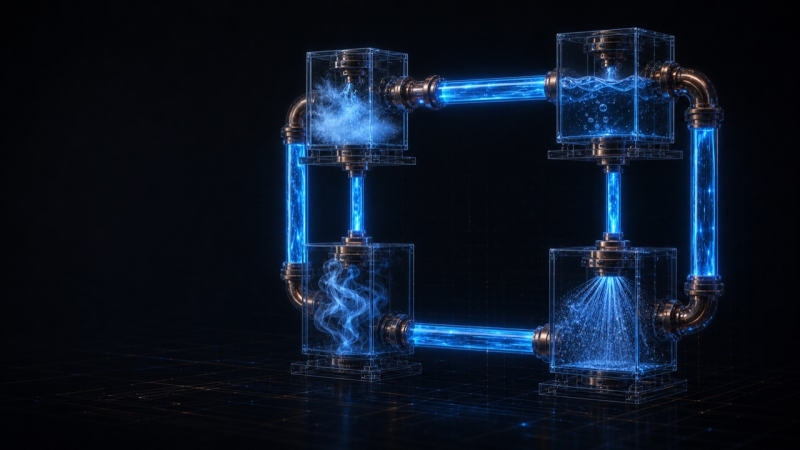
You are standing in a customer's backyard in July. The outdoor unit is humming. One copper line is sweating cold like a soda can. Another is hot enough to burn you. The air blowing off the top of the unit is hotter than the air around it. Nothing in that machine is "making cold." It is moving heat, and by the end of this module you will be able to trace exactly where every BTU goes.
This is the keystone module of the entire course. Every diagnosis you will ever make, every gauge reading, every superheat and subcooling number in the modules ahead, is just a way of asking: where is this cycle healthy, and where is it broken?
Short Version
An air conditioner does not make cold. It moves heat. Refrigerant absorbs heat indoors by boiling at a low temperature, gets squeezed to a high pressure so it becomes hotter than outdoor air, dumps that heat outside by condensing back to liquid, then has its pressure dropped so it can boil cold again. Four components, in order: the compressor raises pressure, the condenser rejects heat, the metering device drops pressure, the evaporator absorbs heat. Pressure controls temperature. That is the whole machine.
Key Values
All values are for a healthy residential R-410A split system with a TXV, running steady on a 95 F Phoenix day with a 75 F indoor return. These are the numbers you will see again and again, so start memorizing them now.
| Point in the cycle | Pressure (psig) | Saturation temp | Actual temp | State |
|---|---|---|---|---|
| Suction line at compressor inlet | 130 | 45 F | about 55 F | superheated vapor |
| Discharge line at compressor outlet | 365 | 110 F | about 170 F | superheated vapor (hot) |
| Liquid line at condenser outlet | 365 | 110 F | about 100 F | subcooled liquid |
| Evaporator inlet, after metering device | 130 | 45 F | 45 F | saturated mix (liquid plus flash gas) |
| Evaporator outlet | 130 | 45 F | about 55 F | superheated vapor |
Supporting values to anchor those numbers:
| Quantity | Healthy value | What it means |
|---|---|---|
| Low side saturation temp | 40 to 45 F | the evaporator coil's boiling temperature |
| High side saturation temp | ambient plus 15 to 20 F (110 F on a 95 F day) | the condenser's condensing temperature |
| Temperature split (return air minus supply air) | 18 to 22 F | proof the evaporator is absorbing heat |
| Superheat at evaporator outlet (TXV) | 10 F plus or minus 5 | covered fully in F6 |
| Subcooling at condenser outlet | about 10 F (check the data plate) | covered fully in F6 |
| Compression ratio | about 2.6 | absolute discharge pressure divided by absolute suction pressure |
Compression ratio uses absolute pressure, which is gauge pressure plus about 14.7 psi: (365 + 14.7) divided by (130 + 14.7) = about 2.6. The compressor is squeezing the vapor to roughly two and a half times its incoming absolute pressure. As that ratio climbs, the compressor works harder and moves less refrigerant. Hold that thought for the Phoenix note below.
Field Checklist
The touch test. You can read most of this cycle with your hand before you ever hang gauges. On a healthy running system:
- Suction line (the fat, insulated copper line): cold and sweating where exposed, like a soda can out of the fridge. It is carrying cool low pressure vapor back to the compressor, around 50 to 60 F.
- Discharge line (short line from compressor to condenser coil): dangerously hot, around 150 to 180 F. Touch it with a quick tap of the back of your fingers if at all. If you can grip it comfortably, something is wrong.
- Liquid line (the thin, uninsulated copper line): warm like bathwater, around 95 to 105 F on a 95 F day. It should never be hot like the discharge line and never cold.
- Air off the top of the condenser: noticeably warmer than ambient. That is the heat from inside the house leaving the property. No warm air off the condenser means no heat is being rejected.
- Supply air at a register inside: 18 to 22 F cooler than the return air. Measure return and supply, subtract. This is the temperature split.
- Evaporator coil (when accessible): uniformly cold and lightly sweating, not frosted. Frost means the coil is running below freezing, and that is a problem for a later module.
If every one of those checks out, the cycle is moving heat. Most of your future diagnostic work starts with one of these feeling wrong.
Full Breakdown
Why moving heat beats making cold
There is no such thing as making cold. Cold is just the absence of heat, the way dark is the absence of light. You learned in F3 that heat is energy and that it always flows from hotter to colder on its own. So the only way to cool a 75 F living room is to grab heat out of its air and carry that heat somewhere else, in our case, to the 95 F air outside.
That sentence should bother you. Heat flows from hot to cold on its own, and we just said we are taking heat from a 75 F room and giving it to 95 F outdoor air. That is uphill. Moving heat uphill is the entire job of an air conditioner, and it takes two tricks:
- Make the refrigerant colder than the indoor air, so indoor heat flows into it naturally.
- Then make that same refrigerant hotter than the outdoor air, so the heat flows out of it naturally.
Both tricks are done with pressure. That is the engine of this whole module.
The pressure-temperature relationship: the engine of the cycle
From F3 you know that boiling absorbs huge amounts of heat (latent heat) and condensing releases it. Here is the new piece: the temperature at which a fluid boils depends on the pressure on it.
Water boils at 212 F at sea level. On top of Mount Everest, with less atmosphere pressing down, it boils at about 158 F. Lower pressure, lower boiling point. Raise the pressure, like a pressure cooker does, and the boiling point goes up.
Refrigerant is a fluid chosen because its boiling points land in useful territory. For every pressure, a refrigerant has exactly one boiling temperature. That temperature is called the saturation temperature: the temperature at which the refrigerant boils or condenses at that pressure. Boiling and condensing happen at the same temperature for a given pressure, just in opposite directions. Add heat at saturation and liquid boils to vapor. Remove heat at saturation and vapor condenses to liquid.
For R-410A, the refrigerant in most of the systems you will service:
- At 130 psig it boils and condenses at 45 F.
- At 365 psig it boils and condenses at 110 F.
Same chemical. Two wildly different boiling points, selected by nothing but pressure. Control the pressure and you control the temperature at which the refrigerant trades heat. That is why a gauge is a thermometer in disguise: read the pressure, convert it to saturation temperature, and you know how hot or cold the refrigerant is wherever it is boiling or condensing. Module F5 makes you fluent in that conversion with the PT chart. For now you only need the concept.
One more term before the walk: saturated means liquid and vapor exist together. While the refrigerant is saturated, its temperature is pinned at the saturation temperature, exactly like a pot of boiling water holds 212 F no matter how high you crank the burner. The temperature cannot rise until the last drop of liquid is gone, and it cannot fall until the last bit of vapor has condensed.
The four components, by what they do
Forget brand names and part numbers for a minute. The refrigeration cycle is four jobs, and every air conditioner, heat pump, refrigerator, and freezer on Earth has one component doing each job. Learn the jobs first.
1. The pressure increaser (the compressor). Takes in cool, low pressure refrigerant vapor and squeezes it into a much smaller volume. Squeezing gas raises both its pressure and its temperature; the molecules are crowded together and moving faster, and temperature is just a measure of how fast molecules move. Vapor enters around 130 psig and 55 F. It leaves at around 365 psig and 170 F. The compressor is also the pump of the system. By drawing vapor in on one side and pushing it out the other, it is the only thing that circulates refrigerant around the loop. Critical fact: the compressor compresses vapor only. Liquid does not compress. Liquid arriving at a compressor is how compressors die, and the whole rest of the cycle is arranged to make sure that never happens.
2. The heat rejector (the condenser). The outdoor coil. Hot 170 F vapor from the compressor enters a long path of tubing covered in thin aluminum fins while a fan pulls 95 F outdoor air across it. Because the refrigerant is hotter than the air, heat flows refrigerant to air, downhill, naturally. The vapor first cools to its saturation temperature (110 F at 365 psig), then condenses back into liquid through most of the coil, releasing its latent heat the entire time at a constant 110 F. By the bottom of the coil it is all liquid, and the air keeps cooling it a little below saturation. It leaves as 100 F liquid. State change inside: superheated vapor in, subcooled liquid out.
3. The pressure dropper (the metering device). A deliberate restriction, either a fixed orifice (a piston with a precisely sized hole) or a thermostatic expansion valve (TXV) that adjusts its opening automatically. Module C11 covers the hardware. High pressure liquid is forced through the tiny opening, and on the far side the pressure collapses from 365 psig to 130 psig. New pressure, new saturation temperature: 45 F. The liquid arrives at 100 F, which is far above the new boiling point, so a portion of it instantly boils. That instant boiling is called flash gas, and it consumes heat from the remaining liquid, chilling the whole mixture down to 45 F. What leaves is a cold saturated mix, roughly three quarters liquid and one quarter vapor by weight. The metering device has no moving heat exchange of its own. It does one thing: drop the pressure so the refrigerant can be cold. It also meters, holding back the flow so the high side stays high and the low side stays low.
4. The heat absorber (the evaporator). The indoor coil. The cold 45 F saturated mix flows through the coil while the blower pushes 75 F return air across it. The refrigerant is 30 F colder than the air, so heat flows air to refrigerant, downhill, naturally. That heat boils the remaining liquid, and because the refrigerant is saturated, it stays pinned at 45 F the whole time it boils. The air, having given up its heat, leaves the coil 18 to 22 F cooler than it came in. Near the end of the coil the last of the liquid boils off, and the now pure vapor warms a few degrees above saturation, leaving at about 55 F. State change inside: saturated mix in, superheated vapor out. The vapor returns through the suction line to the compressor, and the loop begins again.
Say the loop out loud until it is automatic: absorb heat, increase pressure, reject heat, drop pressure. Around and around, as long as the thermostat calls.
Notice something powerful: only two of the four components change the pressure. The compressor raises it; the metering device drops it. The condenser and evaporator are just heat exchangers, tubing and fins where heat crosses a wall. That means the entire system splits cleanly into two pressure zones, which we will name in a moment.
The complete circuit walk, with numbers
Now walk the loop like a technician, station by station, on that healthy system on a 95 F day. At every station, know four things: the pressure, the saturation temperature for that pressure, the actual measured temperature, and the state. The gap between actual temperature and saturation temperature is where all future diagnosis lives.
Station 1: compressor inlet (end of the suction line). Pressure 130 psig. Saturation temp 45 F. Actual temp about 55 F. State: superheated vapor. The vapor is 10 F warmer than its boiling point. Any vapor warmer than its saturation temperature is called superheated, and the number of degrees above saturation is the superheat. Superheat here is your guarantee that no liquid is riding in with the vapor: if even one droplet of liquid remained, the temperature would still be pinned at 45 F. Superheated vapor is safe vapor.
Station 2: compressor outlet (the discharge line). Pressure 365 psig. Saturation temp 110 F. Actual temp about 170 F. State: superheated vapor. The compressor multiplied the absolute pressure by about 2.6 and the squeeze drove the temperature to 170 F, which is 60 F above the new saturation temperature. This is the hottest point in the entire system. The heat in this gas is everything absorbed from the house plus the heat of the compression work itself.
Station 3: condenser outlet (start of the liquid line). Pressure 365 psig. Saturation temp 110 F. Actual temp about 100 F. State: subcooled liquid. Inside the condenser, the gas first dropped from 170 F to 110 F (losing its superheat), then condensed at a constant 110 F through most of the coil, then the finished liquid cooled another 10 F below saturation. Liquid colder than its saturation temperature is called subcooled, and the number of degrees below saturation is the subcooling. Subcooling is your guarantee of a solid column of pure liquid, no vapor bubbles, heading to the metering device. The liquid line carries this 100 F subcooled liquid to the indoor unit essentially unchanged, passing through the filter drier on the way.
Station 4: evaporator inlet (just past the metering device). Pressure 130 psig. Saturation temp 45 F. Actual temp 45 F. State: saturated mix, roughly 75 percent liquid and 25 percent flash gas. The pressure dropped through the orifice, flash gas chilled the mixture to the new saturation temperature, and now actual temperature equals saturation temperature. That equality is the signature of saturation. No superheat, no subcooling, just a cold boiling mixture entering the coil.
Station 5: evaporator outlet (start of the suction line). Pressure 130 psig. Saturation temp 45 F. Actual temp about 55 F. State: superheated vapor. The coil boiled off the last of the liquid using heat pulled from the house air, then warmed the pure vapor about 10 F above saturation. The suction line carries it back to Station 1, and you have walked the entire loop.
Trace the heat itself and the story is simple: heat left the 75 F room air at the evaporator, rode inside the refrigerant through the suction line and the compressor (which added more), and left the property at the condenser, pushed into the 95 F outdoor air. The refrigerant never gets used up. It is a conveyor belt for heat, the same pounds of it going around for the life of the system.
Three zones, three states
Look back over the walk and you will see the refrigerant spends its life rotating through exactly three states, each living in its own stretch of the loop:
- Superheated vapor: from the last part of the evaporator, through the suction line, the compressor, and into the first part of the condenser. Vapor above its saturation temperature.
- Saturated mix: the middle of the condenser (condensing) and almost all of the evaporator (boiling). Liquid and vapor together, temperature locked at saturation. This is where nearly all of the heat transfer happens, because phase change moves far more heat per pound than just warming or cooling a fluid does.
- Subcooled liquid: from the last part of the condenser, through the liquid line, up to the metering device. Liquid below its saturation temperature.
Superheat lives at the evaporator outlet. Subcooling lives at the condenser outlet. In F6 you will learn to measure both, and those two numbers will become the language you use to describe the health of every system you touch.
The lines and the sides
The three pipes connecting the components have names you will use every day:
- Discharge line: compressor to condenser. Small diameter, very hot, carries high pressure superheated vapor.
- Liquid line: condenser to metering device. Small diameter, uninsulated, warm, carries high pressure subcooled liquid.
- Suction line: evaporator to compressor. Largest diameter, insulated, cold, carries low pressure superheated vapor. It is fat because low pressure vapor takes up much more space per pound, and insulated so it does not soak up attic heat or drip condensation.
On many ductless systems the metering device sits in the outdoor unit, so a fourth line, the expansion line, carries the cold saturated mix to the indoor coil. You will meet it in the mini-split module.
And because only the compressor and the metering device change pressure, the loop divides into two halves:
- High side: compressor outlet, discharge line, condenser, liquid line, up to the metering device. Everything at 365 psig in our example.
- Low side: metering device outlet, evaporator, suction line, back to the compressor inlet. Everything at 130 psig.
When you connect a gauge set, the high side hose reads the high side, the low side hose reads the low side, and those two numbers describe the two pressure worlds the refrigerant lives in. The compressor and the metering device are the only doorways between them.
Preview: every diagnosis is reading this cycle
Here is why this module is the keystone. Every system fault changes the numbers at these stations in a predictable way, and diagnosis is the skill of reading the changed numbers backward to the cause. A few previews, no depth yet:
- Not enough refrigerant: the evaporator runs out of liquid early, the vapor superheats far more than 10 F, and suction pressure falls.
- A weak blower or filthy filter: less warm air crosses the evaporator, less boiling happens, liquid survives too far down the coil, superheat collapses, and liquid threatens the compressor.
- A blocked condenser: heat cannot leave, head pressure climbs, the compression ratio climbs, and capacity and the compressor both suffer.
Same loop, same five stations, different fingerprints. The diagnostics track of this course is nothing more than learning those fingerprints. Master the healthy cycle now and the broken ones will read like sentences instead of noise.
Common Mistakes
- Thinking cold is made rather than heat moved. The system is a heat conveyor. If you cannot say where the heat went, you do not yet know what the machine did. This mistake leads techs to stare at the cold side of a problem when the cause is on the hot side.
- Confusing saturation temperature with measured temperature. Saturation temperature comes from a pressure reading and a conversion. Measured temperature comes from a thermometer on the line. They are only equal when the refrigerant is a saturated mix. The difference between them is superheat or subcooling, and treating the two temperatures as the same number makes both meaningless.
- Believing the compressor pumps liquid. It compresses vapor only. Liquid does not compress, and liquid returning to a compressor bends rods and washes out bearings. The evaporator's job is to finish the boiling; superheat at the outlet is the proof it did.
- Thinking the refrigerant gets consumed like fuel. Refrigerant circulates in a sealed loop forever. A system that is low on refrigerant has a leak, period. It did not use anything up.
- Assuming high head pressure always means overcharge. Head pressure tracks condensing temperature, and condensing temperature tracks outdoor air and condenser cleanliness. A hot day or a dirty coil raises head pressure on a perfectly charged system.
- Forgetting that pressure and saturation temperature move together. Every pressure change anywhere in the loop is also a boiling point change. Reading a gauge without thinking in saturation temperature is reading half the instrument.