
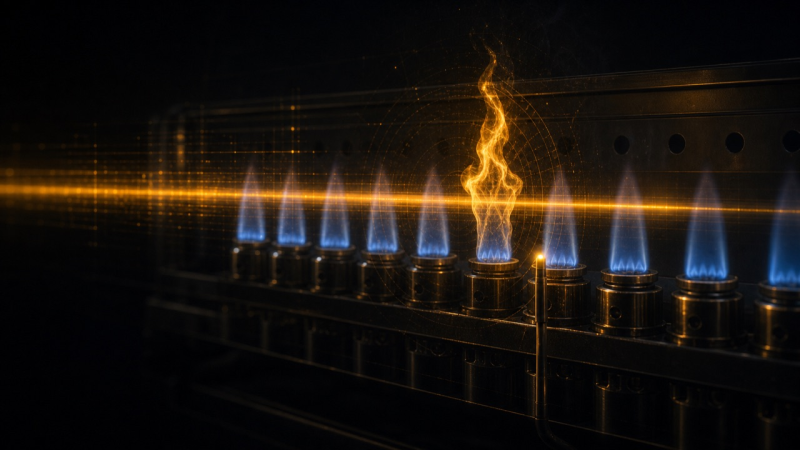
In C18 you learned the furnace sequence of operation as a story: call, inducer, prove, glow, gas, flame, blower. In D23 you learned to put one probe on common and walk a circuit until the voltage disappears. This module welds those two skills into one machine-sized diagnostic method. A gas furnace is the easiest piece of equipment in the trade to diagnose, and that sounds like a joke until you see why: the board runs the same strict sequence every single time, every step must prove itself before the next is allowed, and the furnace stops exactly at the step that failed. The furnace tells you where it hurts. Your whole job is to watch one cycle, note where the sequence stalls, and then prove the fault inside that one step with a meter and a manometer instead of guessing across the whole cabinet. This module gives you the fault ladder, the measurements for each rung, and the two disciplines that keep furnace work honest: never condemn a part without a number, and never, under any circumstance, bypass a safety to make heat.
Short Version
Watch one complete heat cycle and note where the sequence stalls. The stall point names the fault family: no response means control power, inducer runs forever means the pressure switch circuit, igniter never glows means ignition hardware, lights-then-drops means flame sensing, runs-then-stops means limit or airflow, and a tripped rollout means flame escaped where it never should. Then prove the fault with instruments. A hot surface igniter is tested by eye for cracks and by meter for resistance (silicon carbide commonly 40 to 90 ohms cold; open or far out of spec is dead) and for 120 volts during the warm-up window. A flame sensor is judged in DC microamps, typically 1 to 6 uA in flame; clean it with fine abrasive and retest before condemning anything. An open pressure switch is almost never a bad switch: it is the inducer, the vent, the condensate path, or the hose failing to deliver the draft the switch is rated to prove, which you verify with a manometer teed into the hose. Limit trips are airflow symptoms (failure pattern 3) until proven otherwise, and rollout trips mean the flame path is compromised: find the cause, never just reset. Combustion analysis puts chemistry numbers on the fire: roughly 6 to 9 percent O2 on an 80 percent furnace, CO air-free under 100 ppm, and stack temperature that matches the category. Heat exchanger condemnation requires evidence: a scoped crack, a flame that disturbs when the blower starts, or a combustion signature that shifts at blower start, documented with photos and readings. Gas pressures anchor everything: natural gas 3.5 in WC manifold on 5 to 7 inlet, LP 9 to 11 manifold on 11 to 13 inlet.
Key Values
Ignition and flame sensing
| Value | Number |
|---|---|
| Silicon carbide HSI cold resistance | Commonly 40 to 90 ohms; verify against the part spec |
| Silicon nitride HSI cold resistance | Lower and design-specific, often roughly 10 to 50 ohms; always check the spec |
| HSI condemnation | Open circuit (OL), visible crack, or resistance far outside the part spec |
| HSI supply voltage during warm-up | Line voltage (usually 120 VAC) at the igniter plug during the warm-up window |
| Flame signal, healthy | Typically 1 to 6 DC microamps (some boards read up to 10) |
| Flame signal, trouble | Below about 1 uA most boards drop the valve; exact dropout varies by manufacturer |
| Flame proving window | 4 to 7 seconds after the gas valve opens (recall C18) |
Pressure switch and draft
| Value | Number |
|---|---|
| Pressure switch type | Normally open, closes on proven negative draft |
| Switch rating | Printed on the switch body, e.g. -0.60 in WC: it closes when draft exceeds that number |
| Test method | Manometer teed into the switch hose, read actual draft against the printed rating |
| Healthy margin | Measured draft should comfortably exceed the switch rating, not hover at it |
Combustion analysis targets, natural gas (verify against the unit's literature)
| Reading | Target |
|---|---|
| O2, 80 percent induced draft furnace | About 6 to 9 percent |
| O2, power burner equipment | About 3 to 6 percent |
| CO air-free | Under 100 ppm is a well-tuned appliance |
| CO air-free, action level | 100 to 400 ppm: find and fix the cause before you leave |
| CO air-free, fail level | Above 400 ppm: appliance off, do not return it to service as-is |
| Stack temperature, Category I (80 percent) | Roughly 275 to 500 F |
| Stack temperature, Category IV (90 plus) | Roughly 100 to 140 F |
Gas pressures (inches of water column, recall C18)
| Measurement | Natural gas | LP |
|---|---|---|
| Inlet (supply to gas valve) | 5 to 7 in WC | 11 to 13 in WC |
| Manifold (valve outlet, burners firing) | 3.5 in WC | 9 to 11 in WC |
Field Checklist
Furnace no-heat call, pocket version.
- Ask the customer what it does: nothing, clicks, starts then stops, blows cold. The symptom narrows the ladder before you open a door
- Photograph the data plate, the board's flash code, and as-found condition before touching anything
- Check the board's diagnostic LED and decode it against the legend on the door
- Watch one complete cycle and note exactly which step the sequence stalls on
- Stall at start: verify 24 V control power and R to W, hopscotch the safety chain (D23 method)
- Inducer runs, nothing follows: tee a manometer into the pressure switch hose, read draft against the switch rating, then inspect inducer, hose, vent, and condensate path
- Igniter never glows: check for line voltage at the plug during the warm-up window, then ohm the igniter cold and inspect for cracks
- Lights then drops out: measure flame signal in series, clean the rod with fine abrasive, retest, record both numbers
- Runs then trips limit: filter, blower, registers, temperature rise, static pressure. Treat it as airflow until proven otherwise
- Rollout tripped: stop. Inspect the flame path, heat exchanger, and vent before any reset
- Verify inlet and manifold pressure with a manometer, burners firing
- Run combustion analysis when the job calls for it: HX concerns, gas adjustments, CO complaints, conversions
- After any repair: full uninterrupted cycle, flame signal recorded, temperature rise in range, CO checked, all panels on
Full Breakdown
The sequence is the ladder
Recall the C18 spine: call, inducer, prove, glow, gas, flame, blower. Every step is a proof, and the board will not advance past a proof that fails. That design choice, made to keep fires inside heat exchangers, hands you a free diagnostic tool: the furnace always stops at the failing step, so the stall point sorts every furnace fault into a small family before you have touched a meter.
Run the ladder this way. Initiate a call for heat, then stand there and watch the whole attempt with your eyes and ears. Where does it die?
Nothing happens at all. No inducer, no click, no LED activity. This is not a furnace problem yet, it is a control power problem: transformer, fuse, door switch, float switch on the condensate line, thermostat, or the W signal itself. This is pure D23 territory: probe on common, walk the 24 volt circuit until the voltage disappears.
Inducer never starts, but the board is alive. The board wanted to run the inducer and could not, or refused to start because it found a safety in the wrong state. Remember from C18 that the board checks for the pressure switch being open before the inducer runs; a switch stuck closed halts everything immediately, and so does an open limit or rollout. Read the flash code, then hopscotch the safety chain.
Inducer runs and runs and nothing follows. The single most common stall on the ladder. The board is waiting for the pressure switch to close and it never does. This is the pressure switch family, and as you will see below, it is almost never the switch.
Igniter never glows. Draft proved, but no orange glow in the warm-up window. Ignition hardware family: the igniter, its plug and harness, or the board's igniter output.
Igniter glows, gas valve never opens, or opens with no light-off. Gas delivery family: valve power, gas supply, valve itself, or (on light-off failures) gas pressure and orifice problems.
Lights, burns a few seconds, drops out, retries. The signature of the flame sensing family. The fire is real but the proof of fire is failing.
Runs fine, then shuts down mid-cycle and restarts later. Limit family, which means airflow family, which is failure pattern 3 from D25 wearing a furnace jacket.
Rollout tripped. Not a rung on the ladder, a red flag over the whole machine. Flame escaped the burner box. Everything stops until you know why.
Memorize the mapping, not as trivia but as the first sixty seconds of every furnace call. The customer's description alone ("it clicks and blows cold air," "it starts then quits," "it runs a while then stops") often tells you the family before you arrive.
Ignition failures: glow, spark, and pilot
Modern furnaces light one of three ways, and C18 gave you the family history. Diagnosis differs by type.
Hot surface igniters are the overwhelming majority and the most failure-prone part on the furnace, because they are a brittle ceramic element thermally shocked to over 2,000 F on every cycle. Test in three layers:
First, eyes. Kill power, pull the igniter, and inspect under good light. Look for cracks, blisters, white burn spots, or a separated tip. A cracked igniter can read fine on a meter and still fail hot, because the crack opens as the element expands. Handle it by the body only; skin oil on the element creates hot spots that crack it (recall C18).
Second, ohms. Meter on resistance, across the igniter plug. A silicon carbide element commonly reads 40 to 90 ohms cold; many popular parts sit around 40 to 60. Silicon nitride elements run lower and vary more by design, often roughly 10 to 50 ohms, so check the spec for the part in your hand instead of memorizing one number. What you are really screening for is the two clear verdicts: OL means open, dead, done; a reading wildly outside the part spec means a failing element even if it still glows. A reading in range plus a clean visual means the element is probably good, and your attention moves upstream.
Third, volts under command. If the igniter checks out but never glows, the question becomes whether it is being fed. Meter on AC volts at the igniter plug, run the sequence, and watch for line voltage (usually 120 VAC) during the warm-up window. Voltage present with no glow condemns the igniter despite its cold readings. No voltage means the board's igniter output or the harness, and you are back to D23 input-output logic: inputs good and output dead means the board.
Some shops also amp-clamp the igniter circuit as a health check; a current draw far below the part's published spec marks a dying element. Treat the published spec as the reference, since draw varies by family and voltage.
Direct spark ignition replaces the glowing element with a spark electrode snapping at the burner. Diagnosis is mostly eyes and ears: a healthy spark is a sharp, regular, blue-white snap across the gap. No spark means the igniter lead, the electrode (cracked ceramic insulator grounding the spark out), or the board's spark generator. Weak, orange, irregular spark usually means a leaking insulator or a corroded gap. Respect the circuit: spark generators produce several thousand volts, so never hold the lead bare-handed to test for spark.
Intermittent pilot systems spark a pilot first, prove it, and only then open the main valve. The diagnostic split is clean: pilot never lights means spark or pilot gas delivery (a plugged pilot orifice is classic); pilot lights but main gas never comes means the pilot proving circuit. You will meet these mostly on older equipment and some water heaters, and the ladder logic transfers unchanged.
Flame sensing: the microamp truth
Here is the C18 recall, one paragraph, and then we go to work. Flame rectification works because a flame is full of ionized particles and can conduct electricity. The board puts an AC voltage on the sensor rod; current flows from the rod, through the flame, to the grounded burner. Because the grounded burner is enormously larger than the rod, current flows far more easily in one direction than the other, so the flame turns AC into a small pulsing DC current. DC microamps mean real flame on a grounded burner, and nothing else (a shorted rod, a wet board) produces that DC signature, which is why the trade trusts it.
The classic flame sensing failure is the furnace that lights, burns for two to five seconds, and drops out, then retries and eventually locks out. The fire is real; the proof is failing. The board never saw enough microamps inside the proving window, so it closed the valve, exactly as designed.
Measure before you touch. Put your meter in DC microamps, in series with the sensor: disconnect the sensor lead, meter between the lead and the rod terminal, run the furnace. A healthy signal is typically 1 to 6 uA, with some boards happy up to 10. Most boards start dropping the valve somewhere below about 1 uA, and the exact dropout varies by manufacturer, which is why the number you write down matters more than a memorized threshold: 4.2 uA is healthy, 0.8 uA on a board that wants 1.5 is your fault, found.
Then comes the discipline that separates techs from parts changers: clean and retest. The usual disease is a thin coating of silica and oxide on the rod, baked on by hundreds of cycles, insulating the rod from the flame. Kill the call, let it cool, polish the rod gently with a fine abrasive pad or emery cloth (never a coarse file, which scars the rod so oxide builds back faster, recall the C18 warning), wipe it clean, reassemble, and measure again. A rod that read 0.7 uA dirty and 4.5 uA clean is fixed, and both numbers go in the ticket as proof. A rod that reads low even when clean sends you to the rest of the circuit, because rectification needs every link: a solid ground path through the burner (rusty burners and floating grounds read exactly like a bad sensor), a cracked porcelain insulator leaking signal to ground, correct line polarity on boards that care (hot and neutral reversed at the service switch can kill flame sensing on many boards), and honest flame contact with the rod, which manifold pressure problems and misaligned burners can deny.
One more pattern: a furnace that proves flame fine when clean but drops out only at the end of long cycles, or only on windy days, is telling you the flame itself is moving off the rod. Think drafty burner box, vent termination effects, or gas pressure sagging under load, not sensor.
Pressure switches: prove the draft, not the part
The pressure switch has one job: refuse to close until the inducer pulls the draft that proves the vent path works. So when the inducer runs forever and the sequence never advances, the open switch is reporting a fact about the draft, and the single most expensive habit in furnace work is hearing that report and replacing the messenger.
Say it plainly: an open pressure switch almost never means a bad pressure switch. It means the draft the switch is rated to prove is not arriving. The actual fault lives in the inducer (weak motor, cracked or rubbing wheel), the vent (blocked flue, bird nest at the termination, crushed or disconnected pipe), the condensate path on a 90 percent furnace (a plugged trap backs water into the collector box and the switch hose, recall C18, and half of winter lockouts on condensing furnaces are water problems wearing a pressure switch costume), or the humble hose itself (cracked, kinked, split, or full of water).
Prove it with a manometer instead of an opinion. Every pressure switch has its make point printed on the body, for example -0.60 in WC, meaning it closes when the negative draft exceeds 0.60 inches of water column. Tee your manometer into the hose between the inducer tap and the switch, run the call, and read the actual draft the inducer delivers. Now the diagnosis is arithmetic. Draft of -1.10 in WC against a -0.60 switch that stays open: the draft is there and the switch refuses to see it, so the switch really is bad, and you have earned the right to say so. Draft of -0.45 against a -0.60 switch: the switch is doing its job perfectly and your fault is upstream in the inducer, vent, or condensate path. Draft that starts strong and decays as the heat exchanger warms points at a partial vent blockage. While you are teed in, you can also watch the break point by interrupting the call: a switch that chatters near its rating marks a system living on the edge of its draft margin, often the first symptom of a slowly plugging condensate trap or a vent filling with debris.
Two bench checks complete the picture. With the system off, the switch should read open across its electrical terminals; a switch reading closed with no draft is stuck, and the board was right to refuse to start. And a gentle mouth-pull on a clean tube connected to the switch port (never blow; pressure can rupture the diaphragm) should click it closed, confirming the mechanism moves.
Limit trips: the furnace is shouting "airflow"
The high limit opens when the air around the heat exchanger gets too hot, and the board responds by closing the gas valve while running the blower to cool things down. The furnace then cools, the limit recloses, and the cycle repeats: burn, trip, cool, burn. Customers describe it as "it works for a while, then blows cold air."
Here is the diagnostic posture: a tripping limit is a symptom, and the disease is almost always airflow. This is failure pattern 3 from D25, ignored airflow, showing up in heating clothes. The heat exchanger is making heat at full rate, and not enough air is carrying it away, so the temperature at the limit climbs until it trips. Run the D25 playbook before you even think about the limit itself: filter, blower wheel and motor, registers closed by the customer, crushed flex duct, undersized returns, a matched A-coil packed with summer dirt sitting right in the airstream. Confirm with the C18 instrument: temperature rise. Supply minus return above the data plate range is airflow starvation, measured.
The other, rarer cause is overfiring: a manifold pressure set too high or wrong orifices making more heat than the design airflow can carry. That is why the manometer comes out on repeat limit calls even when the filter is filthy, because two problems love to travel together.
Two hard rules. First, a limit that trips repeatedly is cooking the heat exchanger toward cracking, so a "it still makes heat, mostly" furnace is not okay to leave. Second, never bypass a limit, ever, not to test, not for ten minutes, not because the part is on order. The momentary, stand-right-there, meter-in-hand jumper test from C18 is the only exception, and it ends before you step away.
Rollout switches are a different animal entirely. A rollout trip means flame physically left the burner box, and the switch is usually manual reset specifically so a human has to come look. Flame rolls out when the exhaust path through the heat exchanger is blocked or failing: plugged exchanger passages, a blocked flue, a collapsed baffle, or a cracked exchanger disturbing the draft. Resetting a rollout without finding the cause re-arms a furnace that has already demonstrated fire outside its containment, and the second event may not trip a switch. Treat every rollout trip as a flame-path investigation: inspect the exchanger, check the vent end to end, and run combustion analysis before that furnace earns its way back into service.
Venting faults by category
Recall the C18 categories: Category I is the 80 percent furnace, negative pressure, hot buoyant exhaust up metal B-vent; Category IV is the 90 plus condensing furnace, positive pressure, cool acidic exhaust through plastic pipe sloped back to the furnace. Each category fails in its own ways, and the pressure switch is usually the part that tattles.
Category I faults are blockage and slope. Bird nests and debris at the roof termination, a disconnected or crushed section in the attic, rust scale collecting at the base of the vent, or a vent run that lost its upward slope when somebody stored boxes on it. Hot exhaust needs a continuous uphill path; any sag collects condensation and corrosion. Walk the vent end to end with a flashlight, every time, because no reading from the furnace replaces two minutes of looking.
Category IV faults are water and slope. The exhaust is pushed, not buoyant, so the pipe itself rarely fails to flow, but the condensate the furnace makes by design has to drain back through the vent and the secondary heat exchanger to the trap. A vent sloped away from the furnace pools water in the pipe until the inducer is pushing exhaust through a puddle: the symptom is a gurgling inducer and a pressure switch that drops out mid-cycle. The trap itself plugs with sediment and algae; the drain line sags and clogs; and in Phoenix attics the furnace drain often ties into the same line as the AC coil, so a summer algae clog surfaces as a winter furnace lockout. On any 90 percent no-heat: pull the trap, flush it, confirm flow, then diagnose whatever is left.
Termination problems hit both categories: snow is not our problem in Phoenix, but stucco crews, new roofs, added patio covers, and nesting wildlife all rearrange terminations. Intake and exhaust terminations on direct vent units must keep their listed separation; a remodel that moved them too close recirculates exhaust into the intake and shows up as drifting combustion numbers and nuisance lockouts.
Combustion analysis: numbers on the fire
Your eyes can read a flame and C18 taught you how, but a flame can look decent and still make carbon monoxide. The combustion analyzer is the instrument that puts chemistry on the fire, and in the diagnostics track you are expected to drive one.
The analyzer pulls a sample from the flue and reads four things that matter to you. O2 is the oxygen left over after combustion: too little means the fire is running rich and flirting with CO production; too much means excess air is rushing through, cooling the flame and dragging efficiency down. CO is the raw carbon monoxide count in the sample. CO air-free is that same CO mathematically corrected as if there were no excess air diluting the sample, which lets you compare appliances honestly; a heavily diluted flue can hide a dangerous burner behind a low raw number, and the air-free correction takes the disguise off. Stack temperature is the exhaust temperature, which tells you whether heat is going into the house or up the flue, and whether the appliance is behaving like its category.
Targets for natural gas, always checked against the manufacturer's literature: O2 around 6 to 9 percent on an 80 percent induced draft furnace (power burner equipment runs tighter, about 3 to 6). CO air-free under 100 ppm marks a well-tuned appliance. Between 100 and 400 ppm you find and fix the cause before you leave: dirty burners, flame impingement, overfiring, starved combustion air. Above 400 ppm air-free, the appliance comes off line and does not return to service until the cause is corrected, full stop; 400 ppm air-free is the design certification ceiling, and a furnace above it is failing its own birth certificate. Stack temperature should match the category: roughly 275 to 500 F on a Category I 80 percent furnace, and roughly 100 to 140 F on a Category IV condensing unit. A Category IV furnace stacking hot is not condensing, which means its secondary exchanger is fouled or its airflow is wrong; a Category I furnace stacking cold is condensing in a metal vent built to stay dry.
Probe placement matters: sample in the flue before any draft hood or dilution point, per the analyzer's instructions, and let the readings stabilize for a few minutes of steady fire before you trust them.
When is analysis mandatory rather than nice? Any heat exchanger concern. After any gas pressure adjustment or orifice change. On any fuel conversion. On any complaint of headaches, flu-like symptoms in winter, or a CO alarm event. And on equipment whose venting you altered or repaired.
Heat exchanger evaluation: evidence or silence
No call in heating carries more weight than "your heat exchanger is cracked." Said truthfully, it takes a dangerous appliance out of service. Said carelessly, it frightens a family with a false alarm. The trade has a long, ugly history of heat exchanger condemnations that were really sales calls, and the cure is a simple rule: condemnation requires evidence you can show, or it does not happen.
Honest evidence comes three ways, and strong calls usually stack two of them.
Visual, with a scope. Pull the burners or access covers as the manufacturer allows and inspect the exchanger cells with an inspection camera and strong light. You are looking for cracks (commonly at stress points: bends, weld seams, around dimples), rusted-through sections, and on condensing units a fouled or leaking secondary. A photo of a crack is the gold standard of evidence, attached to the ticket. Know the limits: you can never see every surface of every cell, so a clean partial inspection does not prove a healthy exchanger; it just fails to prove a bad one.
Flame disturbance at blower start. The blower side of the exchanger runs at duct pressure; the fire side runs at draft. A breach connects them. Watch the burner flames closely at the moment the blower kicks in: flames that wave, lift, distort, or change character right at blower start are responding to air pushed through a breach. A sealed exchanger shows no change at all. This test costs nothing and catches breaches a scope cannot reach.
Combustion signature shift at blower start. The analyzer version of the same physics. Sample steadily, then watch the readings as the blower starts: O2 that jumps or CO that climbs when the blower energizes points at house air entering the fire side. Stable numbers across blower start are a clean signature.
If the evidence stacks, the protocol is non-negotiable. Gas off to the appliance. Explain what you found with the photos and readings, not adjectives. Red-tag per local utility and code practice, document everything in the ticket, and make sure the home has working CO alarms before you leave. What happens next (repair, replacement, options) is a conversation for the process in D30; your job in this module is the evidence and the safety.
And the ambient side: any time CO is suspected, meter the living space, not just the flue. A reading meaningfully above outdoor background in living space deserves investigation; common field practice treats roughly 9 ppm ambient as the investigate line and anything in the tens of ppm as evacuate, ventilate, and shut the appliance down, then find the source. People out and air moving comes before diagnosis, every time.
Gas pressure: the quiet variable under everything
Half the faults in this module can be caused or mimicked by wrong gas pressure, which is why the manometer earns a tap on almost every furnace diagnostic. The anchors, from C18 and repeated until permanent: natural gas wants 5 to 7 in WC at the inlet and 3.5 in WC at the manifold; LP wants 11 to 13 inlet and 9 to 11 manifold, always verified with burners firing, and on two-stage equipment verified at each stage.
Now connect pressure to the ladder. Low manifold pressure makes weak, lazy flames that may not reach the flame sensor: a flame sensing dropout with a perfectly clean rod. Low inlet pressure that sags when the water heater joins in makes a furnace that drops out only sometimes, the classic intermittent that fools techs who only test the furnace alone (recall the C18 habit: read inlet with other appliances firing). High manifold pressure overfires the furnace: limit trips, stressed exchanger, soot, CO climbing on the analyzer. Wrong orifices after a sloppy fuel conversion produce all of the above at once. When a furnace presents two unrelated symptoms at the same time, suspect the one variable that touches everything, and put a manometer on it.
Common Mistakes
Replacing the pressure switch because it is open. The switch is the messenger. Tee in a manometer and read the draft against the rating printed on the switch. Most of the time the inducer, vent, hose, or condensate path is the fault, and the new switch you installed will be exactly as open as the old one.
Condemning a flame sensor without cleaning and retesting. The fix is usually a thirty-second polish with fine abrasive. Measure dirty, clean, measure again, record both numbers. A tech who swaps sensors on every dropout call is buying parts to avoid carrying a meter.
Skipping the visual on a hot surface igniter. A cracked igniter can ohm fine cold and fail hot. Eyes first, then meter, then voltage under command. And touching the element bare-handed installs the next failure.
Treating limit trips as a limit problem. The limit is the smoke alarm, not the fire. Run the airflow workup (failure pattern 3) and check for overfiring with a manometer before any thought of the switch itself. Replacing a limit that keeps tripping treats the furnace's shout as a nuisance instead of a message.
Resetting a rollout and walking away. A rollout trip is recorded evidence that flame left the burner box. Find the blockage, the exchanger fault, or the vent problem first. Reset-and-run hands the customer a furnace that has already failed containment once.
Bypassing any safety to "get them heat tonight." A jumpered pressure switch or limit converts a no-heat call into a CO incident with your name on the ticket. The only jumper that ever exists is momentary, with you standing at the furnace, meter in hand, and it leaves with you. There is no cold-night exception.
Condemning a heat exchanger on vibes. Age, rust streaks on the cabinet, or "they usually crack about now" is not evidence. Scope it, watch the flames at blower start, watch the analyzer at blower start, and show what you found. If you cannot show evidence, you keep diagnosing or you say the inspection was inconclusive, in those words.
Trusting raw CO instead of CO air-free. A diluted flue sample can read comfortingly low while the burner runs filthy. The air-free number is the honest one; know which one your analyzer is displaying.
Forgetting the furnace is allowed to be smart. A board that refuses to start because the pressure switch is stuck closed, or locks out after three failed trials, is not broken; it is reporting. Read the flash code, respect the lockout logic, and ask what the board is protecting against before clearing anything.
Diagnosing the whole furnace at once. The ladder exists so you never have to. One observed cycle, one stall point, one fault family, then instruments inside that family. The tech who starts swapping parts before watching a full cycle is diagnosing a machine he has not met yet.
DARREL FIELD WISDOM (to be recorded)
- Walk me through the first cold week in Phoenix. What is the fault you see over and over when every furnace in town wakes up the same morning after nine months asleep, and what do you check before you ever hit first fire on an attic unit?
- Tell me about a CO situation that stuck with you. What did the readings show, how did the family react, and what did it change about how you handle red-tag conversations now?
- What is your personal flame sensor routine? When do you clean versus replace, what do you clean with, and what numbers do you want to see before and after on the meter?
- Describe a pressure switch call where the switch was innocent and the real fault was hiding somewhere unusual. How far upstream did you have to go to find it?
- What is your evidence bar for condemning a heat exchanger, and tell me about a time you refused to condemn one that another company had already sentenced. How do you explain "inconclusive" to a worried homeowner?