
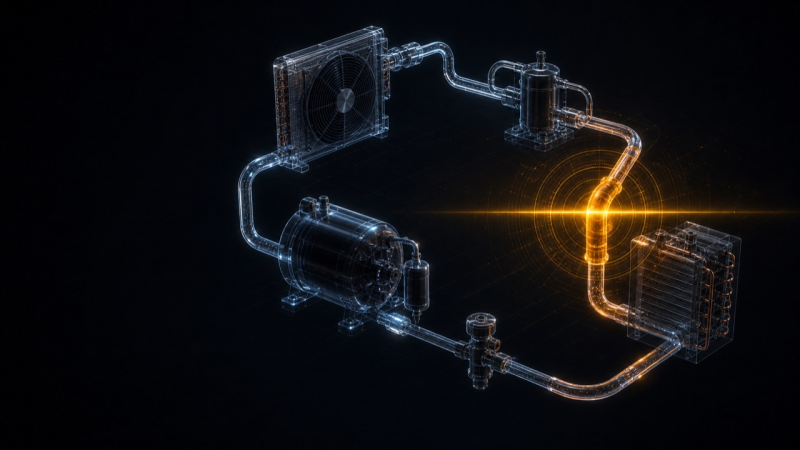
A four-year-old system in Litchfield Park has been "low on freon" three summers in a row. Three different companies have each added refrigerant, each time the cooling improved for a few weeks, and each time the complaint came back. Nobody ever asked the obvious question: a refrigerant circuit is sealed, so where is the refrigerant going, and was it ever actually low in the first place? When you finally connect a full set of probes, the suction pressure is low, exactly as advertised. But the superheat is 4 degrees, the subcooling is dead normal, and the supply air is trickling out of half-crushed flex duct behind a return grille packed with dog hair. The system was never low on charge. It was low on airflow, and three companies in a row read one gauge, said the most expensive sentence in residential HVAC, and overcharged it. This module teaches you the discrimination skill those three techs never learned: reading every measurement together as one picture, and naming the fault from the numbers before you ever open the system.
Short Version
Low suction pressure has three common causes that all look identical on a single gauge: true low charge, a TXV underfeeding the evaporator, and low airflow across the indoor coil. Two more numbers split them apart. Low charge reads low suction with HIGH superheat and LOW subcooling, because the whole system is starved. TXV underfeed reads low suction with high superheat but NORMAL to HIGH subcooling, because the refrigerant exists, it is just dammed up in the condenser behind a valve that will not pass it. Low airflow reads low suction with LOW superheat and normal subcooling, because the coil is full of liquid that cannot find enough heat to boil. You confirm the call with the rest of the picture: head pressure, line temperatures, the 18 to 22 F indoor temperature split, compressor amps, and outdoor ambient. The same full-picture method catches overcharge (high head, high subcooling, high amps), non-condensables (head pressure above what the PT chart predicts for the ambient), and restrictions (a temperature drop or frost across the liquid line drier). NIST lab data backs the method: subcooling is the single most sensitive indicator of undercharge, falling almost 88 percent at 30 percent undercharge, while performance barely flinches until faults get severe. The numbers move long before the comfort complaint does, if you take all of them.
Key Values
| Value | Target or Threshold | Notes |
|---|---|---|
| Superheat, TXV system | 10 F plus or minus 5 | From F6. The TXV actively holds this, so superheat is a poor charge indicator on a TXV |
| Subcooling, TXV system | 8 to 12 F | Nameplate overrides. On a TXV this is your charge dipstick |
| Indoor temperature split | 18 to 22 F return to supply | Below 18 F: weak cooling. Above 22 F: suspect low airflow. Measured dry bulb, steady state |
| Condensing temperature over ambient | 15 to 30 F above outdoor temperature | Convert head pressure to saturation temperature and compare to ambient. Above this band with high subcooling: suspect overcharge or non-condensables |
| Liquid line drier temperature drop | More than about 3 F across the drier | A measurable drop means a restriction is forming. Frost or sweat on the drier in summer is a severe restriction |
| Airflow target | 400 CFM per ton nominal, 350 in dry climates | From C12. Verify airflow before trusting any refrigerant number |
| NIST: most sensitive undercharge indicator | Subcooling, down 87.7 percent at 30 percent undercharge | TN 1648. Subcooling moves first and hardest as charge leaves |
| NIST: most sensitive overcharge indicator | Compressor discharge temperature | TN 1648, heating mode test. Discharge line is the overcharge early-warning |
| NIST: restriction tolerance | No real performance loss until past about 48 percent restriction | The readings shift long before capacity does |
| NIST: field charge statistics | Over 60 percent of 55,000 surveyed units had incorrect charge | 95 percent failed at least one diagnostic test. Assume nothing, measure everything |
| R-410A PT anchors | 90 psig = 25 F, 102 = 32 F, 108 = 35 F, 118.4 = 40 F, 130 = 45 F, 142 = 50 F | Low side anchors from F5 |
| R-410A PT anchors, high side | 317 psig = 100 F, 340 = 105 F, 365 = 110 F, 390 = 115 F, 445 = 125 F, 475 = 130 F | High side anchors from F5 |
Field Checklist
The seven-readings routine. Take all of them, every refrigerant-side call, before you form an opinion.
- Confirm 10 to 15 minutes of stable runtime, panels on, doors closed. Unstable systems lie, exactly as you learned in F6.
- Check the filter, the return, the registers, and the blower before connecting anything. Airflow problems poison every refrigerant reading downstream of them.
- Connect pressure probes to suction and liquid ports. Clamp temperature probes per F6 craft: clean bare copper, suction probe insulated, liquid probe shaded.
- Record reading 1 and 2: suction pressure and head pressure. Convert both to saturation temperatures with your PT app.
- Record reading 3: superheat (suction line temperature minus suction saturation temperature).
- Record reading 4: subcooling (liquid saturation temperature minus liquid line temperature).
- Record reading 5: line temperatures themselves, including the drier inlet and outlet if a restriction is on the table. Touch test first, probe to confirm.
- Record reading 6: indoor temperature split, return dry bulb minus supply dry bulb, probes in the airstream, away from radiant line of sight to the coil.
- Record reading 7: compressor amps, compared against rated load amps from the nameplate, the same way you metered in D23.
- Record the context number: outdoor ambient temperature. Every other number is judged against it.
- Name the fault from the full picture BEFORE attaching a charging cylinder, recovering refrigerant, or condemning a part. Say it out loud and check that every reading agrees.
- If any single reading disagrees with the other six, suspect that measurement first. One outlier is usually a probe problem, not a system problem.
Full Breakdown
From two numbers to seven
In F6 you learned the two-number language: superheat tells you how well the evaporator is fed, subcooling tells you how much liquid is stacked in the condenser, and the pairing of high and low between them points toward charge, restriction, overfeed, or overcharge. In D22 you learned to diagnose the system before the part. This module fuses those two ideas into the full refrigerant-circuit picture: seven readings, taken together, interpreted as one story.
Why seven instead of two? Because the two-number table from F6 narrows the field but cannot always finish the job, and because the most common diagnostic failure in this trade is not a tech who cannot do the math. It is a tech who stops measuring too early. The NIST field survey behind Technical Note 1648 found incorrect charge on over 60 percent of more than 55,000 units checked, and 95 percent of residential systems failed at least one basic diagnostic test. Most of that wrong charge was put there by technicians, one gauge reading at a time.
The seven readings are: suction pressure, head pressure, superheat, subcooling, line temperatures, indoor temperature split, and compressor amps. Outdoor ambient is the eighth value, the context everything else is judged against. None of these is new to you. Suction and head pressure and the PT conversion are F5. Superheat and subcooling are F6. Temperature split and CFM per ton are C12. Amp measurement is F7 and D23. What is new is the discipline of taking all of them before forming an opinion, and the pattern library that turns seven numbers into one fault name.
The healthy baseline
You cannot recognize a sick system until you can recite a healthy one. Here is a 3-ton R-410A TXV split system on a 100 F Phoenix afternoon, 78 F return air, clean filter, clean coils, correct charge:
| Reading | Value | Interpretation |
|---|---|---|
| Suction pressure | 130 psig | 45 F saturation: the coil is boiling at 45 F |
| Head pressure | 390 psig | 115 F saturation: condensing 15 F over the 100 F ambient |
| Suction line temperature | 55 F | 55 minus 45 = 10 F superheat, on target |
| Liquid line temperature | 105 F | 115 minus 105 = 10 F subcooling, on target |
| Temperature split | 78 F return, 58 F supply | 20 F, inside the 18 to 22 F window |
| Compressor amps | About 75 percent of RLA | Working, not straining |
| Outdoor ambient | 100 F | The context all the high-side numbers are judged against |
Memorize the shape of this picture. Coil boiling in the 40s, condensing 15 to 30 F over ambient, superheat near 10, subcooling near 10, split near 20, amps comfortably under rated load amps. Every fault in this module is a recognizable distortion of this shape.
The misdiagnosis triangle
Now the failure pattern this module exists to kill. Three completely different faults all produce the same first symptom: low suction pressure.
True low charge pulls suction down because there is not enough refrigerant to fill the circuit. A TXV underfeeding pulls suction down because the valve is throttling flow into the evaporator: stuck nearly closed, lost its bulb charge, screen plugged, or misadjusted, exactly the failure modes you met in C11. Low airflow pulls suction down because the coil cannot absorb heat from air that is not moving, and a coil absorbing less heat boils less refrigerant, which drops the pressure.
A tech reading only the low-side gauge sees the identical symptom in all three cases and reaches for a cylinder. In the first case the system improves and the leak keeps leaking. In the second and third cases the tech just overcharged a system that had a full charge, the real fault is still there, and the customer pays twice: once for refrigerant they did not need, and again when the overcharge creates its own problems.
The triangle breaks open with two numbers you already own:
Superheat splits airflow away from the other two. Both low charge and TXV underfeed STARVE the evaporator: the last droplet boils off early, a long stretch of coil warms vapor, superheat runs HIGH. Low airflow does the opposite: the coil is full of liquid refrigerant that cannot find enough warm air to boil it, the boil-off point pushes to the very end of the coil, superheat runs LOW. High superheat says starved coil. Low superheat with low suction says the coil is fed fine and the heat is missing, which means airflow.
Subcooling splits low charge away from TXV underfeed. When charge is genuinely low, there is less refrigerant everywhere, including the liquid stack in the condenser, so subcooling runs LOW: the dipstick reads empty. When a TXV underfeeds, the refrigerant still exists, it just cannot get through the valve, so it dams up behind it in the condenser. The liquid stack grows. Subcooling reads NORMAL to HIGH. Same suction pressure, same superheat, opposite subcooling.
That is the entire discrimination in two sentences: superheat low means airflow, superheat high means starved, and then subcooling low means the refrigerant is missing while subcooling normal or high means the refrigerant is trapped.
Worked example 1: true low charge
Same 3-ton system, same 100 F day, after a slow leak has bled the charge down:
| Reading | Value | Interpretation |
|---|---|---|
| Suction pressure | 102 psig | 32 F saturation, well below the healthy 45 F coil |
| Head pressure | 340 psig | 105 F condensing, only 5 F over ambient: the condenser has too little refrigerant to work with |
| Suction line temperature | 58 F | 58 minus 32 = 26 F superheat: badly starved coil |
| Liquid line temperature | 102 F | 105 minus 102 = 3 F subcooling: the liquid stack is nearly gone |
| Temperature split | 78 F return, 66 F supply | 12 F, weak: the starved coil is moving less heat |
| Compressor amps | Well below normal | Thin, low-density vapor means less mass pumped per stroke and less work done |
| Outdoor ambient | 100 F | Context |
Everything in the picture says "not enough refrigerant anywhere": both pressures low, coil starved, condenser stack empty, split weak, amps light. This is the one case where adding refrigerant is the right move, and even here it is only half the call. A refrigerant circuit is sealed. Low charge is not a fault, it is a symptom of a leak, and roughly 80 percent of residential leaks live in the indoor A-coil. Confirming low charge buys you a leak search, not a gas-and-go. Leak detection method is D27; the charging procedure itself, weigh-in and subcooling method on a TXV, is C17 and you already own it.
Worked example 2: TXV underfeeding
Same system, same day, full charge, but the TXV powerhead has lost part of its bulb charge and the valve is pinched nearly closed:
| Reading | Value | Interpretation |
|---|---|---|
| Suction pressure | 102 psig | 32 F saturation, identical to the low charge case. The single gauge cannot tell these apart |
| Head pressure | 365 psig | 110 F condensing, 10 F over ambient, normal-ish and a touch stout for the load |
| Suction line temperature | 56 F | 56 minus 32 = 24 F superheat: starved coil, same as low charge |
| Liquid line temperature | 96 F | 110 minus 96 = 14 F subcooling: NORMAL to HIGH. There is the difference |
| Temperature split | 78 F return, 65 F supply | 13 F, weak, same as low charge |
| Compressor amps | Below normal | Low suction density again |
| Outdoor ambient | 100 F | Context |
Five of the seven readings are nearly identical to the low charge picture. Subcooling is the discriminator: 3 F in the low charge case, 14 F here. The refrigerant is present and stacking up in the condenser because the valve downstream will not pass it. Add refrigerant to this system and subcooling climbs while the suction barely moves, because the bottleneck was never the charge.
One discipline before you condemn the valve, straight from C11 and worth repeating for life: the TXV is the most misdiagnosed component in the refrigerant circuit. Before the valve takes the blame, verify airflow is real, verify the drier has no temperature drop across it, verify subcooling is genuinely normal or high, and check the bulb: mounted tight, correct position on the suction line, insulated. A bulb that has slipped loose or lost insulation reads warm air and misdrives the valve. Only when the supporting checks clear does "underfeeding TXV" become the verdict.
Worked example 3: low airflow
Same system, same day, correct charge, healthy TXV, but the filter is collapsed and matted and the blower wheel is wearing a fur coat:
| Reading | Value | Interpretation |
|---|---|---|
| Suction pressure | 108 psig | 35 F saturation: low again, third fault with the same first symptom |
| Head pressure | 340 psig | 105 F condensing, low side of normal: less heat absorbed indoors means less heat to reject outdoors |
| Suction line temperature | 39 F | 39 minus 35 = 4 F superheat: LOW. The coil is full of liquid that cannot find heat |
| Liquid line temperature | 95 F | 105 minus 95 = 10 F subcooling: normal. The charge is fine |
| Temperature split | 78 F return, 52 F supply | 26 F, ABOVE the window, and the air barely moves at the registers |
| Compressor amps | Below normal | Low suction density, again |
| Outdoor ambient | 100 F | Context |
Low superheat is the headline. A starving fault cannot produce 4 F of superheat; only a coil flooded with unboiled liquid can. The temperature split tells the same story from the air side: the trickle of air crossing the coil spends so long on the fins it leaves colder than it should, so the split reads high even though the total cooling delivered to the house is weak. That is the signature of restricted airflow: a split out of the window on the HIGH side with feeble flow at the registers. Let it run long enough and the 35 F coil ices over, airflow collapses toward zero, and the split measurement itself falls apart into meaningless weak numbers at the registers, which is why a fresh reading on a thawed coil beats any reading taken through ice.
Two more warnings live in this picture. First, 4 F superheat is brushing the floodback threshold from F6: liquid may be approaching the compressor, so this fault damages compressors, not just comfort. Second, this is the case where adding refrigerant does active harm. More charge pushes superheat toward zero and feeds the ice. The fix costs a filter and a blower cleaning. The misdiagnosis costs a compressor. Deep airflow diagnosis, static pressure and duct evaluation, is D25; today your job is to recognize the pattern and stop the cylinder.
The discrimination table
The whole triangle on one card:
| Reading | Low charge | TXV underfeed | Low airflow |
|---|---|---|---|
| Suction pressure | Low | Low | Low |
| Head pressure | Low | Normal to high | Low side of normal |
| Superheat | HIGH | HIGH | LOW |
| Subcooling | LOW | NORMAL to HIGH | Normal |
| Temperature split | Weak (below 18 F) | Weak (below 18 F) | High (above 22 F) with weak airflow, collapsing if the coil ices |
| Compressor amps | Low | Low | Low |
| First confirming check | Both pressures low, dipstick empty | Bulb, drier, screen before condemning | Filter, blower, coil, registers |
Read it as a two-question flowchart. Question one: superheat high or low? Low superheat sends you to the air side. High superheat means starved, go to question two. Question two: subcooling low or normal-to-high? Low means the refrigerant left the building. Normal-to-high means it is dammed up behind the metering device or a restriction.
Overcharge
Overcharge is the triangle's shadow: it is what the misdiagnosing tech leaves behind. On a TXV system the signature is high subcooling first and worst, because every extra ounce parks as liquid in the condenser and the dipstick reads it directly. The stacked liquid eats condensing surface, so head pressure climbs, and the compressor working against that head pulls high amps. Superheat stays near 10 because the TXV keeps absorbing the change, which is exactly why charging to superheat on a TXV fools techs, as C17 drilled. On our 100 F day an overcharged version of our system reads: suction near 130 psig, head 445 psig (125 F condensing, 25 over ambient), subcooling 22 F, superheat 10 F, amps pushing rated load. On a fixed orifice system overcharge also floods the coil and drops superheat, since a fixed hole passes more refrigerant as pressure rises.
NIST's lab work adds a useful nuance: overcharge barely hurts measured capacity, and the COP penalty stays under 5 percent until past 18 percent overcharge. The damage is not in this month's electric bill. It is high head stressing the compressor, liquid creeping toward floodback on fixed orifice systems, and the next tech inheriting a system whose numbers lie. In the NIST heating-mode testing, compressor discharge temperature was the single most sensitive overcharge indicator, which is why a discharge line reading earns a place in your routine whenever overcharge is on the table.
Non-condensables
Non-condensables means gases in the circuit that never condense at system pressures, almost always air or nitrogen left behind by a sloppy install or repair: no evacuation, a blown decay test, a purge skipped. Air collects at the top of the condenser, takes up condensing surface, and adds its own partial pressure on top of the refrigerant's.
The signature: HIGH head pressure, HIGH apparent subcooling, and the giveaway, a head pressure ABOVE what the PT relationship predicts for the conditions. A healthy condenser runs 15 to 30 F over ambient. When your head pressure converts to a condensing temperature 40 or 50 F over ambient and the coil is clean and the charge history is suspicious, air is the suspect.
The clean confirmation is the off-cycle standing pressure check. Shut the system down and let it equalize and soak long enough to reach ambient temperature, ideally overnight. With everything at one known temperature, the PT relationship makes an exact prediction: an R-410A system soaked at a 100 F morning ambient must stand at about 317 psig. If it stands at 360, refrigerant alone cannot explain it; something in there is adding pressure that does not follow the curve, and that something is air. The fix is recover, evacuate to the 500 micron IB standard with a decay test, weigh the charge back in, all C15 and C17 skill you already hold. The lesson for your own installs writes itself: every non-condensables call you ever run was caused by somebody skipping the vacuum you were taught to pull.
Distinguishing non-condensables from overcharge, since both read high head and high subcooling: overcharge follows the PT curve, non-condensables sits above it. The standing pressure check separates them every time, and the system history usually votes too: overcharge follows a parade of top-offs, non-condensables follows an opened system.
Restrictions
A restriction is a partial blockage in the liquid side of the circuit: a filter drier loading up with debris, a kinked liquid line, a crushed spot, a plugged TXV inlet screen. The circuit behaves like low charge downstream of the blockage and like overcharge upstream of it: low suction, high superheat, starved coil, weak split, while subcooling reads normal to high because liquid dams up in the condenser. If that signature sounds identical to TXV underfeed, good, you are paying attention: an underfeeding TXV IS a restriction, located at the valve. The skill is finding WHERE the dam is.
The restriction's address is written in temperature. Refrigerant crossing a restriction drops in pressure, and dropping pressure drops saturation temperature, so the pipe gets measurably colder immediately downstream of the blockage. Across a healthy filter drier the temperature drop is under about 3 F, barely detectable by hand. A restricted drier shows a clear drop, and a severely restricted one drops the refrigerant so far that the drier or the line downstream sweats or wears a frost ring in summer air: a 100 F drier inlet and an 80 F outlet is a drier screaming for replacement. Severe restriction can pull the low side hard enough that suction lands at 90 psig, a 25 F coil, below freezing, and ice joins the party.
NIST's restriction finding belongs in your judgment file: in the lab, a liquid line restriction caused essentially no performance penalty until it exceeded about 48 percent. Translation: the readings shift long before the customer feels anything, so a small but real drier temperature drop found on a maintenance call is an early warning worth documenting and watching, not an emergency, while a frosting drier is well past the cliff edge.
What NIST measured: which numbers move first
NIST Technical Note 1648 put a residential R-410A TXV heat pump in a lab and imposed each fault one at a time, at measured severities, to see exactly which readings respond to which faults and how hard. It is heating-mode data on one unit, so the heating-side numbers themselves belong to D29, but the ranking of indicators is the durable lesson and it confirms everything above:
- Subcooling is the undercharge alarm. At 30 percent undercharge, subcooling at the outdoor service valve had fallen 87.7 percent, by far the most sensitive indicator in the study. Meanwhile the performance cost stayed small until the fault got deep: roughly 25 percent of the charge can be missing before COP drops even 5 percent. The dipstick reads empty long before the engine seizes. A tech who tracks subcooling on every maintenance visit catches leaks a full season before the no-cool call.
- Discharge temperature is the overcharge alarm. Capacity barely moves with overcharge, but the compressor discharge temperature responds early. When the gauges hint at overcharge, the discharge line probe casts the deciding vote.
- Airflow faults are expensive and quiet. Low indoor airflow cost about 53 watts of capacity per percent of restriction, second only to internal compressor leakage among the faults studied, and a 30 percent airflow restriction cost about 10 percent COP. The customer pays that penalty every hour of every day with no dramatic symptom, which is exactly why ignored airflow is one of this trade's signature failure patterns.
- Restrictions hide until they are severe. Essentially no performance penalty until past 48 percent restriction. Readings first, performance later.
The meta-lesson of the whole study: faults announce themselves in the measurements long before they announce themselves in comfort or in the power bill. A tech who takes seven readings is reading next season's failures today.
The five-minute read
Put it all together and a refrigerant-circuit diagnosis stops being a fishing trip and becomes a fixed routine. Airflow eyeball first: filter, return, registers, blower. Probes on, system stable, seven readings down on paper. Convert pressures to saturation temperatures. Ask the two triangle questions: superheat high or low, subcooling low or stacked. Check head against ambient: inside the 15 to 30 F band, above it, or below it. Check the split against 18 to 22. Check amps against the nameplate. Name the fault out loud, then check that all seven readings agree with the name. If one disagrees, re-measure that one before you re-think the other six. Only then does a cylinder, a recovery machine, or a parts quote enter the conversation.
Common Mistakes
- Reading one gauge and reaching for the cylinder. Low suction pressure has three common causes and a single gauge cannot tell them apart. Two of the three get worse when you add refrigerant. Seven readings, two questions, then a verdict. Anything less is guessing with a customer's compressor.
- Trusting superheat as a charge indicator on a TXV system. The valve actively holds superheat near setpoint, absorbing charge changes until it runs out of range. Subcooling is the charge dipstick on a TXV, exactly as C17 taught. Chasing a superheat target on a TXV system ends in overcharge every time.
- Condemning the TXV without the supporting checks. The TXV is the most misdiagnosed part in the circuit. Airflow verified, drier temperature drop checked, bulb mount and insulation inspected, subcooling confirmed normal-to-high. A loose bulb costs nothing to fix; a valve swap costs hours, and on the wrong diagnosis it fixes nothing.
- Judging head pressure as a raw number instead of against ambient. 445 psig is alarming in April and unremarkable at 118 F in July. Convert to condensing temperature, subtract ambient, judge the difference: 15 to 30 F over is the healthy band. Raw-number head pressure judgment misses non-condensables in winter and condemns healthy systems in summer.
- Gas-and-go on a confirmed low charge. The circuit is sealed. Charge that left went through a hole, and 80 percent of those holes are in the A-coil. Topping off without a leak search sells the customer the same pound of refrigerant every season and burns your callback rate. Confirmed low charge starts the D27 leak protocol, it does not end the call.
- Measuring through the fault. Readings taken on an iced coil, a just-started system, or sun-soaked probes are fiction. Thaw the ice with the blower running, give the system its 10 to 15 stable minutes, apply the F6 measurement craft, then trust the numbers.
DARREL FIELD WISDOM (to be recorded)
- Tell the story of a unit another company had gassed up two or three times before Island Breeze got the call. What did the seven readings actually show, what was the real fault, and what did you say to the homeowner about the refrigerant they had been paying for?
- Walk through how you read a system in the first five minutes on site, before the gauges are even out of the bag. What do your eyes, ears, and hands check, and in what order, and how often has that first five minutes already named the fault?
- What is your personal tell for an airflow problem masquerading as low charge? Is there a specific reading, sound, or register-feel that makes you stop trusting the suction pressure?
- Describe the worst overcharged system you have ever opened up: how far off was it, how many top-offs got it there, and what did it take to bring it back to a weighed-in, documented charge?
- When have you caught a restriction by touch, a cold drier or a sweating liquid line, before the gauges confirmed it? What made you put your hand there in the first place?