
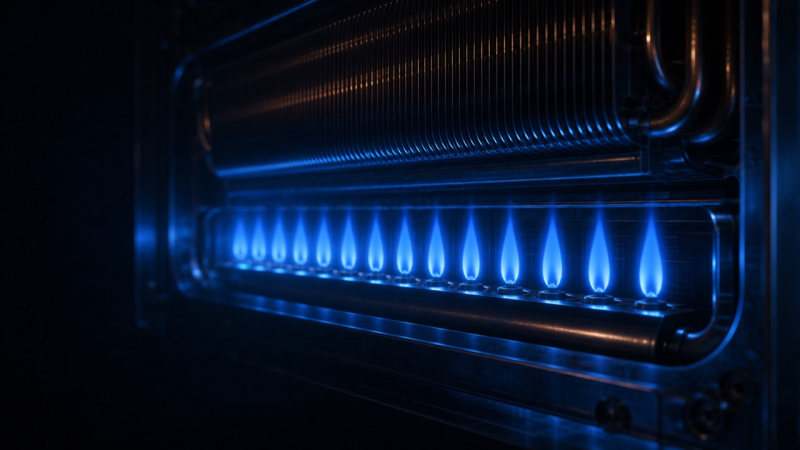
In F9 you walked a gas furnace heat call as a wiring exercise: W gets 24 volts, the board checks its safeties, the inducer runs, and things happen in order. Now we open the cabinet and learn what all of those things actually are and why the order is a matter of life and death. A gas furnace is the only machine you will service that burns fuel inside someone's home, a few feet from where their kids sleep. Run correctly, it is one of the safest appliances ever built, because three generations of engineers have stacked safety on top of safety inside it. Run incorrectly, it can produce an invisible, odorless gas that kills people in their sleep. This module teaches you how the fire works, how the machine controls it, and what every safety device is standing guard against. By the end, you will be able to stand at a running furnace and narrate everything it does, in order, with reasons.
Short Version
Combustion needs three things: fuel, oxygen, and ignition. Complete combustion of natural gas makes carbon dioxide and water vapor. Incomplete combustion makes carbon monoxide (CO), an odorless gas that kills, which is why everything about a furnace is built to guarantee complete combustion and carry the exhaust safely outside. The gas valve regulates fuel to a manifold pressure of 3.5 inches of water column on natural gas, or 9 to 11 on LP, verified with a manometer at the valve's outlet tap. The furnace runs a strict sequence: call for heat, inducer starts, pressure switch proves draft, igniter glows, gas valve opens, flame sensor proves fire within seconds, and only after the heat exchanger warms does the blower start. A safety chain watches every step: the pressure switch proves venting, the flame sensor proves fire, the limit switch catches overheating, and the rollout switches catch flame escaping the burner box. An 80 percent furnace (Category I) vents hot buoyant exhaust up a metal B-vent; a 90 percent plus condensing furnace (Category IV) squeezes so much heat out that water condenses in a secondary heat exchanger, so it vents cool exhaust through plastic pipe and drains acidic condensate through a trap. Your job on every furnace is to verify the sequence, verify the pressures, and respect the chain.
Key Values
Combustion and fuel
| Value | Number |
|---|---|
| Combustion triangle | Fuel + oxygen + ignition (heat). Remove any one and fire stops |
| Air composition | About 21 percent oxygen, 79 percent nitrogen and other gases. Only the oxygen burns |
| Complete combustion products | Carbon dioxide (CO2) and water vapor (H2O) |
| Incomplete combustion product | Carbon monoxide (CO): colorless, odorless, lethal |
| Natural gas heating value | About 1,000 BTU per cubic foot |
| LP (propane) heating value | About 2,500 BTU per cubic foot |
| Natural gas vs air | Lighter than air, rises and disperses |
| LP vs air | Heavier than air, pools in low spots, crawl spaces, and floor cavities |
Gas pressures (inches of water column)
| Measurement | Natural gas | LP |
|---|---|---|
| Inlet (supply to gas valve) | 5 to 7 in WC | 11 to 13 in WC |
| Manifold (valve outlet to burners) | 3.5 in WC | 9 to 11 in WC |
One PSI equals 27.7 inches of water column. Gas pressures are so small that PSI gauges cannot read them, which is why we use water column and a manometer.
Typical sequence timings (always confirm against the unit's literature)
| Event | Typical timing |
|---|---|
| Inducer pre-purge before ignition | 15 to 30 seconds |
| Hot surface igniter warm-up | 15 to 30 seconds |
| Flame proving window after gas valve opens | 4 to 7 seconds |
| Blower-on delay after flame proves | 30 to 60 seconds |
| Blower-off delay after gas valve closes | 90 to 180 seconds |
| Ignition retries before lockout | Usually 3 tries, then soft lockout (often auto-resets in 1 hour) |
Venting categories
| Category | Vent pressure | Condensing? | Typical furnace | Vent material |
|---|---|---|---|---|
| I | Negative (buoyant draft) | No | 80 percent AFUE | Type B double-wall metal vent |
| II | Negative | Yes | Rare | Corrosion-resistant per listing |
| III | Positive | No | Some sidewall power-vented units | Listed stainless steel special vent |
| IV | Positive | Yes | 90 percent plus condensing | PVC, CPVC, or polypropylene per the manufacturer's listing |
Field Checklist
Furnace operation check, pocket version. Run it on every furnace call.
- Photograph the data plate, the wiring diagram, and the as-found condition before touching anything
- Confirm fuel type (natural gas or LP) from the data plate and any conversion kit label on the valve
- Inspect heat exchanger, burners, and burner compartment for rust, soot, scorching, or misaligned flames
- Watch one complete sequence of operation start to finish and confirm every step lands in order
- Verify flames: steady blue, seated on the burners, no yellow tipping, no lifting, no rollout
- Connect a manometer at the gas valve outlet tap and verify manifold pressure (NG 3.5 in WC, LP 9 to 11 in WC) with the burners firing
- Verify inlet pressure is in range while the furnace and other gas appliances fire
- Identify every safety in the chain: pressure switch, limit, rollouts, flame sensor. Confirm none are bypassed or jumpered
- On 90 percent units: inspect the condensate trap, drain slope, and termination; confirm the trap is wet and flowing
- Check the vent: correct material for the category, sloped and supported, no corrosion, no disconnections, proper termination clearances
- Confirm temperature rise is inside the data plate range
- Leak-check every gas connection you disturbed with bubble solution or an electronic leak detector
Full Breakdown
Fire, on purpose: the combustion triangle
Combustion is rapid oxidation: fuel chemically combining with oxygen fast enough to release heat and light. Three ingredients are required, and the trade calls them the combustion triangle: fuel, oxygen, and ignition (a heat source to start the reaction). Remove any leg of the triangle and the fire goes out. Every control on a furnace is really just a machine for managing those three legs: the gas valve manages fuel, the inducer and burner design manage oxygen, and the igniter manages ignition.
The air the burner breathes is only about 21 percent oxygen. The other 79 percent is mostly nitrogen, which does not burn; it just rides along through the flame and out the vent, soaking up heat on the way. That matters later, because the more efficiently a furnace transfers heat out of that exhaust stream, the cooler and wetter the exhaust gets, and that single fact splits the furnace world into 80 percent and 90 percent machines.
Complete vs incomplete combustion, and why CO is the killer
Natural gas is mostly methane: carbon and hydrogen. In complete combustion, every carbon atom finds two oxygen atoms and becomes carbon dioxide (CO2), and every hydrogen pair finds an oxygen and becomes water vapor (H2O). Those products are the same things you exhale. A properly burning furnace exhausts CO2, water vapor, and a lot of leftover nitrogen.
Incomplete combustion happens when the flame runs short of oxygen, gets chilled before the reaction finishes (a flame hitting cold metal, called flame impingement), or burns in a disturbed, unstable way. A carbon atom that only finds one oxygen atom becomes carbon monoxide, CO. Read the names carefully, because they sound alike and could not be more different. CO2 is normal exhaust. CO is poison.
CO is the killer product because of how it behaves. It is colorless and odorless, so nobody senses it. It binds to the hemoglobin in blood a couple hundred times more readily than oxygen does, so it quietly crowds oxygen out of the body. Low doses cause headaches and flu-like symptoms that get misdiagnosed all winter. High doses kill people in their sleep. The reason a furnace has a sealed heat exchanger, a proven vent, and a stack of safeties is to guarantee two things at once: the fire gets all the air it needs to burn completely, and whatever the fire exhausts goes outside, never into the airstream that heats the home.
You can read a flame with your eyes. A healthy natural gas flame is steady and blue with a well-defined inner cone, seated on the burner. A lazy, yellow-tipped flame is starving for primary air and making soot and CO. A noisy flame lifting off the burner has too much air or too much gas velocity. Flame color is your first instrument, but it is not your last: a flame can look decent and still produce CO. The instrument that puts numbers on combustion quality is the combustion analyzer, and using it is its own discipline that you will learn in D28. In this module, your job is to make the machine operate the way it was designed; the analyzer later proves it chemically.
Natural gas vs LP: same triangle, different animal
Most Phoenix homes burn natural gas delivered by the utility. Rural and outlying properties may burn LP (liquefied petroleum, usually propane) from a tank on the property. The two fuels run through the same furnace hardware but behave very differently, and confusing them damages equipment and people.
Natural gas carries about 1,000 BTU per cubic foot and is lighter than air. A natural gas leak rises and disperses. LP carries about 2,500 BTU per cubic foot, two and a half times the energy density, and is heavier than air. An LP leak sinks. It pools in floor cavities, crawl spaces, and low corners of a room, and it waits there for an ignition source. That is why LP leak procedures are stricter and why you never assume a space is clear just because you cannot smell anything at face height.
Because LP packs more energy per cubic foot, an LP furnace must meter less fuel through smaller orifices at higher pressure. Converting a furnace between fuels is never just turning a screw: it requires the manufacturer's conversion kit, which changes the burner orifices and the gas valve regulator spring (or a conversion setting on the valve), and the kit's label must go on the unit. A natural gas furnace connected to LP without conversion is massively overfired: huge flames, an overheating heat exchanger, soot, and CO. An LP-converted furnace fed natural gas is starved and will not heat. The data plate and the conversion label tell you what the unit expects. Believe them, then verify with a manometer.
Inches of water column, and the manometer
Gas pressure in residential equipment is tiny. The manifold pressure on a natural gas furnace is 3.5 inches of water column, which is about an eighth of a PSI. One full PSI equals 27.7 inches of water column. Pressures that small need their own unit and their own instrument.
The original instrument is the U-tube manometer: a clear U-shaped tube holding water. Apply gas pressure to one side and the water falls on that side and rises on the other. The reading is the total difference between the two columns, so you add the rise on one side to the fall on the other: water down 1.75 and up 1.75 reads 3.5 inches WC. Modern digital manometers do the same job with a pressure sensor and a display, and they are what you will carry, but the unit of measure still honors the column of water.
Where you connect matters. The gas valve has two pressure taps, usually 1/8 inch NPT plugs. The inlet tap reads supply pressure arriving at the valve: 5 to 7 inches WC on natural gas, 11 to 13 on LP. The outlet (manifold) tap reads what the valve's regulator is delivering to the burners: 3.5 inches WC natural gas, 9 to 11 LP. The procedure, in full, with gas off at the valve: remove the tap plug, thread in the barbed adapter, connect the manometer hose, zero the meter, restore gas, fire the furnace, and read the pressure with the burners actually burning. A manifold reading only counts under fire, because the regulator is doing its job against flowing gas. When you are done: gas off, adapter out, plug back in, and leak-check the plug with bubble solution. A pressure tap left loose is a gas leak you installed.
Inlet pressure deserves one more habit: read it with the furnace firing and, when possible, with the home's other gas appliances also running. A supply line problem or an overloaded regulator shows up as inlet pressure that sags under full demand, and a furnace can look fine alone yet starve when the water heater joins in.
Clocking the meter: proving the firing rate
The data plate states the furnace's input in BTU per hour. The gas meter outside can prove whether the furnace is actually burning that much. The technique is called clocking the meter, and it works because the meter's test dial measures real gas flow.
Turn off every other gas appliance so the furnace is the only load. Fire the furnace at full rate. Find the test dial on the meter (commonly a half, one, or two cubic foot dial) and time one full revolution with your phone. The math: 3,600 seconds per hour divided by the seconds you timed, multiplied by the dial size in cubic feet, gives cubic feet per hour. Multiply by roughly 1,000 BTU per cubic foot for natural gas and you have the actual input. Example: a one cubic foot dial turns once in 45 seconds. 3,600 divided by 45 is 80 cubic feet per hour, which is about 80,000 BTU per hour. If the plate says 80,000, the furnace is firing on rate. If the clock says 95,000, it is overfired and something is wrong with manifold pressure or orifice sizing. Clocking only works on utility natural gas meters; LP tanks have no flow dial, so on LP the manometer and the orifice chart carry the whole job.
The gas valve: anatomy and family history
The gas valve is the fuel leg of the triangle, and it is really three devices in one body. First, it is a shutoff: one or more solenoid-operated valves that are closed whenever they are not powered. Modern valves are redundant, meaning two valve seats in series inside one body, so a single stuck seat cannot let gas flow. Second, it is a regulator: a spring-loaded diaphragm that takes whatever inlet pressure arrives and delivers a steady manifold pressure to the burners. The adjustment screw under the cap on the valve sets that regulator, and it is the screw you fine-tune while watching your manometer. Third, it is a control interface: terminals where the board energizes the valve with 24 volts at the right moment, and taps where you measure.
How furnaces light that gas has evolved through three generations, and you will meet all three in the field:
Standing pilot is the history. A small pilot flame burned continuously, and a thermocouple sitting in that flame generated a few millivolts to hold the pilot valve open. Thermostat calls heat, main valve opens, pilot lights the burners. Simple and wasteful: the pilot burned gas all summer. You will still see standing pilots on old furnaces and on water heaters, so know the logic, but no modern furnace uses one.
Intermittent pilot ignition was the bridge. No standing flame; on a call for heat, a spark lights a pilot, a sensor proves the pilot, and only then does the main valve open. The pilot exists only during the heating cycle.
Direct ignition is the present. No pilot at all: the igniter lights the main burners directly. The igniter is usually a hot surface igniter (HSI), a silicon carbide or silicon nitride element that glows orange-hot at over 2,000 degrees F when the board powers it. Some units use direct spark instead. HSIs are brittle: handle them by the body, never the element, and never touch the element with bare fingers, because skin oil creates hot spots that crack it.
Beyond ignition style, valves differ in staging. A single-stage valve is on or off at one rate. A two-stage valve has a low-fire setting (commonly around 60 to 70 percent of full rate) and a high-fire setting, each with its own regulator adjustment and its own spec in the literature, so a two-stage furnace can loaf on low for mild days and ramp up when low cannot keep pace. A modulating valve varies the rate continuously in small steps, paired with a variable-speed blower, holding temperature almost flat. On two-stage and modulating equipment, manifold pressure must be verified at each stage per the data plate, not just once.
Furnace anatomy: the cast of characters
Open a furnace and you find five main players plus the safety chain. Learn them by sight and by job.
The burners receive gas from the manifold (the pipe with the orifices feeding each burner) and mix it with primary air on the way in. Their job is a stable, blue, well-shaped flame aimed into the heat exchanger.
The heat exchanger is the whole point of the machine and its most important boundary. It is a set of sealed metal passages: fire and exhaust on the inside, the home's air on the outside. Heat conducts through the metal; the two airstreams never mix. A cracked or rusted-through heat exchanger breaks that boundary, which is exactly how combustion gases reach living spaces. Condensing furnaces add a secondary heat exchanger downstream of the primary, which wrings out so much remaining heat that the water vapor in the exhaust condenses to liquid. More on that below.
The inducer (induced draft motor) is the small fan that pulls combustion air through the burners and heat exchanger and pushes exhaust out the vent. It runs before, during, and briefly after every burn. It is the oxygen leg of the triangle and the reason modern furnaces do not depend on the weather for draft.
The blower is the big indoor fan that moves the home's air across the outside of the heat exchanger and through the ducts. Burner-side air and blower-side air are two separate worlds, and keeping them separate is the heat exchanger's job for as long as the furnace lives.
The control board (integrated furnace control, IFC) is the brain you met in F9. It reads the thermostat, sequences every component, watches every safety, counts flame-proving microamps, and flashes diagnostic codes when something fails. Remember the F9 rule: a board is judged by its inputs and outputs. Inputs good and outputs dead means the board; an input missing means the problem is upstream and the board is innocent.
80 vs 90 percent: AFUE, condensing, and the venting categories
AFUE (Annual Fuel Utilization Efficiency) is the percentage of the fuel's energy that ends up as heat in the home over a season. An 80 percent furnace sends roughly 20 percent of the fuel's energy up the vent as hot exhaust. A 95 percent furnace sends 5 percent. Where did the other 15 points go? Into the secondary heat exchanger.
Here is the physics that creates the two furnace families. Burning hydrogen makes water vapor, and water vapor carries a large amount of latent heat (recall from your foundations: latent heat is the heat of a phase change, not a temperature change). An 80 percent furnace keeps its exhaust hot enough that the vapor stays vapor all the way out the vent. A condensing furnace deliberately cools the exhaust below its dew point inside the secondary heat exchanger, capturing that latent heat for the home. The reward is efficiency in the 90s. The price is liquid condensate, which is mildly acidic, and exhaust so cool it has no buoyancy left.
That trade is what the venting categories describe. Two questions sort every furnace: is the vent pressure negative (the exhaust rises on its own buoyancy, with the inducer just assisting) or positive (the inducer pushes exhaust through the pipe)? And is the appliance condensing or not?
Category I is negative pressure, non-condensing: the standard 80 percent furnace. Hot, buoyant exhaust rises through Type B double-wall metal vent, which must slope upward and stay warm enough that condensation never forms inside it.
Category II is negative pressure but condensing: rare in residential work, and you can file it as a footnote.
Category III is positive pressure, non-condensing: some sidewall power-vented appliances. The pipe is pressurized, so it must be a listed, sealed, corrosion-resistant special vent (typically stainless steel), because hot exhaust under pressure will find any gap.
Category IV is positive pressure and condensing: the 90 percent plus furnace. The exhaust is cool enough and the condensate acidic enough that metal vent would corrode, so Category IV vents in plastic: PVC, CPVC, or polypropylene, exactly as the manufacturer's installation instructions list, sloped back toward the furnace so condensate drains to the trap and not into the termination.
Never mix the worlds. An 80 percent furnace vented in PVC will melt and deform the pipe. A 90 percent furnace piped into a metal B-vent will eat it with acidic condensate and leak combustion gases. The category, the material, the slope, the diameter, and the termination clearances all come from the listing and the installation manual, not from what fits.
Combustion air is the other half of venting: the fire has to breathe in before it can breathe out. Many 90 percent furnaces are installed as direct vent (two pipes: one brings outdoor air straight to the sealed burner box, one carries exhaust out), which makes the furnace indifferent to the room it lives in. Single-pipe installations take combustion air from the space, and then the space has to be big enough or openings have to feed it; the classic sizing rule is that a space needs about 50 cubic feet of volume per 1,000 BTU per hour of input to count as unconfined, and anything tighter needs engineered openings per code. An attic with normal eave venting is usually generous, but a furnace sealed into a tight closet or a platform enclosure can starve, and a starving fire makes CO.
The sequence of operation, step by step
This is the heartbeat of the module. You saw this sequence in F9 as rungs on a ladder. Now attach the hardware, the timings, and the reasons. Every step exists to prove something before the next step is allowed.
Step 1: call for heat. The thermostat closes R to W. The board wakes up, and its first act is to check the safety chain: the limit and rollout switches are normally closed, and the board confirms the circuit through them is intact. It also confirms the pressure switch is open, which sounds backwards until you see why in step 3.
Step 2: inducer starts. Before anything else, the inducer motor runs. Air first, always. The inducer establishes airflow through the heat exchanger and vent, sweeping out any gas or fumes left from a previous cycle. This pre-purge typically runs 15 to 30 seconds.
Step 3: the pressure switch proves. The pressure switch is a diaphragm switch, normally open, plumbed by a small hose to the inducer housing. When the inducer pulls real draft, the negative pressure sucks the diaphragm over and closes the switch. That closure is the furnace proving to itself that the inducer is actually moving air through an actually clear vent before any gas is released. And this is why the board checked that the switch was open at the start: a pressure switch already closed before the inducer runs means a stuck switch or a shorted hose, and the board refuses to start, because a stuck-closed switch could never prove anything again.
Step 4: igniter on. With draft proven, the board powers the hot surface igniter. It glows orange for a 15 to 30 second warm-up until it is well past gas ignition temperature.
Step 5: gas valve opens. The board energizes the valve with 24 volts. Gas flows through the regulator, into the manifold, through the orifices, into the burners, and lights off the glowing igniter. On multi-burner furnaces, flame carries across from burner to burner through crossover ports until all burners are lit.
Step 6: flame sense proves. The board now demands proof of fire, fast. The flame sensor is a simple metal rod sitting in the flame of the last burner in line. The proof works by flame rectification: the board puts an AC voltage on the rod, and a flame full of ionized particles conducts a tiny current from the rod through the flame to the grounded burner. Because the rod and burner are wildly different sizes, the flame passes current better in one direction than the other, turning AC into a small pulsing DC signal, typically a few microamps. DC microamps mean flame, real flame, on a grounded burner. The sensor placement at the last burner is deliberate: flame there proves every burner upstream lit and carried over. If the board does not see those microamps within the proving window, typically 4 to 7 seconds, it slams the gas valve shut, waits, and retries. Usually three failed trials puts the board into lockout, often a soft lockout that auto-resets in an hour. A weak signal from an oxide-coated rod is the single most common furnace no-heat in the field: the burners light, then shut down a few seconds later, over and over.
Step 7: blower on, after a delay. With flame proven, the board waits 30 to 60 seconds while the heat exchanger warms, then starts the blower on heating speed. The delay exists for comfort and physics: blow air across a cold heat exchanger and the registers breathe cold air on the customer; let the exchanger heat first and the first air out is warm.
Steady state. Burners fire, inducer pulls exhaust, blower moves home air, and the board watches the flame signal and the safety chain continuously. This is when you verify temperature rise: supply air temperature minus return air temperature must land inside the range on the data plate.
Shutdown. The thermostat satisfies and opens W. The gas valve closes instantly; fire stops within a second. The inducer keeps running a short post-purge to sweep the last exhaust out of the vent. The blower runs its off-delay, typically 90 to 180 seconds, harvesting the heat still stored in the exchanger metal. Then the furnace is quiet, ready for the next call.
Memorize the spine of it: call, inducer, prove, glow, gas, flame, blower. Every furnace you ever touch runs some version of that order, and every step is a proof that protects the next.
The safety chain: what each guard protects against
The sequence shows the safeties acting. Step back and see them as a chain, because diagnosing a furnace is largely the art of figuring out which link opened and why. Memorize each device by the disaster it prevents.
The pressure switch (normally open, closes on proven draft) protects against firing without venting. Blocked flue, failed inducer, plugged condensate drowning the inducer housing on a 90, a bird nest at the termination: in every case the switch refuses to close and the furnace refuses to light. A tech who jumpers a pressure switch to "get it running" has authorized the furnace to dump exhaust into the home.
The flame sensor protects against gas without fire. If the valve opens and ignition fails, raw gas is filling the heat exchanger. The proving window is seconds long precisely so the valve closes before a dangerous volume accumulates and lights all at once.
The limit switch (normally closed, opens on excess temperature) sits near the heat exchanger and protects against overheating, which usually traces back to starved airflow: a clogged filter, a dead blower, closed registers, or a crushed duct. An open limit kills the gas valve while the blower runs to cool things down. A limit that trips repeatedly is a symptom; the disease is almost always airflow, and a heat exchanger that overheats cycle after cycle is being worked toward cracking.
The rollout switches (normally closed, usually manual reset) sit above and around the burner openings and protect against flame escaping the burner box. Flame rolls out when exhaust cannot get through the heat exchanger, and the classic cause is a blocked or failing exchanger or blocked flue passages. This is the one safety you never simply reset and walk away from: a tripped rollout is evidence that flame was burning where flame must never burn, and the cause must be found before the furnace runs again. That is also why rollouts are manual reset; the engineers wanted a human to come look.
The chain has a logic to it. The pressure switch proves the path out. The flame sensor proves the fire is real and contained. The limit proves the heat is being carried away. The rollouts prove the fire stayed inside. Between them, the three failure modes of a fuel-burning appliance (bad venting, unburned gas, escaped fire) are each covered twice: once by design and once by a watchdog. Never bypass a watchdog, and treat any safety found jumpered by a previous hand as an emergency to correct and document.
Condensate on 90 percent furnaces
A condensing furnace is also a small water machine: a typical winter day produces multiple quarts of condensate, and all of it is mildly acidic (around pH 3 to 5, in the vinegar range) because exhaust gases dissolve into it. The furnace collects condensate from the secondary heat exchanger and the vent, routes it through a built-in collector box, and sends it out through a trap.
The trap is not optional plumbing. The collector box on a Category IV furnace is under the inducer's pressure, and the trap's water seal is what lets liquid drain out while preventing flue gases from blowing out the drain line. A dry, cracked, or missing trap is a combustion gas leak into the space. From the trap, the drain line must slope continuously downhill to an approved termination, and many jurisdictions and manufacturers call for a condensate neutralizer (a cartridge of limestone media) before the drain, especially when draining to metal plumbing, since years of acidic water will eat copper and steel.
Plugged condensate is also a no-heat call in disguise. When the trap or drain blocks, water backs up into the collector box and the pressure switch hose, the pressure switch cannot hold, and the furnace short-cycles or locks out. On any 90 percent no-heat, check the condensate path early: pull the trap, flush it, confirm flow. In attic installations the drain also needs freeze protection thinking in cold climates; in Phoenix attics the bigger enemies are sag in long horizontal runs, algae growth, and drain lines that share the AC coil's condensate path, where a summer clog quietly becomes a winter furnace failure.
Common Mistakes
Confusing CO and CO2. One is normal exhaust, the other is the killer. Sloppy language becomes sloppy thinking. Say carbon monoxide in full when you mean the poison, and never tell a customer their furnace "makes a little CO" when you mean CO2.
Setting manifold pressure by ear or by flame. The flame looks fine is not a measurement. The regulator gets set to 3.5 inches WC (NG) or the LP spec with a manometer attached and burners firing, period. An overfired furnace soots, overheats, and cracks exchangers; an underfired one short-cycles and disappoints. Both look okay from three feet away.
Jumpering a safety to get heat on. Jumping a pressure switch or limit to keep a furnace running converts a no-heat call into a CO incident with your name on the invoice. Safeties are diagnostic information: figure out why the link opened. The only acceptable jumper is a momentary test you stand next to, meter in hand, and remove before you leave the panel.
Resetting a rollout switch without finding the cause. A rollout trip means flame escaped the burner box. Reset-and-run leaves a furnace that has already demonstrated a venting or heat exchanger problem in service at full fire. Find the blockage or the failure first.
Cleaning a flame sensor with coarse abrasive, or condemning it outright. The fix for a weak flame signal is usually a gentle polish with fine abrasive pad or emery cloth and a clean rag, not a new part, and definitely not a coarse file that scars the rod so oxide builds faster. Also confirm the other half of the circuit: flame rectification needs a solid ground path through the burner, so a rusty burner or a floating ground reads exactly like a bad sensor.
Leaving the pressure tap loose. The last act of every manometer connection is reinstalling the tap plug and bubble-testing it. A 1/8 inch open tap is a continuous gas leak inside the cabinet, built by the last tech who stood there. Be better than the last tech.
Wrong vent logic on the wrong category. PVC on an 80 percent furnace melts. B-vent on a condensing furnace corrodes through. Vent material, diameter, slope, and termination come from the manufacturer's listing for that category, not from the truck stock.
Ignoring the condensate system on a 90. Half of winter lockouts on condensing furnaces are water problems wearing a pressure switch costume. Trap first, then diagnose.
Skipping temperature rise. The data plate prints a rise range because it is the heat exchanger's report card. A rise above the range means weak airflow cooking the exchanger; below the range means overblowing and cold supply air. It takes two thermometer readings, and it catches problems no visual inspection will.