
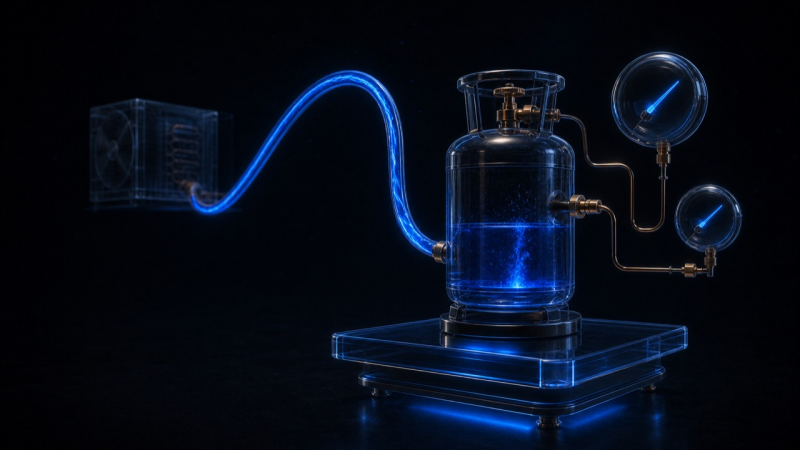
A tech finishes a coil swap in Litchfield Park. The system held a 500 micron vacuum with a clean decay test, exactly like C15 taught. Now comes the question that separates professionals from parts-changers: how much refrigerant goes back in? One tech connects a cylinder, cracks the valve, and "charges by feel" until the suction line sweats and the air feels cold. The other tech reads the data plate, measures the line set, does forty seconds of arithmetic, sets a scale, and puts in the exact charge the engineers specified, then proves it with subcooling before driving away. The first tech's system will limp through spring and fail in July, and nobody will know why. The second tech's system will run at rated capacity for fifteen years. Charging is not pouring refrigerant until things feel right. It is hitting a number, and this module teaches you all three ways to hit it.
Short Version
There are three ways to charge a system, and the situation plus the metering device tells you which one to use. Weigh-in is the gold standard: read the factory charge off the data plate, adjust for the actual line set length (typically 0.6 ounces per extra foot of 3/8 inch liquid line beyond what the nameplate includes), and put exactly that much in on a scale. Weigh-in is required on every new install and after any repair that opened the circuit, and it works at any outdoor temperature. The superheat method is for trimming charge on a running fixed orifice (piston) system: look up the target superheat from indoor wet bulb and outdoor dry bulb, then add or recover until measured superheat matches. The subcooling method is for trimming charge on a running TXV or EEV system: charge to the nameplate subcooling target, or 8 to 12 F if the plate does not give one. Never charge a TXV system to superheat and never charge a piston system to subcooling. Whichever method sets the charge, the other readings still get taken, and the final numbers get documented.
Key Values
| Value | Target or Threshold | Notes |
|---|---|---|
| Line set adjustment, 3/8 in liquid line | 0.6 oz per extra foot, typical for R-410A | The install manual value overrides this. Adjustment is based on liquid line size, not suction |
| Line set length included in nameplate charge | Commonly 15 ft | Printed on the data plate or in the install manual. Never assume, always read it |
| Subcooling charging target, TXV/EEV | 8 to 12 F unless the nameplate says otherwise | Nameplate or install data always wins |
| Superheat charging target, fixed orifice | From the chart: indoor wet bulb plus outdoor dry bulb | A moving target. No single number exists |
| Chart tolerance | Within about 3 F of target | Closer is better. Outside 3 F, keep adjusting |
| Minimum usable chart target | About 5 F superheat | Below 5 F on the chart, do not charge by superheat. Weigh in instead |
| Adjustment increments | 2 to 4 oz at a time on residential systems | Then wait for stability before reading again |
| Stabilization time | 10 to 15 min initial runtime, several minutes after each adjustment | Readings must hold steady before you trust them |
| Evacuation before recharge | 500 microns with a decay test | The C15 standard. No charge goes into a circuit that has not proven tight |
| R-410A PT anchors for charging | 118.4 psig = 40 F, 130 = 45 F, 317 = 100 F, 340 = 105 F, 365 = 110 F, 390 = 115 F, 445 = 125 F, 475 = 130 F | Saturation math from F5 and F6 runs underneath every charging method |
| Condensing temperature over ambient | Roughly 15 to 30 F above outdoor temperature | A 115 F day can legitimately produce head pressure in the 445 to 475 psig range |
Field Checklist
Run this top to bottom on any call where refrigerant is going in or coming out.
- Identify the refrigerant from the nameplate. Match the cylinder to the nameplate. Program the manifold or probes to that refrigerant before connecting anything.
- Identify the metering device: TXV/EEV or fixed orifice. This decides your verification method before you touch a valve.
- Decide the charging method. New install or opened circuit: weigh-in. Trim on a running TXV system: subcooling. Trim on a running piston system: superheat from the chart. Unknown or suspect charge: recover it all and weigh in fresh.
- For weigh-in: read the factory charge and the included line set length off the data plate. Measure or confirm the actual line set length. Compute the adjustment: extra feet times the per-foot value (0.6 oz/ft for 3/8 liquid line unless the manual says otherwise).
- Set the scale on a firm, level surface out of the wind. Place the cylinder, connect and purge hoses, then zero the scale. Zero after connections, not before.
- Charge liquid into the liquid line side with the system off and in vacuum. Stop when the target weight is reached or flow stalls as pressures equalize.
- If charge remains, start the system and throttle the rest in as liquid through the suction side, cracking the manifold valve so the liquid flashes to vapor before the compressor. Never open it wide.
- Run the system 10 to 15 minutes. Verify airflow basics first: filter, registers, blower, roughly 400 CFM per ton, because bad airflow poisons every refrigerant reading.
- Verify with the correct method: subcooling against nameplate (or 8 to 12 F) on a TXV; superheat against the wet bulb/dry bulb chart on a piston.
- If trimming: adjust 2 to 4 oz at a time, wait for readings to stabilize, re-read, repeat. Converge, do not chase.
- Record final superheat, subcooling, both pressures, both line temperatures, outdoor dry bulb, indoor return dry bulb and wet bulb, and the exact ounces added or removed with the refrigerant type.
Full Breakdown
Three methods, one decision
From F6 you know the two numbers that describe a refrigerant circuit's health: superheat, which says how the evaporator is being fed, and subcooling, which says how much liquid is stacked in the condenser. Charging is the act of putting the right mass of refrigerant into the system, and there are exactly three legitimate ways to do it.
Weigh-in means putting in a known weight of refrigerant measured on a scale. You are not interpreting anything. The engineers who designed the system calculated the exact charge it needs, printed it on the data plate, and your job is to deliver that number plus a correction for the line set.
The superheat method means trimming the charge on a running fixed orifice system until measured superheat matches a target from a chart. A fixed orifice, also called a piston, is just a precisely sized hole. It cannot adjust itself, so the charge level directly controls how the evaporator is fed, and superheat becomes your charge gauge.
The subcooling method means trimming the charge on a running TXV or EEV system until measured subcooling matches the nameplate target. The TXV holds superheat at its setpoint by itself, so extra charge shows up as liquid stacked in the condenser, and subcooling becomes your charge gauge, exactly like the dipstick picture from F6.
The decision is two questions. First: is this a new install, or did the circuit get opened, or is the existing charge unknown or suspect? If yes to any, weigh-in. There is no reading you can take on a system that tells you its history, and there is no chart that fixes a mixed or mystery charge. Recover what is there, evacuate per C15, and weigh in fresh. Second question, for trim work on a sealed, running system: what is the metering device? TXV or EEV gets the subcooling method. Fixed orifice gets the superheat method. That is the entire decision tree, and it is on the C17 decision tree visual.
One more rule that overrides everything: the manufacturer's charging instructions on the data plate or in the install manual always win. The methods below are the industry defaults that apply when the plate is silent or generic.
Weigh-in: reading the data plate
Every condensing unit carries a data plate, the metal or foil label with the model number, serial number, electrical specs, and refrigerant information. For charging, you are hunting three things: the refrigerant type, the factory charge, and the line set length that charge includes.
The factory charge is printed in pounds and ounces (for example, 8 lb 12 oz) or sometimes in pounds and decimal fractions or kilograms. That number is the charge for the condensing unit plus a standard length of line set, most commonly 15 feet, and the plate or the install manual says exactly how many feet are included. The matched indoor coil is usually accounted for in that figure when the system is a matched set; the install manual confirms it and lists a correction if the coil is oversized or undersized relative to the match.
If the actual line set is longer than the included length, the system needs more refrigerant, because a longer liquid line holds more liquid. If it is shorter, the system needs less. That correction is the line set adjustment.
The line set adjustment math
The adjustment is driven by the liquid line, not the suction line. Here is why: the liquid line is full of dense liquid refrigerant, while the suction line carries low-density vapor. A foot of 3/8 inch liquid line holds far more refrigerant mass than a foot of 3/4 inch suction line holds, so the liquid line dominates the math and the standard correction factors are quoted per foot of liquid line at a given diameter.
For R-410A in 3/8 inch liquid line, the typical correction is 0.6 ounces per foot. Larger liquid lines hold more (1/2 inch runs roughly 1.2 oz per foot), and the install manual for the specific unit prints the exact factor. When the manual is in hand, use its number. When it is not, 0.6 oz/ft on 3/8 line is the industry default and it is the number this course uses.
The procedure:
- Read the factory charge and included line set length off the plate.
- Measure the actual line set. Walk it, do not guess it. On an attic or roof run, account for the vertical drops on both ends.
- Subtract to find the extra feet.
- Multiply extra feet by the per-foot factor.
- Add the result to the factory charge.
Worked example, the same one on the C17 math visual:
``` Data plate: factory charge 8 lb 12 oz, includes 15 ft of line set Actual line set: 40 ft of 3/8 liquid line
Extra footage: 40 ft - 15 ft = 25 ft Adjustment: 25 ft x 0.6 oz/ft = 15 oz Total charge: 8 lb 12 oz + 15 oz = 8 lb 27 oz = 9 lb 11 oz ```
Watch the ounce carry at the end: 27 ounces is 1 pound 11 ounces, because a pound is 16 ounces, not 10. Adding 12 oz and 15 oz and writing "8 lb 27 oz" on your gauge sheet is fine as an intermediate step, but the number you charge to is 9 lb 11 oz. Botching the 16-ounce carry is one of the most common math errors in the trade.
If the line set is shorter than the included length, the same math runs in reverse and you subtract. A 10 foot line set against a 15 foot allowance on the same unit would be 5 ft x 0.6 oz = 3 oz less, so 8 lb 9 oz total.
Scale technique
A charging scale is a platform scale that reads to half an ounce or finer. The number it gives you is only as good as the setup underneath it.
Surface. Firm and level. A scale rocking on gravel or sitting on a sloped driveway drifts as the cylinder shifts. Put it on a paver, a piece of plywood, or the flattest concrete available.
Wind. Wind pushing on a cylinder and hoses changes the reading by ounces. Shield the scale behind the unit or your body on a windy day, and route hoses so they hang slack, not stretched.
Hose discipline. Connect the cylinder to the manifold, purge the hoses, and THEN zero (tare) the scale. Zeroing means telling the scale that the current weight is the starting point, so everything that leaves the cylinder afterward shows as a negative number you can read directly as ounces delivered. If you zero before connecting and purging, the refrigerant that filled the hoses counts against your charge even though it never entered the system. Once charging starts, do not lean hoses on the cylinder, do not lift the cylinder to shake it, and do not let a hose loop catch on the scale platform. Every touch is a false ounce.
Watch the rate, not just the total. A healthy liquid charge into an evacuated system moves fast at first and slows as pressures equalize. If the scale freezes early, the system and cylinder have equalized and the rest of the charge goes in with the system running, covered next.
Liquid charging a new install or evacuated system
After C15, the circuit sits at a deep vacuum, below 500 microns with a passed decay test. Charging an evacuated system is the cleanest charging you will ever do, because the system is empty and pulling.
Charge liquid, into the liquid line service port, with the system off. Three reasons. First, liquid is dense, so the charge transfers fast. Second, the liquid line port feeds toward the metering device and the evaporator, away from the compressor, so liquid is not landing in the compressor shell. Third, charging liquid keeps the blend composition intact, which the fractionation section below explains.
Getting liquid out of the cylinder depends on the cylinder. A standard R-410A disposable cylinder delivers vapor when upright and liquid when inverted, so you flip it upside down on the scale to charge liquid. Some cylinders, including most A2L cylinders for R-454B and R-32, have an internal dip tube that draws from the bottom, so they deliver liquid sitting upright. The label tells you. Know which one you are holding before you open the valve, because charging vapor when you think you are charging liquid wrecks both your speed and, on a blend with glide, the composition.
With the cylinder set for liquid and the scale zeroed, open the cylinder valve and the manifold high side, and watch the scale. The vacuum pulls liquid in hard. On a typical residential charge, most of the calculated weight flows in within a few minutes, then the scale slows and stops as the system pressure rises to meet the cylinder pressure. Note the scale reading. If the full calculated charge made it in, close everything, start the system, and move to verification. Usually a pound or two remains.
Finishing the charge on a running system: throttling
To move the rest of the charge, the system has to be running, because a running compressor pulls suction pressure down below cylinder pressure and flow resumes. But now the rules change, because now you are feeding the suction side, and the suction side leads to the compressor.
From F6: a compressor is a vapor pump, and liquid slugging into it washes out oil and destroys valves. So you never pour liquid into the suction line of a running system with the manifold wide open. Instead you throttle it: crack the manifold low side valve only partially open, so the liquid flashes to vapor as it tumbles through the hose and manifold before it reaches the suction port. Throttling means using the valve as a restriction, the same job a metering device does. You can hear and feel it working: the hose gets cold, the manifold may frost at the restriction, and suction pressure rises gently instead of spiking.
Keep your eyes on three things while throttling: the scale (counting down to the target weight), the suction pressure (a sudden jump means you are feeding faster than the system can boil it off), and the compressor (any rattle, knock, or sweating shell at the suction fitting means slow down). Feed, pause, let it settle, feed again. The last pound of a charge should take minutes, not seconds.
Some manufacturers also approve finishing with vapor (cylinder upright, no glide concern on a near-azeotropic refrigerant like R-410A), which is slower but removes the slugging risk entirely. On blends with real glide, that door is closed, which brings us to fractionation.
Why blends charge as liquid
R-410A is a blend: 50 percent R-32 and 50 percent R-125 by mass. R-454B is a blend: roughly 69 percent R-32 and 31 percent R-1234yf. The components of a blend have different boiling points, so the vapor sitting above the liquid in a cylinder is NOT the same mixture as the liquid. The lighter-boiling component crowds into the vapor space. Draw vapor off the top of the cylinder and you are removing a different refrigerant than the label promises, and the liquid left behind drifts off-composition too. That drift is called fractionation.
Charging liquid sidesteps the whole problem: liquid leaves the cylinder at the labeled composition, every time.
R-410A is nearly azeotropic, meaning its two components behave almost like a single fluid, with a temperature glide so small it is ignored in the field. Fractionation on R-410A is minor. But R-454B carries about 1.5 F of glide and must be charged as liquid, and R-407C in older equipment carries real glide too. The professional habit is simple: charge every blend as liquid, always. Then the habit is right on every refrigerant you will ever touch, and there is no fatal day where the old shortcut meets a new refrigerant.
The superheat method: fixed orifice systems
Recall from F6: a fixed orifice cannot adjust itself, so on a piston system superheat responds directly to charge. Add refrigerant and the coil gets fed more generously, the last droplet boils off later, and superheat falls. Recover refrigerant and superheat rises. That direct cause and effect is what makes superheat the charging gauge for piston systems.
But there is no single target. F6 said it and now you will use it: fixed orifice superheat is a moving target that depends on the load. The two load inputs are:
- Indoor wet bulb temperature, measured at the return air. Wet bulb captures both heat and humidity, which together set how much total heat the evaporator receives, exactly the sensible plus latent picture from F3.
- Outdoor dry bulb temperature, which sets the condensing conditions and how much liquid the orifice pushes.
Manufacturers publish target superheat tables with indoor wet bulb on one axis and outdoor dry bulb on the other. High indoor wet bulb (a humid, hot house) means the coil receives lots of heat, boils refrigerant off early, and a high superheat is normal and correct. High outdoor dry bulb pushes the other way. The table on the C17 chart visual shows the shape: targets run from the high twenties at high wet bulb and mild outdoor temperatures down toward zero as outdoor temperature climbs and indoor wet bulb drops.
The procedure:
- Verify airflow first. Filter, blower, duct condition, roughly 400 CFM per ton. On a fixed orifice system, low airflow drives superheat down and mimics overcharge, and you cannot charge your way out of an airflow problem.
- Run the system 10 to 15 minutes to stabilize.
- Measure indoor return wet bulb and outdoor dry bulb. Look up the target.
- Measure actual superheat exactly as F6 taught: suction line temperature minus suction saturation temperature from the PT relationship.
- Compare. Measured superheat above target: the coil is starved, add refrigerant. Below target: the coil is overfed, recover refrigerant. Work in 2 to 4 ounce steps, wait for stability, re-read.
- Done when measured superheat sits within about 3 F of target.
If the table gives a target below about 5 F, stop. A target that low means conditions (typically low indoor wet bulb with high outdoor dry bulb, which is to say, a Phoenix summer afternoon in a dry house) have pushed the method into territory where you cannot distinguish a correct charge from a flooding coil. Charging to a 2 F target with a 3 F tolerance is asking for liquid in the compressor. When the chart bottoms out, charge by weigh-in instead, or come back under different conditions.
Why you never use subcooling to charge a piston system: nothing in a fixed orifice system regulates the liquid stack in the condenser. The orifice passes whatever the pressures push through it, so the condenser liquid level, and therefore subcooling, swings with outdoor temperature, indoor load, and charge all at once. A piston system can show 4 F of subcooling or 16 F of subcooling while being correctly charged, depending on the day. Subcooling on a piston system is a useful witness (very high still suggests overcharge or restriction, very low still suggests low charge, as F6 taught) but it is not a charging target. The charging target is superheat from the chart.
The subcooling method: TXV and EEV systems
Recall from F6: a TXV (thermostatic expansion valve) holds superheat at its setpoint by opening and closing automatically, and an EEV (electronic expansion valve) does the same job with a stepper motor and a control board. Because the valve absorbs charge changes to defend its superheat setpoint, superheat barely moves as you add refrigerant. The added refrigerant has to live somewhere, and it stacks as liquid in the condenser. Subcooling reads that stack. So TXV and EEV systems are charged to a subcooling target.
The target comes from the nameplate or install manual, and typical residential values live in the 8 to 12 F range. When the plate gives a number, that number wins, full stop. A plate that says 7 F means 7 F, not "about 10."
The procedure:
- Verify airflow first, same as always.
- Run 10 to 15 minutes to stabilize.
- Measure subcooling exactly as F6 taught: liquid saturation temperature from the liquid pressure, minus measured liquid line temperature. Example with the course anchors: liquid pressure 390 psig converts to 115 F saturation; the liquid line measures 104 F; subcooling is 11 F.
- Compare to target. Low subcooling: thin liquid seal, add refrigerant. High subcooling: liquid stacking, recover refrigerant.
- Adjust in 2 to 4 ounce steps. After each step, wait. The condenser needs minutes to re-stack and the readings drift the whole time. Add, wait until pressures and temperatures hold steady, re-read, decide again. This loop is the C17 subcool loop visual, and the discipline inside it, never adjusting against a moving number, is the entire skill.
- Done when subcooling sits on the target and holds there through a couple of stable readings. Then confirm superheat is sane.
What superheat means during subcooling charging: on a TXV system, superheat is your verification that the valve is doing its job, not your charge gauge. A TXV system charged to perfect subcooling should also show superheat near 10 F plus or minus 5 at the evaporator, up to about 20 F measured at the condenser on a long line set, per F6. If subcooling is on target but superheat is way out, the charge is right and something else is wrong: a starving or overfeeding valve, a restriction, a bulb problem. Adding more refrigerant will not fix a valve, and the pairing table from F6 tells you where to look. Chasing a superheat target by adding charge on a TXV system just drives subcooling through the roof while the valve calmly absorbs everything you add. That mistake overcharges more TXV systems than any other single error.
Manufacturer charging charts and data plates
Between the generic methods and the scale sits the manufacturer's own paperwork, and it outranks both.
The data plate carries the refrigerant type, factory charge, included line set length, and often the design subcooling target. Reading it is step one of every charging job. A plate that lists "Subcooling: 7 F" has just replaced the 8 to 12 default. A plate that lists charge in kilograms has just handed you a unit conversion to do carefully (1 kg is about 35.3 oz).
Charging charts in the install manual or glued inside the service panel come in several flavors. Fixed orifice units carry the target superheat table described above. Many TXV units carry a charging table or curve that plots liquid pressure against outdoor temperature or liquid line temperature, which is the same subcooling logic pre-baked into a picture. Some manufacturers print required-superheat curves, others print liquid pressure tables. Whatever the format, the rule is the same: when the manufacturer gives you a chart for that model, the chart is the spec and the generic defaults stand down.
Charts also have edges. Most fixed orifice charts stop at 115 F outdoor dry bulb, and many TXV charts carry a note telling you not to trim charge by readings above some ambient. Past the edge of the chart, the manufacturer is telling you the readings stop meaning what you think they mean. The answer past the edge is always the same: weigh-in.
Charging in extreme heat
Phoenix designs around a 112 F outdoor design temperature, and real afternoons run hotter. Charging behaves differently up there, and a tech who learned to charge on 90 F days has to recalibrate.
Start with what is normal. Condensing temperature runs roughly 15 to 30 F above outdoor temperature. On a 115 F afternoon, that puts condensing in the 130 to 145 F range, and the PT anchors say 130 F condensing is about 475 psig on R-410A. Head pressure that would scream overcharge on a spring morning is simply Tuesday in July. Judge pressures against saturation math at the actual ambient, never against remembered spring numbers.
Now what changes:
The margins shrink. R-410A's critical temperature, the ceiling above which it cannot condense at all, is about 160 F. At 140 F condensing you are operating within 20 degrees of that ceiling, and near the ceiling the system loses capacity and every reading becomes more sensitive. Small charge changes swing subcooling harder than they would on a mild day, so adjustments that were polite 4 oz steps in April should become 2 oz steps in July, with longer waits between them.
Fixed orifice charts bottom out. Phoenix indoor air is dry, so return wet bulb runs low, and outdoor dry bulb runs at the far edge of the chart. Low wet bulb plus high dry bulb is exactly the corner of the table where targets fall below 5 F or off the chart entirely. On a piston system at extreme ambient, the superheat method is frequently unavailable. That is not an inconvenience to push through. It is the method telling you no.
The decision: charge hot or come back. Weigh-in works at any ambient, because a scale does not care what the weather is doing. The right total mass of refrigerant is the right total mass at 75 F and at 118 F. So when the circuit is open anyway, or the charge is suspect, recover, evacuate, and weigh in, regardless of temperature. Trim charging by readings at extreme ambient is the case that demands judgment: on a TXV system with a nameplate target, careful small-step subcooling work remains legitimate at high ambient as long as readings are stable and you respect the slower convergence. On a piston system with a bottomed-out chart, or any system where readings will not stabilize, the professional answers are weigh-in or a morning return visit. "I charged it by feel because it was too hot for the chart" is not a sentence that has ever appeared in a good job record.
What a charge adjustment does to both numbers
Every ounce you add or remove moves both readings, and knowing the directions cold lets you sanity-check your own work in real time.
| Action | Subcooling | Superheat, fixed orifice | Superheat, TXV |
|---|---|---|---|
| Add refrigerant | Rises (liquid stacks) | Falls (coil fed more) | Holds near setpoint until overcharge overwhelms the valve, then falls |
| Recover refrigerant | Falls (seal thins) | Rises (coil starved) | Holds near setpoint until the seal breaks and the valve starves, then rises |
The pairing matters most as a tripwire. Adding charge should raise subcooling. If you add 4 ounces and subcooling does not move, either the system has not stabilized (wait longer), the refrigerant did not actually go in (check the scale and valves), or something upstream of your probe is wrong. If you add charge and superheat on a piston system rises, stop, because the readings are contradicting the physics, and from F6 the rule stands: an impossible reading means the measurement is wrong, so fix the probe, not the system.
A second tripwire: on a TXV system, superheat sitting rock-steady while subcooling climbs past target is not stability, it is the valve hiding your overcharge. The subcooling number is the truth-teller. Believe it.
Documenting the final numbers
A charge that is not documented might as well not have been set, because the next tech, maybe you in two years, arrives with no baseline. The complete charging record is:
- Refrigerant type, from the nameplate
- Method used: weigh-in, superheat, or subcooling
- Refrigerant added or removed, in pounds and ounces, from the scale
- Final superheat AND final subcooling, with the pressures and line temperatures behind them
- Outdoor dry bulb, indoor return dry bulb and wet bulb at the time of the readings
- Target used (nameplate subcooling value, or the chart target with the wet bulb and dry bulb that produced it)
- For weigh-in: factory charge, line set length, and the adjustment math
Federal rules sit underneath this paperwork too: venting refrigerant is a violation of Section 608 of the Clean Air Act, and additions of refrigerant to a leaking system without finding the leak is a path you do not walk. Recovery, leak search, and the legal side carry their own modules; the point here is that the ounces on your scale are a regulated substance and the record is not optional.
Common Mistakes
- Charging by feel. The suction line is cold, the air feels good, the beer-can test says done. Every one of those signals can be present on a system 20 percent low or 15 percent overcharged. Feel is not a method. Scale, chart, or target: pick the right one and hit a number.
- Skipping the line set math. Weighing in the bare nameplate charge on a 40 foot line set leaves the system about a pound short, and it will run, and it will cool, and it will limp through every mild day until the first heat wave exposes it. Read the plate, measure the line, do the math. Forty seconds.
- Blowing the 16-ounce carry. 8 lb 12 oz plus 15 oz is 9 lb 11 oz, not 8 lb 27 oz on the scale display and not 9 lb 7 oz from sloppy mental math. Pounds carry at 16, not 10. Write it down.
- Charging a TXV system to superheat. The valve holds superheat at setpoint while you pour in ounce after ounce, subcooling climbs past 20, and the head pressure pays for it all summer. TXV systems charge to subcooling. Superheat on a TXV verifies the valve, nothing more.
- Charging a piston system to subcooling. Nothing regulates condenser liquid on a fixed orifice system, so subcooling wanders with the weather even at perfect charge. Piston systems charge to the superheat chart, with airflow verified first.
- Dumping liquid into a running suction line. Manifold wide open, liquid slugs the compressor, and the damage bill can exceed the job's value. Throttle liquid through a cracked valve so it flashes before the compressor, watch suction pressure, and take your time on the last pound.
- Adjusting against unstable readings. Add 3 oz, glance at the gauges 45 seconds later, add 3 more, now subcooling overshoots and the tech recovers some, and the system seesaws for an hour. Every adjustment gets its waiting period. Converge like a professional: small step, full stabilization, honest reading, next decision.
- Topping off a mystery. Unknown service history, abnormal pressures, maybe somebody mixed refrigerants in there. Topping off a suspect charge buries the problem under fresh refrigerant and contaminates your cylinder and recovery equipment when it comes back out. Recover it all, evacuate per C15, weigh in fresh. The only cure for an unknown charge is a known one.