
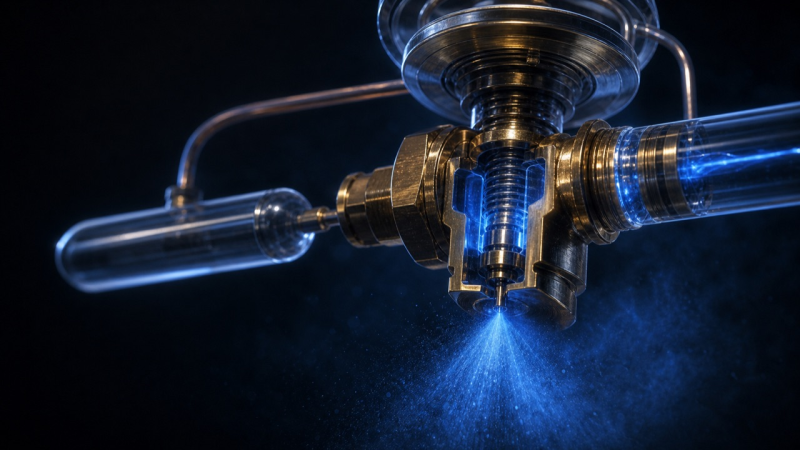
A tech in Glendale condemns a compressor because the suction pressure is low and the unit is barely cooling. The second opinion tech opens the same panel, looks at the same numbers, and then does something the first tech never did: he finds the TXV bulb hanging loose off the suction line with the strap rusted through and the insulation missing. Ten minutes with a new strap and a wrap of cork tape, and the "dead compressor" is blowing 20 degree splits again. The metering device is the smallest major component in the system, it has no wires on most units, it never makes noise, and it quietly causes more misdiagnoses than any part except the charge itself. This module is where you learn the three devices that do this job, how each one thinks, how each one fails, and why the device in front of you decides how you charge the system.
Short Version
Every refrigeration circuit needs a pressure dropper between the liquid line and the evaporator, the metering device you met in F4. Three devices do that job in the equipment you will touch. A piston is a fixed hole: dumb, cheap, reliable, and unable to adapt, so its superheat swings with charge, load, and outdoor temperature. A TXV is a spring-loaded valve controlled by a sensing bulb: it balances three pressures (bulb opening, spring plus evaporator pressure closing) to hold superheat near a setpoint, about 10 F plus or minus 5, no matter what the day is doing. An EEV is the same needle and seat moved by a stepper motor under board control, the most precise of the three. The device determines the charging method: fixed orifice systems are charged by superheat against a charging chart, TXV and EEV systems are charged by subcooling, 8 to 12 F unless the nameplate says otherwise. And the single most expensive thing to know: a starving TXV produces the same high superheat and low suction pressure as a low charge. Subcooling is the tiebreaker, and getting that call wrong is how compressors get condemned for a 40 dollar power head.
Key Values
| Value | Target or Threshold | Notes |
|---|---|---|
| TXV superheat target | 10 F plus or minus 5 (6 to 14 F typical) | Measured at the evaporator outlet. The valve holds this across load changes |
| Subcooling target, TXV and EEV systems | 8 to 12 F | Nameplate or install data overrides. This is the charging target on these systems |
| Fixed orifice superheat | No single target | Moves with outdoor temperature and indoor wet bulb. Charge by the manufacturer charging chart |
| Bulb position, suction line under 7/8 inch | Any position on the upper half, 1 to 3 o'clock typical | Small lines do not stratify enough to matter |
| Bulb position, suction line 7/8 inch and larger | 4 o'clock or 8 o'clock | Just below the horizontal centerline. Never on the bottom of the line |
| Bulb position never allowed | 6 o'clock (bottom of line) | Oil travels along the bottom and insulates the bulb from true vapor temperature |
| Bulb mounting | Tight metal strap on clean, straight, horizontal copper, then insulated | Loose, unstrapped, or bare bulbs sense air, not refrigerant, and overfeed the coil |
| Piston identification | Bore number stamped on the piston body | Must match the size specified by the outdoor unit, not whatever was in the coil from the factory |
| EEV travel | Roughly 0 to 500 steps on typical residential valves | Board drives the stepper. Many boards overdrive the valve closed at power-up to re-zero it, which makes a brief clicking or ratcheting sound. That sound is normal |
| Useful R-410A PT anchors | 118.4 psig is 40 F, 130 psig is 45 F, 390 psig is about 115 F | From F5. You will use these in every example below |
Field Checklist
Metering device inspection on any refrigerant-side call:
- Identify the device before you judge a single number. Look at the evaporator inlet: a brass distributor body with a removable nut and no bulb means piston. A valve body with a capillary tube running to a bulb on the suction line means TXV. A valve body with a wire harness and no bulb means EEV.
- Write the device type into the job record. The charging method, the targets, and half the diagnostic logic depend on it.
- On a TXV, find the bulb. Confirm it is on the suction line within a few inches of the evaporator outlet, on a clean straight horizontal section, not on a fitting, a trap, or a vertical drop.
- Check the clock position: upper half of the pipe on lines under 7/8 inch, 4 or 8 o'clock on lines 7/8 inch and larger, never on the bottom.
- Grab the bulb and try to move it. A correctly strapped bulb does not rotate or slide. Rusted, stretched, or plastic-tie mountings fail this check.
- Confirm the bulb and the pipe around it are insulated so the bulb senses pipe temperature, not the air around it.
- On an externally equalized TXV, trace the small equalizer tube. It must connect to the suction line downstream of the bulb, and it must be open, not kinked or capped.
- On an EEV, confirm the harness is seated and trace the suction thermistor and pressure transducer the board uses to calculate superheat. A failed sensor mispositions the valve even when the valve itself is perfect.
- Measure superheat and subcooling per the F6 procedure. Judge them against the targets for this device, not against a memory of some other system.
- Before condemning any metering device, verify airflow, verify subcooling, and check for a temperature drop across the filter drier. The valve is the most misdiagnosed component in the refrigerant circuit.
Full Breakdown
Why the cycle needs a pressure dropper
Recall the loop from F4: compressor raises pressure, condenser rejects heat, metering device drops pressure, evaporator absorbs heat. The metering device is the pressure dropper, and the reason it must exist comes straight from the PT relationship you learned in F5: pressure controls boiling temperature. The condenser hands you liquid refrigerant at high pressure, around 390 psig on an R-410A system on a hot day, and at that pressure the refrigerant cannot boil until it reaches about 115 F. Useless for cooling a 75 degree living room. Force that liquid through a restriction and the pressure collapses to around 118 psig, where the same refrigerant boils at 40 F. Same molecules, new pressure, new boiling point, and now the coil can drink heat out of indoor air.
Two things happen at that restriction that you should be able to picture. First, the pressure drop itself: high pressure liquid on one side, low pressure on the other, with the restriction holding the two sides apart. The metering device and the compressor are the two borders between the high side and the low side of the system. Second, flash gas: the instant the pressure drops, a portion of the liquid boils off immediately, stealing heat from the rest of the liquid and chilling the whole mixture down to the new saturation temperature. That is why the mix entering the evaporator is roughly 70 percent liquid and 30 percent vapor, all of it sitting at coil saturation temperature, exactly as you used it in F6.
So every metering device has the same two jobs: drop the pressure, and meter the flow rate so the evaporator gets enough liquid to fill the coil without flooding liquid out the end toward the compressor. The three devices in this module differ only in how smart they are about the second job.
The family: piston, TXV, EEV
Line the three up by intelligence.
A fixed orifice, almost always a piston in residential equipment, is a hole. It has no moving control parts, no feedback, and no opinion. Flow through it is set by the hole size and the pressure difference across it. Its cousin the capillary tube, a long skinny tube doing the same job, lives in window units and refrigerators; you will see cap tubes, but pistons are what you will service.
A TXV (thermostatic expansion valve, also written TEV) is a mechanical thermostat for refrigerant flow. A sensing bulb on the suction line feels the superheat leaving the coil and adjusts a needle valve automatically to hold that superheat at a setpoint. No wires, no board, pure mechanics, and it has been the workhorse of comfort cooling for decades.
An EEV (electronic expansion valve) is the same needle and seat moved by a stepper motor under the command of a control board. The board reads temperature and pressure sensors, calculates superheat in real time, and positions the valve in hundreds of small steps. It is the most precise of the three, and it is standard on inverter, communicating, and most modern high-efficiency equipment.
Cost and complexity rise in that order. So does control quality. Keep that trade in your head: every step up the family tree buys tighter superheat control and pays for it with more parts that can fail.
The piston: a hole with a part number
Pull the nut off a piston-style distributor at the evaporator inlet and a small brass cylinder slides out, about the size of the last joint of your finger, with a precisely drilled hole through its center. That hole is the entire metering device. The bore diameter is stamped on the body as a number, and that number is not decoration. Each outdoor unit specifies the piston size that delivers correct flow with that unit's compressor and condenser. Indoor coils ship with a factory piston that matches some assumed pairing, and the installing tech is supposed to check the outdoor unit's literature and swap in the specified piston if it differs. Plenty never do, which is why "mismatched piston" is a real diagnosis on systems that have never cooled right since the day they were installed. Too small a bore starves the coil and runs high superheat forever. Too large a bore overfeeds, runs low superheat, and threatens the compressor with liquid.
The piston has one more trick that matters on heat pumps: it only meters in one direction. Flow one way pushes the piston into its seat, forcing all refrigerant through the drilled bore, and it meters. Flow the other way pushes the piston off its seat and refrigerant sails around it almost unrestricted. A heat pump reverses flow between cooling and heating, so each coil has its own metering device, and the piston's float-free direction is what lets refrigerant pass through the idle one. When a heat pump cools fine and heats terribly, or the reverse, one of the two metering devices, or a piston hung up in its bore, belongs on your suspect list.
How does a fixed hole respond to a changing world? It does not. Flow through the bore is set by the pressure difference across it, which means charge level and outdoor temperature drive the feed rate, not the coil's actual need. Add charge and head pressure rises, which shoves more refrigerant through the hole, which drops superheat. A hotter outdoor day does the same. A mild evening does the opposite, and superheat drifts up. The piston cannot tell a full coil from a starved one. That is not a defect, it is the design: simple, cheap, nothing to stick or fail, and acceptable control as long as the charge is exactly right and conditions are near design. It is also exactly why fixed orifice systems are charged by superheat: on a piston, superheat is the direct readout of the charge and feed balance, and the target moves with conditions, which is why you charge against the manufacturer chart using outdoor temperature and indoor wet bulb instead of a single number.
TXV: five parts and three pressures
Cut a TXV open and you find five things: the valve body with its orifice, a needle (or pin) that rides in and out of that orifice to set flow, a spring pushing the needle toward closed, a thin flexible metal diaphragm pushing the needle toward open, and the sensing bulb, connected to the top of the diaphragm by a thin capillary tube. The bulb, capillary, and the chamber above the diaphragm (the power head) are one sealed container holding a small charge of refrigerant that is completely separate from the system charge. That sealed charge is the brain of the valve.
The bulb clamps to the suction line at the evaporator outlet, so the sealed charge inside it sits at suction line temperature. Warmer line, more of the bulb charge boils, higher bulb pressure. Cooler line, bulb charge condenses, lower bulb pressure. The bulb converts suction line temperature into a pressure signal and sends it up the capillary to the top of the diaphragm.
Now the balance. Three pressures fight over the needle:
- Bulb pressure pushes down on the diaphragm. Opening force. It represents suction line temperature.
- Evaporator pressure pushes up under the diaphragm. Closing force. It represents coil saturation temperature.
- Spring pressure pushes the needle toward closed. Closing force. It is the setpoint.
Look at what the first two represent and you will see the genius of it. Bulb pressure stands for the measured line temperature. Evaporator pressure stands for saturation temperature. The difference between measured line temperature and saturation temperature is superheat, the exact subtraction you did in F6. So the diaphragm is physically computing superheat, and the spring sets how much superheat it takes to win. The valve floats at the opening where bulb force equals spring force plus evaporator force, and that equilibrium lands at the superheat the spring is set for, about 10 F on a standard valve.
Run the loop both directions to make it stick. Load rises: a hot afternoon, more heat into the coil, liquid boils off earlier, superheat climbs, suction line warms, bulb pressure rises, diaphragm wins more, needle opens, more refrigerant feeds the coil, superheat comes back down. Load falls: cool evening, liquid boils off later, superheat drops, line cools, bulb pressure falls, spring wins more, needle closes down, feed shrinks, superheat comes back up. Nobody adjusts anything. The valve plays defense all day, holding superheat near 10 F plus or minus 5 while charge, weather, and load shift around it.
This is also why superheat tells you almost nothing about charge on a TXV system. The valve absorbs charge changes by repositioning the needle, and the surplus or deficit shows up as liquid stacked in the condenser instead, which is why TXV systems are charged to subcooling, 8 to 12 F unless the nameplate says otherwise. The valve does have limits. It is a metering valve, not a magician: run the charge low enough that bubbles reach the valve inlet and it cannot hold its setpoint no matter how far it opens.
Internal versus external equalization
That clean three-pressure story has one hidden assumption: that the evaporator pressure pushing up under the diaphragm is the pressure at the coil outlet, where the bulb lives. An internally equalized TXV takes that pressure from inside its own body, at the coil inlet. On a tiny coil with almost no pressure drop, inlet and outlet pressure are close enough and the simple valve works.
But most residential A-coils feed multiple parallel circuits through a distributor, and the distributor plus the coil itself can eat real pressure. Now the inlet pressure under the diaphragm is meaningfully higher than the true outlet pressure. Higher closing force than reality deserves means the valve closes down too far, underfeeds the coil, and holds superheat well above setpoint, permanently. The fix is the external equalizer: a small tube from the underside of the diaphragm out to the suction line, connected just downstream of the bulb, feeding the diaphragm the true outlet pressure. Almost every TXV you will touch on ducted residential equipment is externally equalized. Two field rules follow. First, that little tube is part of the valve's brain: kinked, capped, or brazed shut, the valve loses its true outlet signal and misbehaves. Second, the equalizer connects downstream of the bulb, never upstream, so any refrigerant weeping through the equalizer fitting cannot chill the line under the bulb and lie to it.
The bulb: placement, strapping, insulation
The TXV's entire view of the world comes through that bulb. Treat the bulb sloppy and the smartest mechanical valve in the system turns stupid.
Location. On the suction line, close to the evaporator outlet, on a clean, straight, horizontal run of pipe. Not on a fitting or elbow where contact is poor. Not after a trap or in a sagging low spot where liquid refrigerant and oil collect and chill the bulb erratically. Not downstream where attic heat has already contaminated the reading.
Clock position. Picture the pipe's cross section as a clock face. On suction lines under 7/8 inch, the line is small enough that the vapor inside is well mixed, so anywhere on the upper half of the pipe works, 1 to 3 o'clock is the common habit. On lines 7/8 inch and larger, mount the bulb at 4 o'clock or 8 o'clock, just below the horizontal centerline. The reasoning lives inside the pipe: a film of refrigerant oil travels along the bottom of the line, and the bottom of a large line can also carry occasional liquid droplets. A bulb at 6 o'clock sits on that oil layer, which insulates it and feeds it a sluggish, damped temperature. The very top of a large line, meanwhile, reads the gas layer least representative of the mix. The 4 and 8 o'clock positions sit on clean metal below the centerline but above the oil river, where the pipe wall tracks the true vapor temperature. The two positions are mirror images; pick whichever side gives you flat, clean contact.
Strapping. The bulb must be strapped tight to bare, clean copper with the metal strap made for it. Scuff off oxidation first, just like a temperature probe in F6, because the bulb IS a temperature probe, one that happens to control a valve. Plastic zip ties, tape, or a stretched rusty strap give partial contact, and partial contact means the bulb reads somewhere between pipe and air.
Insulation. After strapping, insulate over the bulb and the pipe around it. An uninsulated bulb in a 130 F attic, clamped to a 50 F line, splits the difference. It senses too warm, which it interprets as high superheat, so it drives the valve open and overfeeds the coil. The failure mode of a bare bulb is not a starved coil, it is floodback creeping toward the compressor. Insulation on a TXV bulb is not cosmetic. It is part of the control circuit.
Hunting and the floor under superheat
Watch a TXV system where superheat will not sit still: 5, then 15, then 6, then 14, swinging on a slow rhythm with suction pressure swinging opposite. That is hunting: the valve overshooting open, then overcorrecting closed, then overshooting again, chasing its own tail. Every feedback loop has a stability limit, and the TXV's limit shows up as a minimum stable superheat. Ask the valve to hold superheat too low and the time lag between the needle moving and the bulb feeling the result turns the control loop into an oscillator. This is the floor mentioned back in F6: the engine tuner trade. A fuller coil performs better, but below the stable floor the valve cannot hold a setpoint at all.
Hunting has causes beyond an aggressive setpoint: an oversized valve (big needle moves swat a small coil around), a bulb in a bad location getting slugged by liquid and oil from a trap, or erratic load. Mild hunting that averages to setpoint is common and livable. Deep hunting that swings superheat from near zero to 20 means the valve, its sizing, or its bulb installation needs attention, because every swing through the bottom sends a wet breath toward the compressor.
EEV: the valve grows a brain
Take the TXV's needle and seat, throw away the bulb, diaphragm, and spring, and bolt a stepper motor on top. A stepper motor is a motor built to move in small fixed increments, steps, rather than spin freely; pulse its windings in sequence and the rotor clicks around a precise fraction of a turn per pulse. Gear that rotation into a lead screw driving the needle, and the control board can park the valve at any opening it wants, typically somewhere in a 0 to 500 step range on residential valves, from sealed shut to wide open.
The feedback loop moves out of the brass and into software. A thermistor (a temperature-sensing resistor, from F8) clamps to the suction line where the TXV bulb would have lived, and a pressure transducer reads suction pressure. The board converts pressure to saturation temperature, the same PT math you do by hand, subtracts to get live superheat, and steps the valve open or closed to hold target. Where a TXV is one fixed spring setting, the EEV's target is a number in firmware, and the board can change it on the fly: one superheat for full-speed cooling, another for low-speed dehumidification, a different strategy for heat pump defrost. That flexibility is why every inverter and communicating system you see ships with an EEV. It holds superheat in a band a mechanical valve cannot match, it adapts when a variable-speed compressor swings capacity moment to moment, and it can slam fully closed on shutdown to stop off-cycle refrigerant migration.
Two field behaviors to know. First, the re-zero: a stepper has no built-in position sensor, so the board finds home by overdriving the valve closed more steps than full travel can use, guaranteeing it is at zero, then counting open from there. Many boards do this at every power-up, and the valve makes a soft clicking or ratcheting buzz while it happens. Techs replace healthy valves over that sound every year. It is the valve calibrating, not dying. Second, the dependency chain: the valve only knows what its sensors tell it. A drifted thermistor, a failed transducer, or a chafed harness mispositions a mechanically perfect valve. On an EEV system you are not just a refrigerant tech anymore; the metering device diagnosis runs through the board, the sensors, and the wiring, with the meter skills from F7 and F8.
One day, three devices
Make the differences concrete. Same house, same afternoon, load climbing from a mild morning into a 110 F Phoenix afternoon:
The piston system drifts. As head pressure rises with the heat, the fixed bore passes more refrigerant, and its superheat slides around with conditions. The numbers are healthy only to the degree the charge is exactly right, and you judge that charge by superheat against the chart for today's conditions.
The TXV system holds. The bulb feels every change and trims the needle continuously, pinning superheat near 10 F all afternoon. Charge surplus or deficit hides in the condenser as subcooling. Steady superheat here does not mean the charge is right; it means the valve is doing its job. Subcooling is where the truth is.
The EEV system holds tighter, and may deliberately change its own target as the compressor shifts speed. Its superheat trace is nearly a flat line, and like the TXV system it is charged and judged by subcooling.
That one paragraph trio is the foundation of charging logic, and C17 will build the full charging procedures on top of it: superheat method with the chart on fixed orifice, subcooling method on TXV and EEV, weigh-in as the anchor for both.
How each device fails
Piston failures are debris and sizing. A drilled hole has exactly one moving part, the piston sliding in its bore, so almost nothing wears out. What kills pistons is what comes down the line: filings, flux, oxidation flakes from a sloppy braze job, or sludge from a compressor burnout, lodging in the bore. A partially plugged piston is a restriction: high superheat, starved coil, low suction pressure, and high subcooling as refrigerant dams up in the condenser behind it. The other piston failure was installed on day one: the wrong bore size for the outdoor unit, giving a system that has never held correct superheat in its life. And on heat pumps, a piston hung up off its seat will not meter in the direction it should, which shows up as one mode working and the other not.
TXV failures are the bulb, the charge in the bulb, sticking, and hunting. Loss of bulb charge is the classic: the sealed charge leaks out of the bulb or capillary, bulb pressure falls toward nothing, and with no opening force the spring slams the valve essentially shut. The system starves: high superheat, low suction, poor cooling. A bulb that is loose, bare, or fallen off fails the opposite direction: it senses warm ambient air instead of the cold pipe, reads that as huge superheat, and drives the valve open, flooding the coil, low superheat, floodback risk. Sticking goes either way, debris or corrosion freezing the needle: stuck closed or restricted looks like starving, stuck open looks like flooding. Add hunting from the previous section, and note that a plugged inlet screen on the valve, or a kinked external equalizer, produces convincing imitations of a dead valve. Always check the cheap causes before the power head.
EEV failures are electrical more often than mechanical. The needle and seat can stick on debris like any valve, but the usual suspects are upstream: a failed or drifted thermistor feeding the board a lie, a dead pressure transducer, a chafed or unplugged harness, a failed stepper winding, or a board driver fault. The symptom is a valve parked at the wrong opening, starving or flooding depending on where it froze. Diagnosis runs through the service literature: most boards report valve position, sensor readings, and fault codes, and many have a test mode that strokes the valve full travel so you can listen and watch live superheat respond. Verify the sensors with your own probes before you condemn a valve the board may be commanding incorrectly.
The imitation game: a starving TXV mimics low charge
Here is the punchline of the whole failure section, and the setup for D24. A TXV that is underfeeding, from lost bulb charge, a stuck needle, a plugged inlet screen, or a kinked equalizer, produces high superheat, low suction pressure, a warm house, and a coil that may even ice up. A low refrigerant charge produces high superheat, low suction pressure, a warm house, and a coil that may even ice up. From the low side gauge, the two are identical twins, and the tech who only reads suction pressure "fixes" the starving valve with a pound of refrigerant. The superheat barely moves, so another pound follows. Now the system is overcharged on top of a bad valve, head pressure is climbing, and the original problem is still in the box.
The tiebreaker is subcooling, exactly as the F6 quadrant table promised. Low charge starves the whole system: high superheat AND low subcooling, nothing stacked anywhere. A starving valve dams refrigerant behind itself: high superheat WITH normal or high subcooling, the refrigerant exists but cannot get through. Before you condemn the valve even then, walk the checklist: airflow verified, filter drier checked for a temperature drop across it (a restricted drier is a restriction that is not the valve), bulb checked by hand, equalizer traced, inlet screen considered. The TXV is the most misdiagnosed component in this trade precisely because so many other problems wear its costume. D24 builds this into the full charge misdiagnosis triangle: low charge versus metering versus airflow.
What the device means for charging
Tie it off with the rule you will use on every install and every top-off, the rule C17 turns into full procedure. The metering device decides the charging method:
Fixed orifice: charge by superheat. The hole cannot adapt, so superheat responds directly to charge, and the correct superheat depends on conditions. Use the manufacturer charging chart with outdoor dry bulb and indoor wet bulb, never a single memorized number.
TXV and EEV: charge by subcooling. The valve holds superheat regardless of charge, so superheat is nearly useless as a charge indicator; chase it and you will overcharge a healthy system, the F6 mistake. Charge to the nameplate subcooling target, 8 to 12 F when no nameplate value is given, after airflow and measurements are verified.
Both: weigh-in is the anchor. Factory charge plus line set adjustment, weighed on a scale, is the starting truth on any new install or recovered-and-recharged system. Superheat and subcooling then confirm.
One habit makes all of this automatic: identify the metering device first, before the gauges go on. The device tells you which numbers matter, which targets apply, and which failures to suspect. Skip that step and every number you collect is a guess wearing a costume.
Common Mistakes
- Charging a TXV system by superheat. The valve absorbs the charge you add and holds superheat near setpoint, so the tech keeps adding, the condenser keeps stacking liquid, and head pressure climbs. TXV and EEV systems are charged by subcooling. Identify the device before you charge.
- Condemning a TXV, or a compressor, for what is actually low charge, and vice versa. High superheat plus low suction has two faces. Subcooling is the tiebreaker: low subcooling points to low charge, normal or high subcooling with a starved coil points to a restriction or a starving valve. Skipping that one number is how 40 dollar bulb problems become 3000 dollar compressor quotes.
- Ignoring the bulb. Loose strap, missing insulation, wrong clock position, bulb resting on a fitting or in a trap. The bulb is the valve's only sense organ, and in a Phoenix attic a bare bulb reads the attic, not the pipe, and floods the coil. Hand on the bulb, every TXV call.
- Mounting the bulb on the bottom of the line. Six o'clock puts the bulb on the oil river that runs along the bottom of the suction line, insulating it and feeding it damped, sluggish readings that make the valve slow and sloppy. Under 7/8 inch, upper half of the pipe. At 7/8 inch and larger, 4 or 8 o'clock.
- Not verifying piston size on an install or coil swap. The factory piston in the new coil matches an assumption, not necessarily your outdoor unit. The spec sheet names the required bore; thirty seconds with the literature prevents a system that runs wrong superheat for its entire life.
- Replacing an EEV because of startup clicking, or because the board says so, without checking sensors. The ratcheting at power-up is the re-zero routine, not a failure. And a drifted thermistor will park a perfect valve in a terrible position. Verify sensor readings against your own probes before the recovery machine comes off the truck.
- Forgetting the external equalizer. A kinked, capped, or brazed-shut equalizer line robs the valve of its true outlet pressure and turns it into a chronic underfeeder that no adjustment will fix. Trace the little tube. It is part of the brain.