
In F4 you learned the refrigeration cycle as four jobs in a loop: increase pressure, reject heat, drop pressure, absorb heat. In F9 you learned to read the wiring that tells those components when to run. Both of those modules lived mostly on paper. This module is where the paper becomes metal. By the end of it you will be able to stand in front of any residential split system, point at every component from the compressor terminals to the float switch, say what each one is, what job it does in the cycle or the circuit, and what it looks like when it is installed right.
This matters more than it sounds. A tech who cannot name the hardware cannot describe a problem to a senior tech, cannot order the right part, and cannot write a job summary a customer or another tech can trust. Component identification is the vocabulary of this trade. Everything in the diagnostics track assumes you have it cold.
Short Version
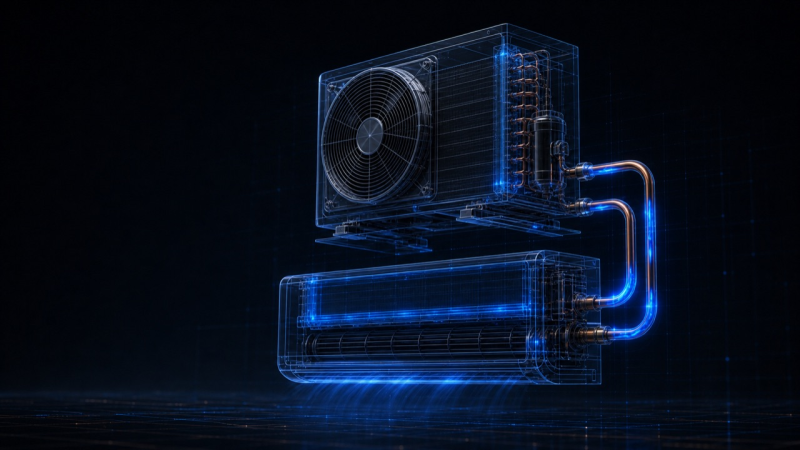
A split system is the refrigeration cycle cut into two boxes connected by two copper lines. The outdoor unit holds the compressor, the condenser coil, the condenser fan, and the switchgear that runs them: a contactor and a dual run capacitor. The indoor section holds the evaporator coil (usually an A-coil), the metering device mounted at that coil, and a blower that lives inside either a furnace or an air handler. The line set joins the halves: a small bare liquid line carrying warm high pressure liquid out to the coil, and a large insulated suction line carrying cold low pressure vapor back to the compressor. Service valves at the outdoor unit are your gateway into the sealed system, a filter drier in the liquid line protects it from moisture and debris, and a short list of accessories, float switch, surge protector, hard start kit, condensate pump, rounds out the hardware you will see daily. Every piece of this metal maps to a station on the F4 cycle or a rung on the F9 ladder. Learn the map and the machine stops being a mystery box.
Key Values
The numbers a tech must know cold about split system hardware. State references assume the healthy 95 F day baseline from F4.
| Item | Value | Why it matters |
|---|---|---|
| Suction line contents | low pressure superheated vapor, 130 psig, about 55 F | the fat insulated line, cold and sweating |
| Liquid line contents | high pressure subcooled liquid, 365 psig, about 100 F | the small bare line, warm like bathwater |
| Line set sizes, 2 to 3 ton | 3/8 inch liquid, 3/4 inch suction | most common residential pairing |
| Line set sizes, 4 to 5 ton | 3/8 inch liquid, suction typically steps up to 7/8 inch | bigger systems move more vapor |
| Suction insulation thickness | 3/4 inch minimum, 1 inch in attics, UV rated outdoors | bare suction copper is an automatic defect |
| Line set support spacing | every 4 feet | unsupported line sets vibrate, rub, and leak |
| Nominal airflow | 400 CFM per ton | the blower's job in one number |
| Temperature split | 18 to 22 F return minus supply | proof the A-coil is absorbing heat |
| Run capacitor tolerance | replace beyond minus 6 percent of rated microfarads | from F8, the most replaced part in the trade |
| Capacitor share of service calls | about 21 percent | the single most common electrical failure |
| Contactor coil resistance | 20 to 100 ohms | quick health check on the 24 V coil |
| Share of refrigerant leaks found in the A-coil | about 80 percent | the indoor coil is leak suspect number one |
| Condensate drain | 3/4 inch PVC, 1/4 inch per foot slope | flat or back-sloped drains grow clogs |
| Hard start kit effect | cuts compressor inrush amps 50 to 70 percent | relief for aging compressors |
| Disconnect rule | NEC 440.14: within sight of the unit and within 50 feet | every outdoor unit must have one |
| Typical circuit sizing | 2 to 3 ton about 30 A, 4 to 5 ton 40 to 45 A | read the nameplate MCA and MOCP, never guess |
Field Checklist
The ten-stop anatomy walk. Run it on every system you meet until it is automatic.
- Disconnect: mounted within sight of the outdoor unit, weatherproof, cover closes. Pull it and verify dead before any panel comes off.
- Outdoor cabinet: condenser coil wraps the sides, fan on top blowing up, compressor inside the base, electrical compartment in one corner.
- Electrical compartment: contactor (line lugs, load lugs, 24 V coil spades), dual run capacitor (HERM, FAN, C terminals), any add-ons such as a hard start kit or surge protector.
- Service valves: small liquid valve and large suction valve where the line set lands, caps on stems and ports, no oil staining around the cores.
- Line set run: suction line fully insulated end to end, supported about every 4 feet, no kinks, no bare copper, no insulation flaking off in the sun.
- Filter drier: in the liquid line, flow arrow pointing toward the indoor coil, no frost or sweat line across its body.
- Indoor unit type: furnace with a cased A-coil on top, or an air handler with coil and blower in one cabinet. Know which one you are looking at before you open it.
- A-coil and metering device: coil fins clean, TXV or piston at the coil inlet, distributor tubes feeding the circuits.
- Condensate path: primary pan and drain sloped 1/4 inch per foot, secondary pan or secondary drain where the unit sits over living space, float switch present and wired.
- Blower and filter: filter correct size and not collapsed, blower wheel clean, return and supply sides identified.
If you can narrate all ten stops out loud, naming each part and its job, you know this module.
Full Breakdown
Why the system is split in two
Recall from F4 that only two components change the refrigerant's pressure: the compressor raises it and the metering device drops it. The other two components are heat exchangers, and each one needs to trade heat with a different air stream. The condenser needs outdoor air to dump heat into. The evaporator needs indoor air to pull heat from. So the machine gets cut in half and each half goes where its air is: the heat-rejecting half outside, the heat-absorbing half inside. That is the entire meaning of the words split system.
The cut lands in a specific place. The outdoor unit gets the compressor, the condenser coil, and the fan that moves outdoor air. The indoor section gets the evaporator coil, the metering device, and the blower that moves indoor air. Two refrigerant lines bridge the gap, and a low voltage wire pair lets the indoor side tell the outdoor side when to run. The pressure split from F4 maps onto the boxes almost perfectly: nearly everything in the outdoor unit and the liquid line lives on the high side, and the metering device at the indoor coil is the doorway back to the low side.
One naming habit to fix early: techs and customers both call the outdoor unit "the condenser," and you will too, but be precise in your own head. The condenser is a coil inside that cabinet. The cabinet also holds the compressor, the fan, and the electrical gear. When a senior tech asks what is wrong with the condenser, they mean the coil. When a customer says it, they mean the whole gray box.
The outdoor unit: the refrigeration side
Pop the top or the service panel of a typical residential condenser cabinet and you find three refrigeration components arranged the same way in almost every brand.
The compressor sits in the base of the cabinet, a black or gray steel dome bolted to rubber feet. It is the pressure increaser from F4 and the heart of the system: the only thing that circulates refrigerant. Almost every residential compressor you will meet is a hermetic scroll: hermetic means the motor and the pumping mechanism are sealed together inside one welded shell that is never opened for service, and scroll means the pumping is done by one spiral orbiting inside another, squeezing vapor toward the center. The shell has three electrical terminals under a cover: Common, Start, and Run, the same C, S, R pattern you learned on single phase motors in F8. Two copper stubs leave the shell: the suction stub drinks in cool vapor, and the smaller discharge stub sends hot high pressure vapor to the condenser coil. The dome itself runs warm to hot; the discharge stub runs hot enough to burn. Modern scrolls protect themselves with an internal pressure relief that opens if discharge pressure runs away and a thermal overload that cuts the motor if the shell or windings overheat. When a compressor shuts itself off on a brutal afternoon and restarts later, those protections are usually the reason.
The condenser coil is the heat rejector. It wraps two, three, or all four sides of the cabinet: copper or aluminum tubing snaked back and forth through thousands of thin aluminum fins. The fins exist to multiply surface area, because the coil's whole job is to give refrigerant heat a huge doorway into outdoor air. Hot 170 F discharge vapor enters at the top, desuperheats, condenses at about 110 F through the middle passes, and leaves the bottom as subcooled liquid around 100 F, exactly the Station 2 to Station 3 trip from F4. Treat the fins gently. They bend if you look at them hard, and crushed fins block airflow the same as dirt does.
The condenser fan sits in the top of the cabinet, blade pointed up, pulling air in through the coil on the sides and throwing it out the top. That hot column of air off the top of the unit is the house's heat leaving the property. The fan motor hangs from the top grille, and in most single stage equipment it is a PSC motor (permanent split capacitor, from F8) that shares the dual run capacitor with the compressor. Newer high efficiency equipment uses ECM fan motors (electronically commutated motors) that need no run capacitor. If the fan stops while the compressor runs, head pressure climbs fast, so the fan's health is the condenser coil's health.
The outdoor unit: the electrical side
In one corner of the cabinet, behind its own small panel, lives the electrical compartment. You met every part of it in F8 and F9; now fix where each one physically sits.
The contactor is the 24 V controlled switch that connects line voltage to the compressor and fan. Line wires from the disconnect land on its line lugs, the compressor and fan feed from its load lugs, and the thermostat's Y call energizes its coil through the low voltage spades on the side. This is the clunk you hear when cooling starts. From F9 you know its coil and its contacts are one device drawn in two places on the ladder; here in the metal they are one small block you can hold in your hand. A healthy coil measures 20 to 100 ohms. Pitted, chattering, or welded contacts are its common end-of-life failures.
The dual run capacitor is the round or oval silver can strapped beside the contactor. One can, two capacitors: the HERM terminal serves the compressor (the hermetic), the FAN terminal serves the condenser fan motor, and C is their shared common. From F8 you know a run capacitor gives a PSC motor its phase-shifted starting torque and run efficiency, you know it holds a charge after power is off and must be discharged before you touch it, and you know the replacement rule: out of tolerance beyond minus 6 percent of the rated microfarads means replace it.
The disconnect is not inside the cabinet, but it belongs to this tour: a weatherproof box on the wall beside the unit, required by NEC 440.14 to be within sight of the equipment and within 50 feet, so anyone servicing the unit can kill power without leaving it. Between the disconnect and the cabinet runs the whip, a short flexible conduit carrying the line voltage conductors. The circuit behind all of it is sized to the nameplate: MCA (minimum circuit ampacity, the wire sizing number) and MOCP (maximum overcurrent protection, the breaker or fuse ceiling). Typical residential sizing runs about 30 A for 2 to 3 ton equipment and 40 to 45 A for 4 to 5 ton, but the nameplate always wins over the rule of thumb.
Service valves and ports: your gateway into the sealed loop
Where the line set meets the outdoor unit you find the two service valves, and they deserve their own section because they are the only place a technician's gauges ever touch the refrigerant circuit.
The liquid service valve is the small one, where the 3/8 inch liquid line lands. The suction service valve (also called the vapor valve) is the large one, where the suction line lands. Each valve has three jobs built into one brass body:
- Connection point. The line set is brazed or flared to the valve, joining the field-installed lines to the factory-charged outdoor unit.
- Shutoff. Under a cap on each valve is a stem, usually a hex socket. Screwed all the way in (front-seated), the valve isolates the outdoor unit from the line set; this is how units ship from the factory holding their charge, and how a tech can pump the charge down into the outdoor unit for certain repairs. Backed all the way out (back-seated), the valve is fully open for normal operation. Normal running position is fully open, stem backed out, cap on.
- Service port. Each valve carries a small side port with a Schrader core, the same spring-loaded valve core as a tire stem. Your gauge hoses press these cores open; remove the hose and the core snaps shut. The port on the suction valve reads low side pressure, the port on the liquid valve reads high side pressure, and together they are how every gauge reading in F5 and F6 physically happens.
Two habits separate professionals here. First, caps are the seal. Schrader cores weep over the years; the brass cap with its gasket is the final barrier, so every cap goes back on finger-plus-a-quarter-turn tight, every time. A missing service cap is a slow leak waiting for a date. Second, look before you connect. Oil staining around a service port or valve stem is the fingerprint of refrigerant leaking past, because the oil that circulates with the refrigerant gets carried out through any leak path and stays behind as a stain.
The line set: two copper lines, two different worlds
The line set is the pair of copper lines connecting the halves of the system, and everything about each line follows from what it carries. You learned the contents in F4; now learn the hardware.
The suction line carries cool, low pressure superheated vapor from the evaporator outlet back to the compressor: 130 psig and about 55 F on the baseline day. It is the larger line because low pressure vapor is thin stuff; each pound of it takes up far more space than liquid, so it needs a bigger pipe to move without losing pressure to friction. And it is insulated full length in black foam for two reasons that both cost the customer money: bare suction copper at 55 F soaks up heat from a 150 F attic, which is heat the system already paid to remove plus lost cooling of the compressor itself, and bare cold copper sweats, dripping condensation onto drywall and framing.
The liquid line carries warm, high pressure subcooled liquid from the condenser outlet to the metering device: 365 psig and about 100 F. It is small because dense liquid needs little room, and it runs bare because at 100 F it is close enough to the air around it that insulation buys little. Warm like bathwater is its healthy feel, from the F4 touch test.
Common residential sizing pairs a 3/8 inch liquid line with a 3/4 inch suction line for 2 to 3 ton systems, with the suction line typically stepping up to 7/8 inch on 4 to 5 ton equipment. Manufacturers publish required sizes by tonnage and run length; long runs and tall vertical rises have their own rules about sizing and oil return, which the installation track covers. What you must recognize now is wrong on sight: a suction line with torn, missing, or sun-rotted insulation, a line set sagging between supports more than about 4 feet apart, a kinked bend that chokes flow, or bare copper rubbing against a wall or strap until it wears through.
The indoor section: the A-coil
Indoors, the refrigerant's destination is the evaporator coil. In residential equipment it is almost always an A-coil: two slanted slabs of finned tubing joined at the top in the shape of a capital A, sitting in the airstream so air flows up through both slabs. The A shape packs maximum coil face into a small cabinet and gives condensation a natural path to run down the slabs into the drain pan below. Horizontal installations lay the coil on its side, and some air handlers use a single slanted slab coil, but the job never changes: this is the heat absorber where 45 F refrigerant boils and the house's heat leaves the air.
At the coil inlet sits the metering device, the pressure dropper from F4. On modern equipment it is usually a TXV (thermostatic expansion valve), a brass valve with a sensing bulb clamped to the suction line at the coil outlet; on older or budget equipment it may be a fixed orifice piston. The TXV feeds a distributor, a small brass hub that splits the refrigerant into several thin tubes so every circuit of the coil gets an equal share. Module C11 takes the metering device apart in detail; for anatomy purposes, know where it lives and what feeds it.
Under the coil sits the primary drain pan, catching the condensation the cold coil wrings out of the air, with a 3/4 inch PVC drain line leaving it at a continuous slope of 1/4 inch per foot. Where the unit sits above living space, a secondary pan under the whole unit or a secondary drain connection backs up the primary, and its termination is placed somewhere visible, over a window or eave, so water dripping from it is a signal a homeowner notices.
The A-coil also owns an unfortunate statistic: about 80 percent of the refrigerant leaks you will find live in the indoor coil, much of it from formicary corrosion, a chemistry problem where household air chemicals attack copper tube walls and leave pinholes. File that now; the leak search module builds on it.
Furnace pairing or air handler: the two indoor configurations
The A-coil never works alone. It needs a blower to push air across it, and that blower comes packaged one of two ways.
Furnace plus cased coil. In homes with gas heat, the indoor unit is a gas furnace, and the A-coil sits in its own sheet metal case strapped on top of (or beside, in horizontal attics) the furnace. The furnace's blower serves both seasons: in winter it pushes air across the furnace's heat exchanger, in summer the same blower pushes air through the now idle furnace and up through the A-coil above it. The cooling system borrows the furnace's blower, which is why a cooling problem can have a furnace cause.
Air handler. In homes without gas heat, an air handler replaces the furnace: one cabinet containing the blower, the coil, and usually electric heat strips, resistance elements that provide heat in winter and supplemental heat for heat pumps. Heat pump systems pair with air handlers almost exclusively. From the refrigerant's point of view nothing changes; from the wiring's point of view, the F9 diagrams differ, because heat strips and their sequencers replace gas controls.
Either way, the airflow path is the same and you should be able to trace it blindfolded: return grille, return duct, filter, blower, heat exchanger or heat strips, A-coil, supply plenum, supply ducts, registers. The filter always lives upstream of the blower and coil, because its real job is protecting the blower wheel and coil fins from dust, with cleaner room air as a bonus.
The blower itself is a squirrel cage wheel inside a housing, driven by a PSC motor or, in most newer equipment, an ECM. Its output target is the number from the airflow modules: about 400 CFM per ton of cooling. A 3 ton system wants about 1200 CFM across the coil. Starve the coil of air, with a crushed filter, a dirty blower wheel, or closed registers, and the coil gets too cold, superheat collapses, and the F4 preview about liquid threatening the compressor starts coming true.
The filter drier: the system's kidney
Somewhere in the liquid line, usually at the outdoor unit or just before the metering device, sits a sealed metal cylinder called the liquid line filter drier. Inside is a desiccant core, a moisture-absorbing material block that also acts as a fine particle filter. Its two enemies are the two contaminants that destroy sealed systems from the inside: moisture, which reacts with refrigerant and oil to form acids that eat motor windings and create sludge, and debris, copper shavings, flux, oxide scale, which jams the tiny passages of the metering device.
Filter drier rules every tech must carry:
- It goes in the liquid line, flow arrow pointing toward the metering device. The body is stamped with an arrow. Backwards installation lets the drier shed its own debris downstream.
- It is a one-time part. A desiccant core that has been open to the atmosphere, or has been absorbing moisture in service for years, is full. There is no cleaning or reusing a filter drier.
- Any time the sealed system is opened, the drier is replaced. Opening the system, for a compressor, a coil, a TXV, any repair that breaks the refrigerant circuit, admits air and moisture. A fresh drier plus a proper evacuation is how the system gets its dry sealed life back.
- A temperature drop across the drier means it is clogging. A drier restricting flow acts like an unplanned metering device: pressure drops across it, and with pressure drop comes temperature drop. A drier noticeably cooler on its outlet than its inlet, or one that sweats or frosts, is failing. You will use this in diagnostics.
Accessories: the supporting cast
Four add-ons show up on residential splits often enough that you must know them on sight, what they do, and where they belong.
Float switch. A small switch mounted on the drain pan or plumbed into the drain line, holding a float that rises with water level. If the drain clogs and water backs up, the float rises and the switch opens the 24 V circuit, usually breaking Y or R so the system stops making condensation before the pan overflows. From F9 you can place it precisely: a normally closed safety switch in series on the control rung, exactly like the pressure switches you traced. A tripped float switch is a message: the system did not fail, the drain did. Find the clog.
Surge protector. A small module wired at the disconnect or in the electrical compartment that clamps voltage spikes before they reach the contactor, capacitor, and any control board. Boards and ECMs are the expensive casualties of surges.
Hard start kit. A start capacitor plus a potential relay packaged together, wired across the run capacitor to give a single phase compressor a strong extra phase shift for the first fraction of a second of starting, then drop out. It cuts starting inrush current by 50 to 70 percent, which matters for aging compressors that start hard against worn bearings, for homes with weak utility voltage, and for any compressor that must start against unequalized pressures. A sensible guideline: compressors 7 or more years old benefit from one. From F8 you already know the components; the kit is just both of them in one can with three wires.
Condensate pump. When gravity cannot drain the pan, a basement unit below grade, a closet with no drain path, a small reservoir pump collects the condensate and pushes it through vinyl tubing to a legal drain. Most include their own overflow safety switch, which gets wired into the control circuit just like a float switch: pump fails, switch opens, cooling stops, ceiling saved.
Mapping the metal to the cycle and the ladder
Close the loop on this module by overlaying everything you just learned onto the two maps you already own.
The F4 cycle map, station by station:
| F4 station | Physical hardware, by name and location |
|---|---|
| Compressor inlet, 130 psig vapor | suction service valve and suction stub on the compressor dome, outdoor cabinet base |
| Compressor outlet, 365 psig hot vapor | discharge stub to the top of the condenser coil, inside the outdoor cabinet |
| Condenser, rejecting heat | the finned coil wrapping the outdoor cabinet, fan above pulling air through |
| Condenser outlet, subcooled liquid | bottom of the outdoor coil, through the liquid service valve, into the 3/8 inch liquid line, through the filter drier |
| Metering device, pressure drop | TXV or piston at the A-coil inlet, with its distributor |
| Evaporator, absorbing heat | the A-coil in the furnace case or air handler, blower pushing return air through it |
| Evaporator outlet, superheated vapor | top of the A-coil into the 3/4 inch insulated suction line, back to the suction service valve |
And the F9 ladder map: the thermostat's Y call travels to the outdoor unit on the low voltage pair, through any safeties including the float switch, to the contactor coil in the electrical compartment. The contactor's contacts feed the compressor and condenser fan in parallel, each through its half of the dual run capacitor. The G call runs the blower at the indoor unit. Every rung you traced on paper in F9 has a street address in this module.
When you can stand at a system and narrate both maps, hardware to cycle and hardware to ladder, you are no longer a parts-changer in training. You are a technician who knows what they are looking at.
Common Mistakes
- Calling the whole outdoor unit the condenser and thinking that way too. The condenser is the coil. Sloppy language becomes sloppy diagnosis when a tech condemns "the condenser" without separating coil, compressor, fan, and electrical gear.
- Leaving service caps off or loose. Schrader cores weep. The cap is the real seal, and the missing cap you shrugged at becomes next summer's low charge call with your name on the last invoice.
- Treating the filter drier as optional on a repair. Opening the system without replacing the drier leaves a saturated desiccant core in a wet system. The acid damage shows up a year later as a dead compressor, long after the cheap repair was paid for.
- Ignoring suction line insulation. Torn or missing insulation looks cosmetic and is not. It is lost capacity, sweating copper over drywall, and hot vapor returning to a compressor that needed cool vapor for its own motor cooling.
- Skipping the float switch test. Mounting a float switch and never pouring water is installing a part and skipping the proof. The first real test will be a clogged drain over a ceiling.
- Guessing wire and breaker sizes from tonnage. The rules of thumb are for recognizing the ballpark. The nameplate MCA and MOCP are the law for the circuit, and equipment changes between model years.
- Crushing condenser fins and walking away. Bent fins are blocked airflow, and blocked airflow is high head pressure, the F4 preview you will meet again in diagnostics. Comb them straight or own the consequence.
- Forgetting that the cooling system borrows the furnace blower. On a furnace-plus-coil system, a summer cooling complaint can be a winter appliance's fault: a dying blower motor, a fouled wheel, a furnace board that never sends the blower a fan call.