
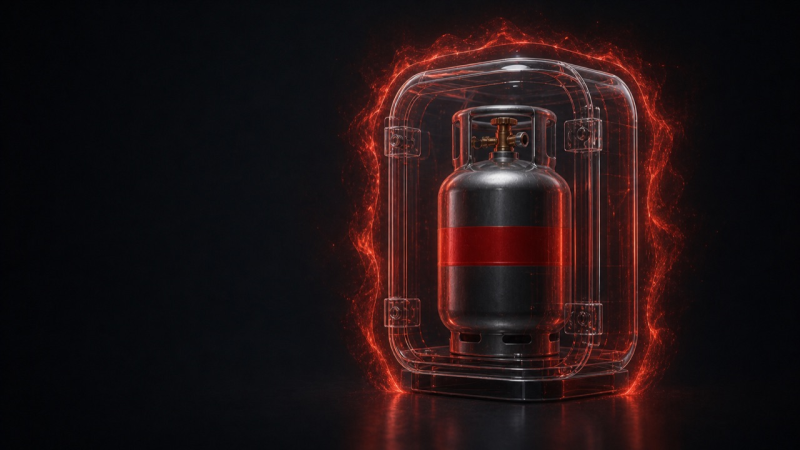
Two trucks roll up to two new heat pump installs on the same street. The first tech treats the R-454B system exactly like every R-410A system he has ever touched: same recovery machine, same cylinder habits, torch lit on a charged line "just to sweat one joint real quick." The second tech reads the red band on the cylinder, checks the rating sticker on his recovery machine, ventilates the garage, verifies the circuit is recovered and purged before any flame exists on the property, and weighs the charge in on a scale just like C17 taught. Here is the uncomfortable truth: the first tech will probably get away with it, today, because A2L refrigerants are genuinely hard to ignite. And that is exactly what makes them dangerous to careless people. A refrigerant that punished sloppiness instantly would train techs fast. A refrigerant that forgives a hundred shortcuts and then, on the hundred and first, meets a torch flame in an unventilated closet at just the right concentration, breeds complacency. This module is the biggest field change of your generation: what A2L actually means, what changed, what carried over, and the discipline that keeps "mildly flammable" from ever becoming flammable on your job.
Short Version
The industry is moving from R-410A (GWP 1924, non-flammable A1) to A2L refrigerants: R-454B (GWP 466) and R-32 (GWP 675). A2L means lower toxicity, lower flammability: R-454B will not burn until it reaches 11.25 percent of the air by volume, needs a competent ignition source above 1290 F or an open flame, and burns slower than walking pace. That is nothing like propane, and it is also not nothing. Equipment built under UL 60335-2-40 carries a refrigerant detection sensor on ducted systems holding more than 3.91 lb of charge: when it smells a leak it shuts the compressor and runs the blower to dilute the refrigerant below a quarter of its flammability limit. Never bypass that sensor. Recovery machines, vacuum pumps, and leak detectors must be A2L rated; gauges, scales, micron gauges, and hand tools carry over. A2L cylinders wear a red band and left-hand threads. Hot work rules tighten into law: no flame ever touches a circuit containing A2L refrigerant, recover first, nitrogen purge, flow nitrogen while brazing, and prefer cutting over unsweating. The deadline matrix: split system manufacturing stopped 1/1/2025, splits built before then had to be installed by 1/1/2026, package units sell through 12/31/2027, and R-410A service stays legal indefinitely. And the loudest rule in the module: NEVER retrofit an R-410A system to an A2L refrigerant. Not ever, not partially, not "just this once."
Key Values
| Value | Target or Threshold | Notes |
|---|---|---|
| ASHRAE 34 class, R-454B and R-32 | A2L | A = lower toxicity, 2 = lower flammability, L = low burning velocity |
| R-454B lower flammability limit (LFL) | 11.25 percent by volume | Below this concentration in air it cannot burn at all |
| R-454B burning velocity | Below 10 cm per second, about 3.9 inches per second | A slow, low-energy flame, not an explosion |
| Competent ignition source for R-454B | Heat above 1290 F, or an open flame | Switches, relays, lamps, and static from your hand cannot ignite it |
| UL 60335-2-40 sensor requirement | Ducted systems with more than 3.91 lb of A2L charge | One or more refrigerant detection sensors, factory set, no field adjustment |
| Sensor trip point | At or below 25 percent of LFL | A built-in safety factor of four before anything is flammable |
| Sensor response | Compressor off, blower on | Stops feeding the leak, dilutes the refrigerant |
| GWP comparison | R-410A 1924, R-32 675, R-454B 466 | The entire reason for the transition |
| R-454B composition | 68.9 percent R-32, 31.1 percent R-1234yf | A blend with about 1.5 F of glide: charge as liquid, per C17 |
| Split system deadlines | Manufacturing stop 1/1/2025, install by 1/1/2026 | Field-charged splits are "systems" under the EPA rule |
| Package unit deadline | Sell-through 12/31/2027 | Factory-sealed "products" get the longer runway |
| R-410A service | Legal indefinitely | Production continues for the service market |
| A2L cylinder identification | Red band near the top, left-hand threads | Hose connections need a left-hand adapter |
| Cylinder temperature limit | Never above 125 F | A real number in a Phoenix truck, not a lawyer number |
| Service vehicle transport limit | 225 lb total A2L refrigerant | DOT Class 2.1 Flammable Gas labeling applies |
| Evacuation standard | 500 microns with a decay test | The C15 standard, unchanged for A2L |
| R-454B vapor density | 2.2 times heavier than air | Leaks pool low: floors, basements, return chases |
Field Checklist
Run this on any call involving A2L equipment or refrigerant.
- Identify the refrigerant from the nameplate before anything else. R-454B and R-32 are both A2Ls and are NEVER interchangeable. Match the cylinder, the recovery machine rating, and the manifold programming to the nameplate.
- Confirm your tools are rated: A2L recovery machine (read the rating sticker, every job), A2L rated or spark-proof vacuum pump, A2L certified leak detector, flammable-rated recovery cylinders with left-hand threads.
- Control the ignition zone: no smoking, no open flames, no running torch, no sparking tools within the work area while refrigerant could be present. Stage a dry powder or CO2 extinguisher.
- Ventilate before you open anything: garage door up, closet door open, attic hatch open, fan moving air at floor level. R-454B vapor is heavier than air and settles low.
- Leak check BEFORE recovery. Find where it is leaking while the system still has pressure to leak with, per D27, using an A2L rated detector.
- Recover completely with the A2L rated machine into a labeled A2L recovery cylinder. Keep the machine and the vacuum pump switch away from the spot where vapor could pool.
- Purge the circuit with nitrogen before any hot work. Prefer cutting the circuit open over unsweating joints with a torch.
- If brazing: circuit recovered, purged, and verified with the detector first, then flow nitrogen while brazing exactly per C16. No exceptions, no "quick joints."
- Pressure test with nitrogen only. NEVER pressurize an A2L circuit with air or oxygen: refrigerant mixed with compressed air can become flammable inside the pipe.
- Evacuate to 500 microns with a decay test, pump exhaust routed away from any ignition source.
- Weigh the charge in as liquid per C17. Check the cylinder label: most A2L cylinders have a dip tube and deliver liquid sitting upright.
- Never bypass, jumper, or disconnect a refrigerant detection sensor, and never leave one disconnected "until the part comes in."
- Document refrigerant type, amounts recovered and charged, and final readings.
Full Breakdown
Why this is the biggest field change of your generation
From C13 you know the pattern: the industry retired R-22 over ozone depletion and replaced it with R-410A. That transition changed pressures and oil. This one changes something more fundamental: for the first time, mainstream residential and commercial comfort equipment circulates a refrigerant that can burn.
The driver is global warming potential, GWP, a number that says how much heat a released kilogram of gas traps compared to a kilogram of carbon dioxide over a century. R-410A scores 1924. The AIM Act of 2020 ordered an 85 percent phasedown of high-GWP HFCs, and the EPA's Technology Transitions rule set a GWP ceiling of 700 for new residential equipment. R-410A could not clear the bar. The replacements that could, R-32 at 675 and R-454B at 466, both carry a new letter-number code on their labels: A2L. Understanding exactly what that code means, physically, is the foundation of everything else in this module.
One calibration before we go further: nothing about your existing R-410A knowledge is wasted. R-454B was chosen specifically because its temperatures and pressures run close to R-410A, it uses the same POE oil family, and it charges by the same weigh-in and subcooling logic C17 drilled into you. The fundamentals transfer. What changes is the safety envelope around them.
ASHRAE 34: decoding the safety classes
ASHRAE Standard 34 classifies every refrigerant with a letter and a number. The letter is toxicity: A means lower toxicity, B means higher toxicity. The number is flammability:
- Class 1: no flame propagation. The refrigerant will not carry a flame at all. R-410A and R-22 live here. This is what you grew up on.
- Class 2: lower flammability. The refrigerant can burn, but only at high concentrations and with limited energy.
- Class 3: higher flammability. Hydrocarbons: propane (R-290), isobutane. These ignite easily, at low concentrations, with violent energy. Gas grill fuel.
- Class 2L: a subclass ASHRAE carved out of Class 2 for refrigerants that meet the Class 2 limits AND burn very slowly, with a maximum burning velocity below 10 centimeters per second. The L stands for low burning velocity.
So A2L decodes to: lower toxicity, lower flammability, low burning velocity. R-454B and R-32 are both A2L. Propane is A3. Those two classifications are separated by a physical canyon, and the next section measures it.
What "mildly flammable" actually means physically
Three numbers define how dangerous a flammable gas really is: how much of it must be in the air before it can burn, how much energy it takes to light it, and how fast the flame moves once lit. A2Ls score gently on all three.
Concentration: the LFL. The lower flammability limit is the minimum concentration of refrigerant in air, by volume, below which the mixture simply cannot burn, no matter the ignition source. For R-454B the LFL is 11.25 percent by volume. Sit with that number. More than one ninth of the air in the room has to be refrigerant before combustion is even possible. A typical residential system holds 6 to 13 pounds of charge; reaching 11.25 percent in an ordinary room takes a massive release into a sealed, unventilated space with no air movement. Propane, by contrast, becomes flammable at around 2 percent, roughly a fifth of the concentration. There is also an upper flammability limit, about 22 percent for R-454B, above which the mixture is too rich to burn. The flammable window is narrow and sits very high.
Ignition energy. Even inside the flammable window, R-454B demands a serious ignition source. The standards work behind ANSI/ASHRAE Standard 15 defines competent ignition sources for R-454B as heat sources above 1290 F and open flames. A light switch arcing, a relay clicking, a thermostat contact, a hair dryer, the static spark off your fingertip after walking on carpet: none of these can light it. A torch flame can. A propane cylinder failing in the same room would need none of that; A3 refrigerants light from the kind of small spark household electrical equipment produces routinely. This is the single biggest physical difference between A2L and A3, and it is why your ignition control discipline targets flames and glowing-hot surfaces above all.
Flame speed. If both conditions are somehow met and an A2L ignites, the flame front moves at less than 10 centimeters per second, about 3.9 inches per second. That is slower than you walk. It produces a low-energy burn, not a blast. Propane's flame speed is roughly ten times faster and arrives with explosive pressure.
Put the three together and you get the honest summary: A2L is not propane. It is also not R-410A. The correct professional posture is in the middle: no fear, no swagger, total discipline. The refrigerant gives you three layers of physical forgiveness. Your job is to never need any of them.
UL 60335-2-40: the equipment fights back
Refrigerant safety used to live entirely in the tech's hands. With A2Ls, the equipment itself becomes part of the safety system. UL 60335-2-40 is the product safety standard A2L heat pumps and air conditioners are built to, and its core requirement is simple to state: ducted systems holding more than 3.91 lb of A2L charge must include one or more refrigerant detection sensors. Since nearly every residential split holds more than that, assume every A2L split you touch has a sensor.
What the sensor system does when it detects refrigerant:
- Shuts down the compressor. No more refrigerant gets pumped toward the leak.
- Energizes the blower. Moving air dilutes the leaked refrigerant and breaks up any pocket trying to accumulate toward the LFL.
The engineering behind it is worth knowing because it explains the rules around it. The sensor must trip at or below 25 percent of the LFL, which builds in a safety factor of four: mitigation starts when the concentration is still four times too lean to burn. The setpoint is factory set and sealed, with no field adjustment permitted. The sensor self-tests every hour, and if the sensor itself fails, the system fails safe: the blower runs continuously until the sensor is replaced. The detection logic is part of a protective electronic circuit under the standard, which is a formal way of saying it is a listed safety device, not an accessory.
Now the rule that follows from all of that: never bypass, jumper, disable, or "temporarily" defeat a refrigerant detection sensor. A blower that will not shut off and a dead compressor with no other electrical fault should make you think "tripped or failed RDS" before anything else, and the fix is diagnosis and a proper replacement part, never a jumper wire. A tech who bypasses an RDS has personally removed the engineered mitigation from a flammable refrigerant system in someone's home. There is no version of that story that ends well in a deposition.
Some systems need the sensor added in the field: the classic case is a gas furnace with an A2L cased coil set on top, where the air handler did not come from the factory with detection. Manufacturers sell field-install RDS kits for exactly this, and the install manual tells you when one is required. Skipping it because "the coil fit fine without it" is an incomplete, non-compliant install.
Charge limits and the room: the conceptual math
Why does the standard care about charge size at all? Because the worst-case scenario it guards against is the entire charge releasing into the smallest space the system serves. The logic runs like this: take the full refrigerant charge, imagine it all leaks into the room, and ask what concentration results. UL 60335-2-40 requires that the charge be limited based on the minimum occupied room volume so that even a total release stays well below the LFL, with that same safety factor of four doing the heavy lifting.
You will not run this calculation daily; the equipment manufacturer ran it when they sized the charge and decided whether a sensor was required. What you need conceptually is the relationship: bigger charge needs bigger room, or it needs mitigation. That is why the sensor threshold exists at 3.91 lb, why ductless heads in small bedrooms have strict charge ceilings, and why the install manual for an A2L system sometimes specifies a minimum conditioned area. When an install manual gives you a minimum room area for a given charge, that number is load-bearing in the legal sense. Honor it.
The same physics drives a field habit: R-454B vapor is 2.2 times heavier than air. A leak does not float away; it pools at the floor, in basements, in return air chases, in the bottom of a closet. When you ventilate, move air low. When you hunt a leak per D27, hunt low. And remember the D27 anchor: 80 percent of refrigerant leaks live in the A-coil, which on an A2L system sits inside the airstream of the very blower the sensor uses for mitigation. The system was designed knowing where leaks happen.
Tooling: what changes, what carries over
The dividing line is simple: anything with a motor, a switch, or an electrical contact that touches refrigerant vapor must be rated for A2L. Everything else mostly carries over.
Must be A2L rated:
- Recovery machine. This is the hard line. A legacy R-410A recovery machine has unprotected electrical components and is NOT legal or safe on A2L refrigerant. Modern machines are dual-rated A1/A2L; the rating is printed on the unit, and you verify it before recovery starts, every time.
- Vacuum pump. A2L rated pumps are built spark-proof: sealed or brushless motors and a power switch positioned so the on-off arc happens away from where vapor could sit. During evacuation the pump exhausts whatever vapor remains in the circuit, so the exhaust gets routed away from ignition sources and never into a confined pocket.
- Leak detector. Your heated-diode R-410A sniffer is not automatically capable here. The detector must be A2L certified, both safe to operate in the gas and able to see it. Per D27, the leak check happens before recovery, while there is still pressure to find.
- Recovery cylinders. Flammable-rated cylinders with left-hand threads, labeled for the refrigerant they hold. One refrigerant per cylinder, no exceptions, per the never-mix rule.
Carries over from your R-410A kit:
- Gauges and digital probes, as long as the manifold or app is set to the correct refrigerant scale. R-454B has its own PT chart; running it on the R-410A scale gives you garbage superheat and subcooling.
- Charging scale, micron gauge, nitrogen regulator and purge rig, hoses in good condition with A2L rated valve cores, hand tools, tubing cutters, flaring tools.
- Your brain: the C15 evacuation standard (500 microns plus decay test), the C16 nitrogen brazing discipline, and the C17 charging math all apply unchanged.
Add one item that was optional before: a dry powder or CO2 fire extinguisher staged at the work area on every A2L job. Not because you expect to need it. Because the day you need it is not the day to go shopping.
Cylinders: red band, left-hand threads, and respect
A2L cylinders look and act different on purpose, so that nobody ever connects flammable refrigerant by accident.
- Red band. A2L cylinders carry a red band or stripe near the top (some are fully red on top). Cylinder bodies industry-wide are also moving to gray with the refrigerant number stamped on, retiring the old per-refrigerant color rainbow. The red band is your flammability flag.
- Left-hand threads. The valve connection threads backward: clockwise loosens, counterclockwise tightens, the same convention fuel gases have always used. Your standard hoses need a left-hand adapter, and that adapter is part of the truck kit, not a thing you improvise.
- Resetting relief valve. Instead of a one-shot rupture disc that dumps the entire cylinder, A2L cylinders use a pressure relief valve that releases just enough refrigerant to drop the pressure, then reseats. Never tamper with it, never block it, and when disposing of a cylinder, never puncture the relief valve; spent cylinders get ruptured through the sidewall with a spark-proof method, per the recovery rules you learned in C13 and C15.
- Temperature. Never let a cylinder exceed 125 F, and never heat one with a flame to raise its pressure (that was already a fireable offense on R-410A; on a flammable refrigerant it is closer to criminal).
- Transport. A2L refrigerant rides as DOT Class 2.1 Flammable Gas, and a service vehicle is limited to 225 lb total of A2L refrigerants. Cylinders ride secured, upright, valves capped, in a ventilated compartment, never loose in a hot closed van. Storage at the shop follows the fire code: ventilated space, away from ignition sources and incompatible materials, with quantity limits that depend on the building and its sprinkler protection. Refrigerant already sealed inside installed equipment does not count toward storage limits.
- Charging behavior. Most A2L cylinders include a dip tube and deliver liquid sitting upright, unlike the flip-it-over R-410A jugs. The label tells you. C17 already taught you why blends charge as liquid: R-454B is 68.9 percent R-32 and 31.1 percent R-1234yf with about 1.5 F of glide, so vapor pulled off the top is not the labeled recipe. Liquid, weighed, every time.
Hot work: the C16 discipline becomes law
C16 taught you to flow nitrogen while brazing to prevent oxide scale. On A2L equipment, that discipline graduates from quality standard to safety requirement, and it gets three brothers.
Rule one: no flame ever touches a circuit containing A2L refrigerant. Not to unsweat a fitting, not to warm a joint, not for two seconds. Before any hot work, the sequence is fixed: recover the charge completely with the A2L machine, purge the circuit with nitrogen to push residual vapor out, and verify with your detector that the work area is clean. A torch applied to a charged A2L line is the one scenario where everything in this module goes wrong at once: the leak provides the concentration, the torch provides the competent ignition source, and you provided both. There is a second reason the rule exists even below flammable concentrations: refrigerant vapor passing through a flame decomposes into toxic, corrosive gases. A torch flame that suddenly enlarges or changes color is telling you refrigerant is present. Stop, ventilate, re-verify.
Rule two: prefer the cutter to the torch. Open A2L circuits by cutting the tubing with a tubing cutter instead of unsweating joints. Cutting makes no heat, no flame, and no decomposition products. Save the torch for the rejoining work after recovery, purge, and verification.
Rule three: control the whole ignition zone, not just your own torch. No smoking on the jobsite, period. Check what else shares the space: a water heater with a standing pilot in the same garage or closet is a competent ignition source you did not bring. Extinguish pilots or ventilate until verified clear before opening the circuit nearby. Position drop lights, extension cord connections, and the vacuum pump switch away from low spots where vapor would pool.
Rule four: nitrogen is the only pressure-test gas. You never pressure-tested with air anyway, but on A2Ls the reason sharpens: refrigerant mixed with compressed air at elevated pressure can become flammable inside the circuit, where a pressure spike or hot spot could ignite it. Nitrogen, regulated, with a relief-protected rig, exactly per C16.
The full open-circuit service sequence, the one the practical tests, looks like this: leak check (D27, A2L detector) → ventilate → recover (A2L machine, A2L cylinder) → nitrogen purge → open by cutting → repair, flowing nitrogen during any brazing → nitrogen pressure test → evacuate to 500 microns with decay test, pump exhaust routed safely → weigh in the charge as liquid (C17). Recovery before flame is required by EPA Section 608 regardless of refrigerant; on an A2L it is also what keeps the fire triangle permanently missing a side.
The deadline matrix
The EPA's Technology Transitions rule under the AIM Act draws the line between equipment types using one question: was the refrigerant circuit completed in the factory, or in the field?
| Equipment | Rule | Date |
|---|---|---|
| Split systems (field charged: "systems") | Manufacturing and import stop | January 1, 2025 |
| Split systems built before 1/1/2025 | Must be installed by | January 1, 2026 |
| Package units (factory sealed: "products") | Sell-through of pre-2025 production ends | December 31, 2027 |
| Existing R-410A equipment | Service with R-410A | Legal indefinitely, no sunset |
A split system gets charged in the field, so the EPA calls it a system and gives it roughly one year of install runway after the manufacturing stop. A package unit leaves the factory sealed and charged, so it is a product and gets a three year sell-through. By the time you read this, the split install window has closed: a never-installed R-410A split sitting in a warehouse is now a parts donor, not an installable system.
Two service-side facts keep customers and dispatchers calm. First, R-410A production continues for the service market; you will be topping off, repairing, and recovering R-410A systems for the rest of your career, and your EPA Section 608 card covers A2L work with no new federal certification required. Second, the EPA clarified in 2026 that replacing a failed condensing unit on an existing R-410A system counts as a repair to that system, not a new system installation, which keeps the repair path open for the installed base.
NEVER retrofit an R-410A system to A2L
This rule gets its own section because someone, someday, will suggest it to you, probably framed as a favor to a customer with a dead compressor and a tight budget. The answer is no, and the answer is always no.
You can NEVER convert, retrofit, top off, or "transition" an R-410A system to R-454B, R-32, or any A2L refrigerant. There is no drop-in A2L replacement for R-410A. None exists, none is coming, and putting a flammable refrigerant into equipment designed for a non-flammable one is prohibited by the EPA and by every safety standard in the industry.
The reasons stack. The R-410A system has no refrigerant detection sensor, no mitigation blower logic, no protected electrical circuits, and was never evaluated for ignition sources inside its own cabinet: the contactor arcing two inches from a leak point, the sequencer, the board relays. Its charge was never checked against any room volume. Its components, valves, and listings are all single-class: coils and air handlers are certified for A1 or for A2L, never both. A retrofitted system is an unlisted, uninsured, non-compliant flammable gas appliance, and the contractor who created it owns every consequence. When R-410A equipment dies past the point of repair, the answer is a new A2L system designed, listed, and sensor-equipped for the refrigerant it holds.
The same logic powers the never-mix rule at the cylinder level: R-454B never tops off R-32, R-32 never tops off R-454B, and neither ever touches an R-410A circuit. Read the nameplate first, match the cylinder to the nameplate, and treat abnormal pressures on an unknown-history system as a suspected mixed charge per C17 and D24: recover it all, never top off a mystery.
R-32 versus R-454B: one fleet, two A2Ls
Manufacturers split their bets, which means both A2Ls live on your truck and in your market.
| R-454B | R-32 | |
|---|---|---|
| What it is | Blend: 68.9 percent R-32 plus 31.1 percent R-1234yf | Single-component refrigerant |
| GWP | 466 | 675 |
| Glide | About 1.5 F: charge as liquid, by weight | None: a pure fluid cannot fractionate |
| Who uses it | Trane, Carrier, Lennox, York ducted equipment | Daikin, Goodman, Amana; Lennox ductless |
| Pressures vs R-410A | Slightly lower (suction roughly 10 psig lower, head roughly 25 to 30 psig lower at matched conditions) | Slightly higher than R-410A |
| Discharge temperature | Runs about 10 F hotter than R-410A | Runs hotter still; compressor cooling design matters |
| Oil | POE | POE |
| Safety class | A2L | A2L |
Both are A2Ls, so every safety rule in this module applies identically to both. But they are different refrigerants with different PT charts, different cylinders, and zero interchangeability. The fleet reality of two A2Ls plus legacy R-410A means three PT scales in your probes and three cylinders on your truck, and the nameplate, not habit, picks which one comes off the rack. The matching discipline from C17 (nameplate, cylinder, manifold programming, all agreeing before anything connects) is now carrying a flammability consequence on top of the contamination one.
Service practice changes, in the order you work
Most of an A2L service call is an R-410A service call. The deltas, in job order:
- Leak check before recovery. D27 taught leak detection as a diagnostic; A2L practice hardens the sequence. Find the leak while the system holds pressure, with an A2L rated detector, hunting low and at the A-coil first. Recovering first and leak checking later means hunting a leak on a flat system with nitrogen you did not need to spend.
- Ventilate enclosed spaces before opening the circuit. Closets, garages, attics, mechanical rooms: open them up and move air at floor level before recovery begins, and keep it moving. For a large leak in a confined space, get everyone out and let it disperse before working; and remember that a refrigerant detector tells you where refrigerant is, it does NOT tell you the air is breathable. Displaced oxygen is the quiet hazard in a refrigerant-flooded pit or basement.
- No open flames during evacuation, or any other phase with the circuit open. The vacuum pump exhaust carries refrigerant vapor early in the pull. No torch running nearby, exhaust routed to open air, pump switch located away from the work opening.
- Charging per C17, with the A2L details. Weigh-in primacy is absolute on A2Ls: liquid charge, on a scale, against the nameplate plus line set math. Dip tube cylinders deliver liquid upright. Subcooling verifies a TXV system afterward, on the correct PT scale for the refrigerant.
- Documentation with the refrigerant named. Type, amounts recovered and added by weight, sensor status confirmed, and the cylinder it came from. On a flammable refrigerant the paper trail is also your proof of professional care.
Common Mistakes
- Treating A2L like propane. Refusing the work, double-charging fear into every decision, or telling customers their new heat pump is "full of explosive gas." The physics says otherwise: 11.25 percent LFL, 1290 F ignition threshold, walking-pace flame speed. Fear is not professionalism. Discipline is.
- Treating A2L like R-410A. The opposite failure and the more common one: legacy recovery machine, no ventilation, torch on a charged line, sensor jumpered to stop a nuisance blower. Every layer of A2L protection assumes the others might fail; stripping them one at a time eventually leaves zero.
- Retrofitting, topping off, or mixing. Putting any A2L into an R-410A system, or either A2L into the other's system. This is the loudest rule in the module and the easiest to enforce: the nameplate decides, every time, and a system that cannot be repaired with its own refrigerant gets replaced, not converted.
- Bypassing the refrigerant detection sensor. A jumpered RDS turns a listed, mitigated appliance into an unlisted experiment. Blower running constantly with the compressor locked out means the sensor is doing its job or asking for replacement. Diagnose it, replace it with the listed part, never defeat it.
- Unsweating joints on a system that "should be empty." Should be is not verified. Recover, nitrogen purge, prove it with the detector, and reach for the tubing cutter before the torch. The torch comes out only for rejoining, with nitrogen flowing, per C16.
- Using the R-410A PT scale on an A2L. The pressures are close enough to look plausible and wrong enough to ruin a charge. Program the probes to the actual refrigerant before the hoses connect, and verify the scale on the readout, not from memory.
- Wrong-handing the cylinder threads. Cranking a left-hand A2L valve connection the familiar direction tightens nothing and chews the threads. Left-hand threads, left-hand adapters, and a second of attention at every connection.
- Cooking cylinders in the truck. A closed truck in summer sun exceeds the 125 F cylinder limit without trying. Ventilated, secured, shaded storage, 225 lb vehicle maximum, and cylinders never left in a sealed vehicle through a heat event.